

See the Series Introduction for Just Tao It, Part I: HERE
See the Just Tao It Series Introduction Tao/It on-ramp, PART II: HERE
See Just Tao It, Chapter 1: HERE
From my interpretation of the Tao Te Ching, Chapter 65 (Unpublished):
The wise of yesterday,
Knew what not to know.
For in endless knowing,
Self-importance grows.
Without certainty in command,
To real needs the people attend.
When knowing becomes identity,
Wisdom loses its way.
Knowledge has a place,
As rivers have their banks.
Wisdom knows their limits,
And offers humble thanks.
The wise need little acclaim,
Their actions speak their name.
Teaching more through living,
Than seeking praise or fame.
This way of being,
Is never-ending.
So deep and wide It is reaching,
Forever returning.
—
One hope I have for this series is that the Tao might become more usable for people living inside the actual weather of our time. Ancient wisdom earns its keep when it still helps us see what is happening now. Chapter 65 does that with unusual force. It speaks directly into an age that treats accumulation as insight, volume as authority, and confidence as proof.
We live surrounded by information. The quantity is staggering. The availability is nearly instantaneous. The social reward for displaying knowledge has become so woven into public life that it often passes as seriousness. A person can gather facts, slogans, followers, clips, metrics, and reactions all day long and still become steadily less able to recognize what is actually happening.
Knowledge has its place, as rivers have their banks.
Trouble begins when knowing becomes identity.
That is the deeper warning running through this chapter. A person can use knowledge in service of reality, or in service of self-importance. The vocabulary sounds similar enough that the difference often hides in plain sight. One remains open to correction, genuinely curious about what is true. The other begins protecting an image. Knowing no longer serves understanding. Understanding begins serving the self.
Public life is crowded with people who confuse certainty for leadership. The performance works because certainty feels reassuring. It reduces complexity. It relieves anxiety. It offers answers at exactly the moment reality becomes harder to understand. Yet certainty detached from discernment carries a hidden cost. It narrows attention. It weakens curiosity. It turns disagreement into threat and correction into humiliation.
Some leaders repeat, insist, exaggerate, accuse, and move on before reality has time to catch up. Their authority comes less from what is true than from how forcefully they occupy the microphone. Some knowingly bend the truth. Others appear to enter a more complicated territory where repetition becomes persuasion, persuasion becomes identity, and identity becomes refuge. The story begins protecting itself.
This is where the chapter makes a hard turn.
A leader who cannot be corrected teaches followers that correction is weakness. A leader who treats fact-checking as insult trains a culture to experience truth as attack. A leader who feeds people narrative in the place of reality may gain devotion for a season, yet the cost is carried elsewhere. Trust thins. Institutions fray. Language becomes less reliable. Shared reality weakens. People continue speaking, yet the conversation itself becomes harder to inhabit.
Democracy depends upon people who can remain in relationship with one another while holding different views of reality. Families, communities, schools, courts, businesses, faith communities, and nations all require that same capacity. People must be able to disagree, verify, revise, persuade, doubt, and return. Democratic life flourishes when curiosity remains available, correction remains possible, and conversation remains stronger than certainty.
Beneath that conversation sits a field of interdependent tensions. Freedom And Authority. Justice And Due Process. Diversity And Equality. Human Rights And Communal Obligations. Participation And Representation. Together they form a Democracy Multarity (i.e., an interdependency of more than two or more than two polarities that share a greater purpose. See Polarities of Democracy Institute.) When these tensions are leveraged well, democratic life remains resilient. When they are neglected, public life becomes increasingly vulnerable to those who can dominate attention without remaining accountable to reality.
That danger is older than social media and older than any current politician. The pattern has simply found new machinery and fragile psyches to inhabit.
Artificial intelligence amplifies the challenge. AI can gather language, mimic confidence, simulate familiarity, scale persuasion, and generate convincing expressions of intelligence without any relationship to truth, trust, suffering, responsibility, or consequence. Intelligence of this kind can become astonishingly capable while remaining untouched by wisdom.
A system can sound informed and still possess no wisdom at all.
That realization may become one of the defining lessons of our time. For centuries, many of us treated intelligence and wisdom as close relatives. Artificial intelligence reveals that they are fundamentally different capacities. One can process information at extraordinary scale. The other requires discernment, proportion, humility, judgment, and relationship.
Wisdom asks different things of a mind.
It asks for the ability to recognize what should be said, what should be withheld, what must be questioned, and what should not be claimed too quickly. Wisdom has a relationship to limits. Knowledge often seeks expansion. Wisdom also values containment. Knowledge gathers. Wisdom discerns.
This is one reason Chapter 65 feels so current. The warning is directed at identification rather than knowledge itself. Once knowing becomes identity, knowledge stops serving reality and reality begins serving performance instead. A person may become more impressive and less trustworthy in the same motion.
The pattern is easy to see in public leaders. It is also present in institutions, movements, media systems, universities, professional cultures, and technology firms. It appears wherever people begin believing that more data, more expertise, more language, more strategic fluency, or more rhetorical force will eliminate the need for discernment. It appears whenever intelligence begins treating itself as sufficient.
It is not sufficient.
A civilization can become highly informed and deeply unwise. A leadership culture can celebrate brilliance while rewarding distortion. A movement can defend truth in one moment and abandon it in the next when truth threatens tribal advantage. None of this requires villains in the melodramatic sense. It requires something far more familiar. People begin relying on certainty more than reality. I find that tendency in myself more often than I would like to admit. There is a particular flavor of confidence that appears in me right when I am least equipped to earn it.
This is where Taoist restraint reveals itself as a fierce form of intelligence. The wise of yesterday knew what not to know. That is not anti-intellectualism. It is disciplined non-possession. A way of remaining present without turning possession into identity. A refusal to build a self from claims reality has not yet earned. It carries the capacity to stay in relationship with what exceeds our grasp, and the willingness to let discernment outrank display.
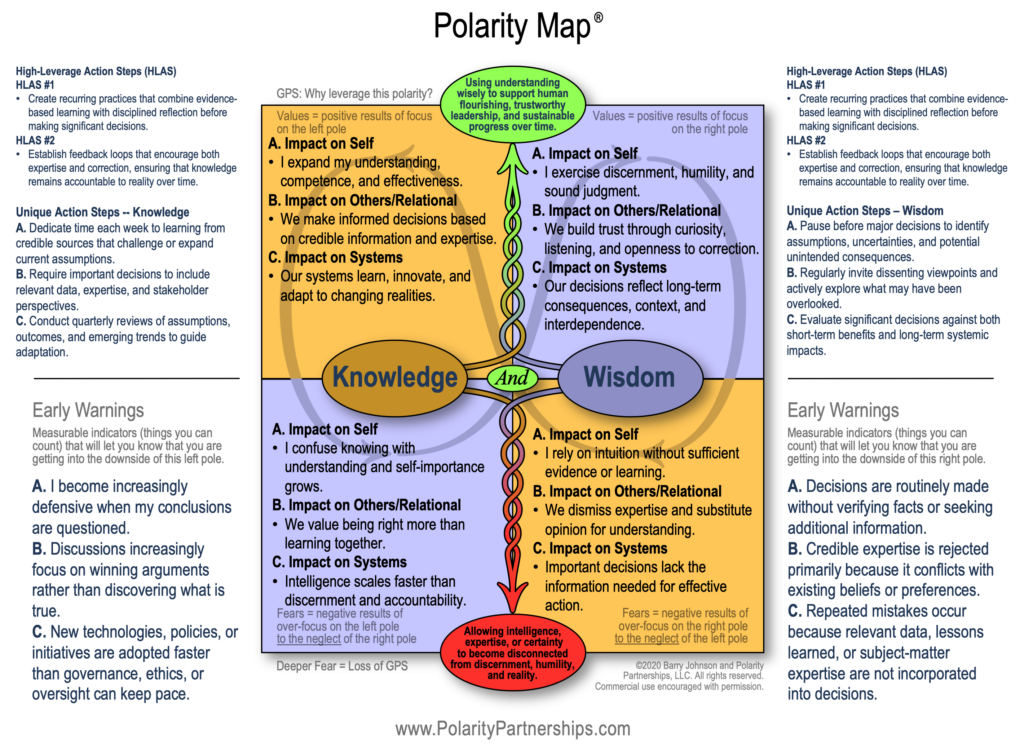
The way I would name this as a polarity is Knowledge And Wisdom. You might choose different pole names. The point is that both energies matter. Knowledge extends reach. Wisdom gives shape. Knowledge names, measures, compares, and recalls. Wisdom senses proportion, timing, fit, consequence, and limit. Knowledge builds institutions, tools, and systems. Wisdom helps prevent those institutions, tools, and systems from turning against the life they were intended to support.
When Knowledge is pursued to the neglect of Wisdom, information multiplies while discernment thins. Self-importance grows. Certainty hardens. Public language becomes more aggressive and less trustworthy. Intelligence scales faster than conscience. A culture becomes increasingly vulnerable to imitation, manipulation, and grandiosity dressed as strength.
When Wisdom is pursued to the neglect of Knowledge, discernment loses contact with verification. Humility drifts toward vagueness. Reverence becomes detached from evidence. A person may speak as though depth alone were enough while remaining untouched by the disciplines that make understanding reliable. A culture can begin distrusting expertise without becoming wiser in its place.
Either pattern is easier to spot in others than ourselves because each is protecting something real. The Knowledge-heavy version often protects competence, certainty, and the relief of being right. The Wisdom-heavy version often protects humility, depth, and caution about arrogance. Both values are important. Both contain fears and blind spots that make perfect sense. Both carry the potential for costs that someone else or others, eventually carries.
When both are leveraged alongside each other, another pattern becomes available. A person can learn without making learning into identity. A leader can speak with conviction without becoming captive to performance. A society can use technology without surrendering judgment to the machine.
I believe this is important because the greater purpose is larger than being correct. The greater purpose is wiser participation in reality over time. That is true for a person. It is true for a democracy. It is true for a civilization standing inside tools it is still too immature to worship safely.
Chapter 65 isn’t asking us to become less intelligent. It’s only asking us to become less impressed with intelligence that’s detached from wisdom. Those are quite different movements because one diminishes humanity and the other reorders it.
The work is ongoing. It returns with every conversation, every decision, every headline, every feed, every claim, every fear, and every performance of certainty. Whether or not knowledge matters is an absurd question. The bigger question is what kind of human being is carrying it, how humanity carries it, and what larger purpose it’s serving. Knowledge shapes what we can do. Wisdom shapes what we become.
Chapter 65 invites us to remember that distinction before intelligence outruns discernment, before performance outruns reality, and before certainty convinces us there is nothing left to learn.
Here’s a Polarity Map for Knowledge And Wisdom:
INVITATIONS:
To use an AI-trained “Chat w/Cliff” for Step 1, Seeing” CLICK HERE.
Ready for the Polarity Advantage? Go deeper into Polarity Thinking, see our online self-directed Credentialing and Introduction to Polarity Practice or in-person training with Barry Johnson and me at Kayser Ridge by CLICKING HERE.