

See the Series Introduction for Just Tao It, Part I: HERE
See the Just Tao It Series Introduction Tao/It on-ramp, PART II: HERE
See Just Tao It, Chapter 1: HERE
From my interpretation of Chapter 2 of the Tao Te Ching (Unpublished):
When people see beautiful things,
Ugly things arise.
When people see good things,
Bad things are recognized.
Difficult AND Easy
Long AND Short
High AND Low
Stand beside each other.
Each comes forth from the other.
Being AND Non-Being
Give birth to one another.
Seeing this, the wise one lives differently:
Teaching without speaking.
Doing without claiming.
Holding while letting go.
Giving without possessing.
Completing the work
Without claiming the credit.
And because nothing is claimed,
Nothing is lost or denied.
—
Just a handful of days ago, which was the second day of what was meant to be a celebration vacation in South Africa (Tracy’s 60th B-day and soon-to-be retirement), my body made a different decision. A long-standing spine condition brought everything to a halt, and I found myself in a hospital bed at Mediclinic in Cape Town, completely dependent on others.
That dependence puts lots of things into perspective.
Dr. Ramanare Magampa entered the room with a steadiness that did not need to assert itself. Patela, the head nurse practitioner, carried a presence that made it easier to trust what was unfolding, even when I did not fully understand it. The rest of the staff moved in the same way—competence and care not as separate qualities, but as something integrated in how they showed up.
In a matter of hours, strangers became something else.

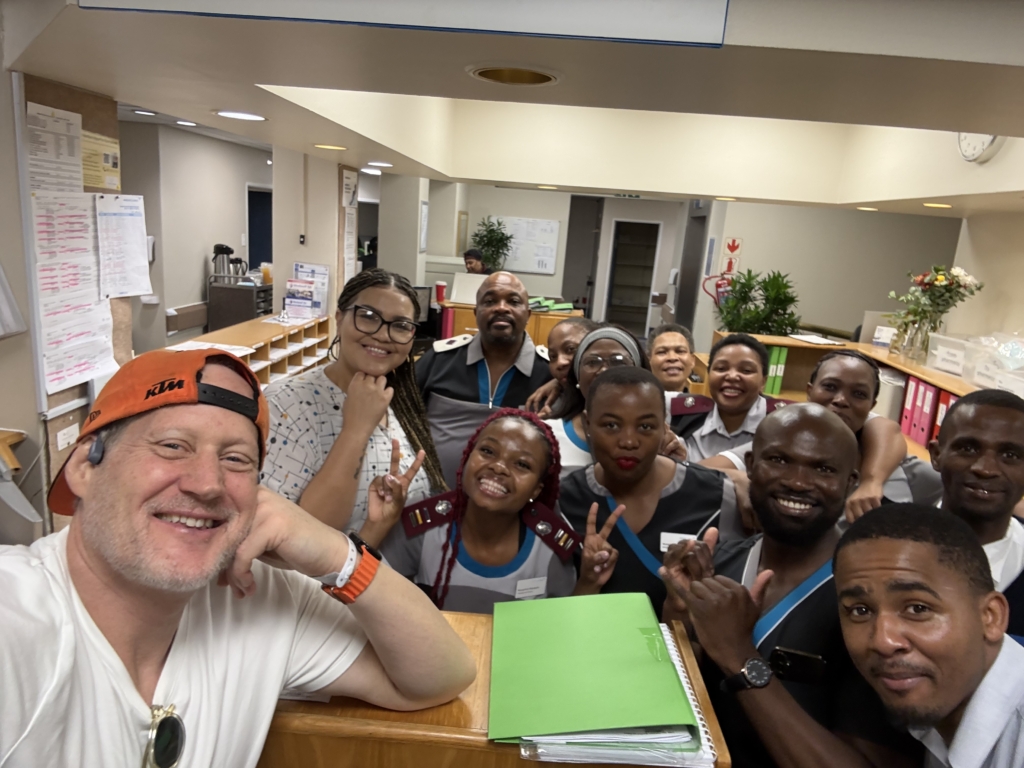
What stayed with me was not only the care. It was the conversations that unfolded around it. Between moments of treatment and long stretches of reflection (in tandem with IV painkillers), I began to notice something that felt familiar and difficult to name. The stories people shared were not simply about the past. They seem to still be shaping what they said, what they held back, what they felt possible, and what they still felt out of reach.
The past was not settled. It was moving.
From a distance, it is easy to believe that clearer thinking might have changed things. That if what had been named as good and not good had been more precise, different decisions would have followed. Human minds seem to want to reach for that kind of certainty. To believe that better answers will produce better outcomes.
The Tao points somewhere else.
Not away from knowing, but alongside it.
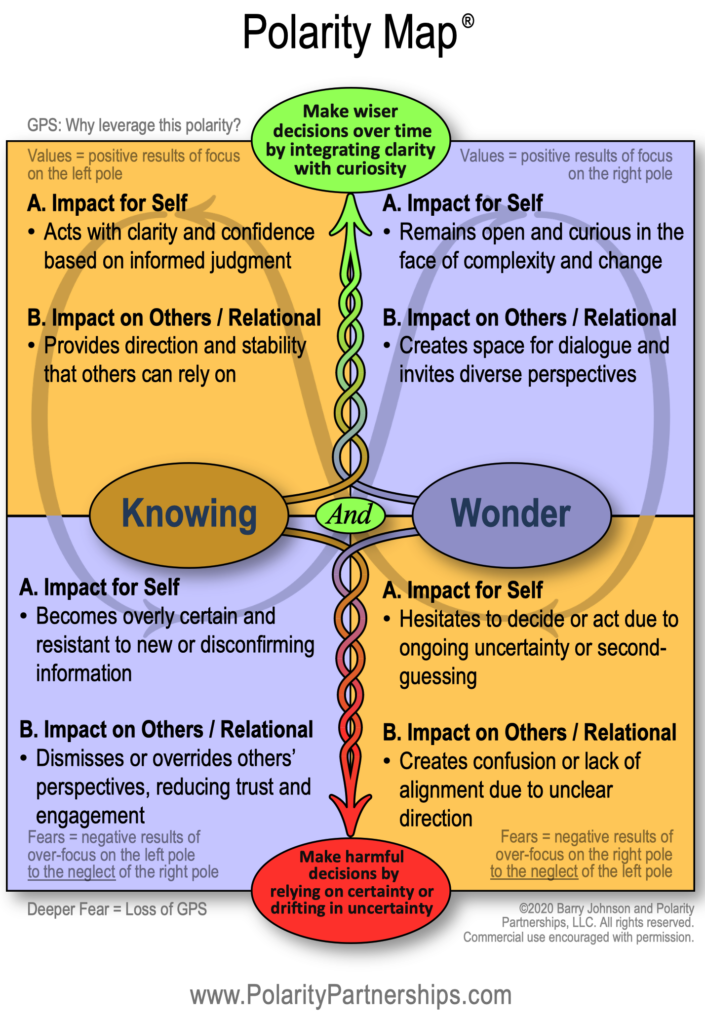
Knowing names, distinguishes, and gives us something to act on. Wonder stays in relationship with what cannot be fully named. Knowing allows us to move. Wonder keeps us from mistaking movement for understanding.
The moment we name something as good, we have already created the conditions for its counterpart. When that is remembered, naming can serve us. When it is not, naming becomes something we defend, and over time, what we defend can lose its connection to what it was meant to serve.
That is where the pattern begins.
We organize around what we have named. We reinforce it. We repeat it. We align with others who see it the same way. What began as something in service of life begins to stand on its own, and when that happens, the shift follows a familiar path.
The purpose that once held the tension gives way to the pole itself.
Justice becomes the purpose. Mercy becomes the purpose. Power becomes the purpose. Freedom becomes the purpose. Each carry values. Each address something real. And each, on its own, is incomplete.
This is where history begins to rhyme.
Not because people choose what is obviously destructive, but because they remain committed to something that once made sense and continue to pursue it after it has lost its connection to the larger whole.
Justice, pursued to the neglect of Mercy, punishes without restoring. Mercy, pursued to the neglect of Justice, avoids accountability and leaves harm unresolved. Claiming Power to the neglect of sharing concentrates control, while sharing Power to the neglect of claiming allows harm to continue.
These are not opposing truths.
They are interdependent goods.
When they are treated as independent, conviction hardens into certainty, certainty becomes justification, and justification becomes self-righteousness. The pattern is not surprising. It is repeatable.
What’s missing is not intelligence.
It is seeing the whole picture over time and remaining connected to what the tension is in service of.
Without that shared purpose, each good begins to act as if it is sufficient. You can see this in religion, when belief becomes singular and no longer allows for relationship. You can see it in nations, when pride separates from the responsibility to examine how ideals are lived. You can see it in everyday thinking, where partial truths become slogans that guide action long after they have outlived their usefulness.
A partial truth, held long enough, begins to function as the whole truth.
And once it does, it becomes difficult to bring its counterpart back into view.
Simple. Not easy.
Which is why what emerged in South Africa matters.
After decades of systemic harm, there was more than enough reason to pursue Justice alone. Few would have questioned it. And still, something else was held alongside it.
Truth AND Reconciliation.
Not as a compromise, but as a recognition that neither pole, on its own, could serve what the country needed to become. Truth that faced what was done. Reconciliation that made a future possible. Accountability that remained intact. Forgiveness that remained available.
What holds these together is not agreement.
It is purpose.
A commitment to restoring the possibility of a future in which people can live together without repeating what brought them there.
Without that purpose, the pattern continues. With it, something else becomes possible.
Not resolution.
Shared direction.
There is no place to stand outside of this pattern. It shows up wherever we name something and begin to treat it as the answer.
So the work is not to stop naming.
It is to remain connected to what the naming is in service of.
Polarity Thinking does not simplify the Tao. It reveals the patterns within it, so we are less likely to mistake the part we prefer for the whole we all depend on, over time.
Knowing helps us name and act.
Wonder keeps us in relationship with what we cannot fully name.
It does not ask less of Knowing.
It keeps Knowing from becoming final.
And from there, a different quality of action becomes possible. Not driven to secure one side. Not compelled to resolve what does not resolve. More able to remain in relationship with what is still unfolding.
Not because we have found the answer.
Because we have not forgotten what the answer is for.
Polarity Map for Knowing And Wonder:
Here’s a Polarity Map to help see the pattern:
INVITATIONS
How do you make decisions under uncertainty, over time? To take a short Polarity Assessment based on the Knowing And Wonder polarity, CLICK HERE
NOTE: the results include Leveraging Action Steps and Early Warnings (to support maximizing upside benefits and minimizing downside limitations).
To use an “AI-trained Chat w/Cliff for Step 1, Seeing” CLICK HERE.
Ready for the Polarity Advantage? Go deeper into Polarity Thinking, see our online self-directed Credentialing and Introduction to Polarity Practice or in-person training with Barry Johnson and me at Kayser Ridge by CLICKING HERE.