

See the Series Introduction for Just Tao It, Part I: HERE
See the Just Tao It Series Introduction Tao/It on-ramp, PART II: HERE
See Just Tao It, Chapter 1: HERE
From my interpretation of the Tao Te Ching, Chapter 27 (Unpblished):
Without forcing,
It flows.
Travelers move with It,
and the journey unfolds.
Artists create,
and the work appears.
Scientists inquire,
and clarity comes.
The skillful stay with It,
and change unfolds.
Most of us don’t have a philosophy problem. We have a pacing problem. We move too fast for what’s actually happening, or we wait too long for what needs to happen. Then we wonder why things feel harder than they should.
This chapter isn’t telling you to stop acting. It’s pointing to something more subtle. In Taoist terms, this is wu wei. It’s often translated as “non-action,” which has probably done more harm than good. It doesn’t mean doing nothing. It means not forcing. It means acting in a way that is aligned with what is already unfolding, instead of pushing against it.
You still act. You still decide. You still move things forward. The question is whether your action is aligned with what is actually happening, or whether you’re trying to make reality conform to what you’ve already decided should happen.
That’s where this gets real.
You’re not choosing between doing something or doing nothing. You’re living in a polarity.
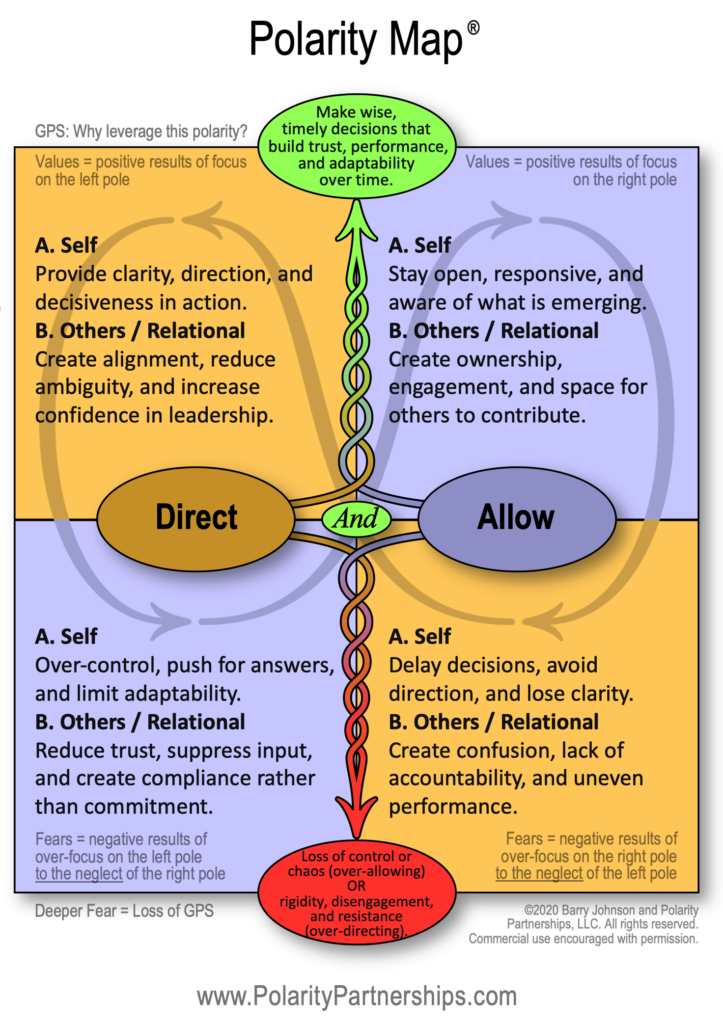
Direct AND Allow.
Direct gives shape. It sets direction. It clarifies what matters. It moves things forward.
Allow creates space. It lets patterns emerge. It makes room for better timing, better thinking, and better decisions.
Both are required.
Wu wei sits right here. Not as passivity, but as skill. The skill of acting without forcing. The skill of knowing when to step in and when to step back. The skill of moving with what is unfolding, rather than trying to dominate it.
Overfocus on Direct (w/out Allow), and you start forcing. You push outcomes faster than reality can support. You create resistance. You burn people out. You call it “driving results.” Other people call it “being a lot.”
Overfocus on Allow (w/out Direct), and you drift. You wait for clarity that isn’t coming. You delay decisions that need to be made. You call it “being thoughtful.” Other people call it, “are we ever going to decide anything?”
Welcome to being human.
At a deeper level, this is the polarity of Steadiness AND Fluidity.
Steadiness holds direction. It keeps you anchored. It ensures you don’t lose what matters.
Fluidity responds to what is actually happening. It adjusts. It adapts. It lets the next step become visible.
Steadiness without fluidity becomes rigidity. Fluidity without steadiness becomes drift.
Together, they create the conditions for wiser decisions over time.
And this is not abstract. This shows up in meetings, in decisions, in emails, in how you respond when something doesn’t go your way (which, lately for me, has been more often than I’d prefer).
Most of us have a preference. Some of us are wired to direct, move, decide, push. Give us a situation, and we’ll fix it, optimize it, or at least try to look like we’re fixing it. Others are wired to allow, observe, reflect, consider. Give us a situation, and we’ll gather input, explore options, and make sure we’re not missing something important.
Both look good. Both are useful. Both break down when either/or thinking is misapplied as a problem to solve.
This isn’t something to solve. It’s something to leverage.
And leverage requires movement between the poles over time. The skill is not choosing the right side. The skill is knowing when to direct and when to allow, when to step in and when to step back, when to hold steady and when to stay fluid.
Or, said another way: stay with It.
Polarity: Direct AND Allow
Greater Purpose: Effective, sustainable progress (the kind that doesn’t require therapy later)
Here’s the part that matters. Systems don’t break because people are bad at their jobs. Systems break because we over-rely on one side of a polarity and call it leadership.
Organizations push too hard and burn people out, or they slow down so much that nothing meaningful moves. Teams feel either driven or directionless. Individuals feel either overwhelmed or stuck. And then we try to “fix” it with more process, more tools, more frameworks—without addressing the tension underneath.
The tension doesn’t go away.
Without forcing, It flows. And you still have to move.
So the question isn’t whether you prefer directing or allowing, steadiness or fluidity. The question is how well you are leveraging both.
Where are you pushing harder than the situation requires?
Where are you holding back when action is needed?
Where are you trying to control what cannot be controlled?
Where are you avoiding responsibility by waiting for perfect clarity?
That’s the work.
Stay with It.
Here’s a Polarity Map for Direct And Allow:
INVITATIONS:
How does:
Direct And Allow … Steadiness And Fluidity … show up for you these days?
Try the “AI-trained Chat w/Cliff for Step 1, Seeing, CLICK HERE.
If you want to take a quick self-assessment for Direct And Allow? CLICK HERE – the results include Leveraging Action Steps and Early Warnings (to support maximizing upside benefits and minimizing downside limitations).
Want to go deeper into Polarity Thinking? See our online self-directed Credentialing and Introduction to Polarity Practice, CLICK HERE.