

See the Series Introduction for Just Tao It, Part I: HERE
See the Just Tao It Series Introduction Tao/It on-ramp, PART II: HERE
See Just Tao It, Chapter 1: HERE
From my interpretation of the Tao Te Ching, Chapter 64 (Unpublished):
What’s recent
is easily corrected.
What’s brittle
is easily shattered.
What’s little
is easily scattered.
Attend early.
The tallest tree
started
in a small seed.
The tower nine stories
started
in a pile of clay.
The ten-thousand-mile journey
started
in steps one, two, and three.
Grasping—loss.
Forcing—failure.
With less desire,
less is lost.
Most of what becomes a problem didn’t start that way. It started as something small, slightly off, easy to feel… and just as easy to ignore. Not because we don’t see it. Usually we do. It’s the nudge. The strong intuition together with a distinctly human “gut check.” That soft internal self-talk saying, “something’s not quite right here.” And if we’ve been around long enough, it isn’t even mysterious. It’s implicit pattern recognition. It’s experience, speaking. It’s, “we’ve seen before in different clothes.”
And still, we let it go. Because it’s not urgent. Maybe because it’s inconvenient. Or, because we’d rather not deal with it right now. Until it grows, hardens, and becomes something that requires effort, coordination, escalation. Then we find ourselves pouring a lot of energy into something that, earlier, would have taken very little.
That’s the first move: Attend Early. Not as a technique, more as a willingness to trust what you already know. The signal before the spreadsheet. The feeling before the proof. Saying the thing while it’s still easy to say. Adjusting while it’s still easy to adjust. Most of us don’t lack the signal—we override it. If we’re even a little in tune with body intelligence, those signals sometimes clear their throat: “Ahem… helloooo?”
I’ve spent most of my life doing extreme sports. Still do. As I approach a point in life where I most certainly have more years behind me than in front of me, I’ve taken a certain pride in saying I still do what I did in my teens. That pride came with a few receipts—multiple back surgeries, a collection of broken bones, and more “there was this one time” stories than I probably should have to tell.
What I was slower to notice was that something had changed. My body was not the same. My reactions were not the same. And how I needed to ride now was different from how I rode then. Pride has a way of talking over signals. Eventually that caught up with me: one life-changing ride, one corner, one moment of coming in too hot and too fast. The tree I crashed into is burnished in my memory along with the sound of impact. The years that followed taught me both downsides at once—regret and incapacitation. It wasn’t that I shouldn’t or couldn’t still do what I loved—mountain biking. It was that I hadn’t attended early to the realities of the rider I had become, and the cost of “later” got steep.
And that’s where the second move appears, because once you start attending early, it’s tempting to act early on everything. To jump in, fix, improve, help—especially if you’re good at it, especially if you’re the person who’s used to moving things forward. Sometimes that’s exactly right. And sometimes that’s how you create the very problem you were trying to prevent, because not everything emerging needs your intervention. Some things are already organizing themselves. Some things need space, not pressure. Some things need time, not acceleration.
Which brings the second move: Let It Work. Easy to say. Harder to live—especially when you don’t know how it’s going to turn out. Let It Work asks for comfort with ambiguity. Not controlling. Not inserting yourself just because you can. It’s the lived version of “trust the process,” without turning it into a slogan.
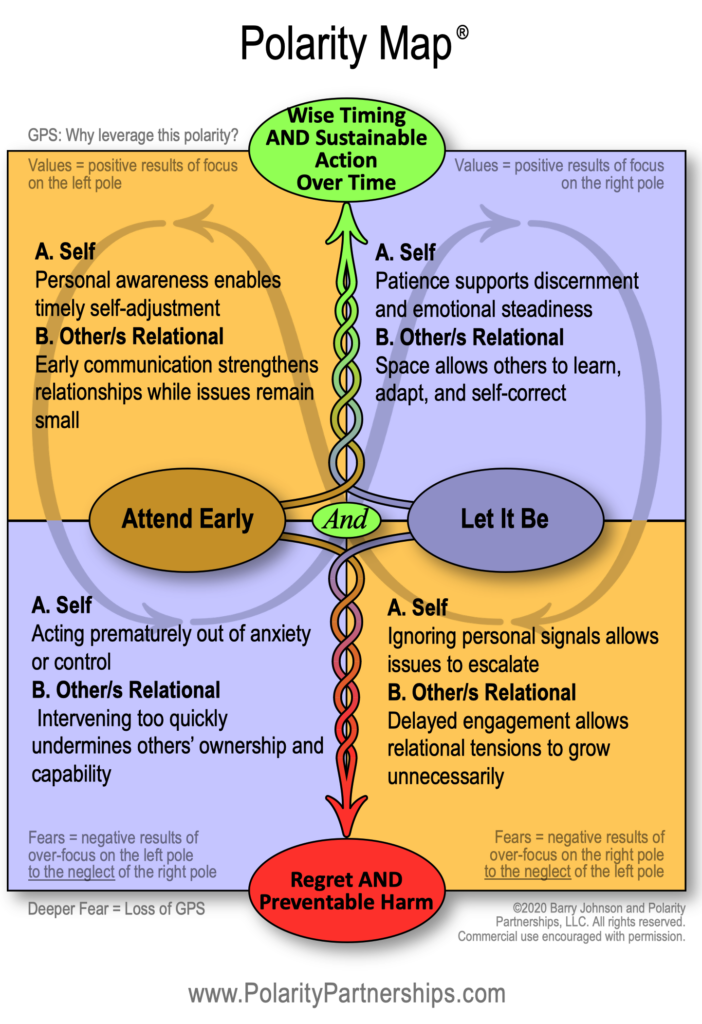
That’s the tension: Attend Early AND Let It Work. Two connected moves that need each other more than we usually admit. Overfocus on Attend Early to the neglect of Let It Work, and you start managing everything. You see every signal and feel responsible to act on all of them. You call it being proactive. Others experience it as interference… or control. Overfocus on Let It Work to the neglect of Attend Early, and you start missing what’s right in front of you. You wait. You give too much space to reality. You rationalize. You talk yourself out of what you know. Sometimes it works out. Sometimes it doesn’t. And when it doesn’t, the stakes are no longer small.
What this chapter points to is something more subtle than “act” or “don’t act.” It’s discernment. Timing. Knowing when the nudge is asking for a small move now, and when it’s asking you to stay with the uncertainty a little longer. Which, if we’re honest, is often harder than just doing something. It would have made a big difference for me to attend early and tell myself something like: “You ride well at 59, but you’re not 15—let it work for you with some ease and a little differently, now. Yeah?” (NOTE: I referred to this accident in Chapter 1 about how it called me to write this series. It has has also taught me a lesson in attending early.)
“Grasping—loss. Forcing—failure.” That’s not philosophy. That’s what happens when we try to control what isn’t ours to control, or when we wait until something requires force to move at all. And it’s why the Greater Purpose here is not “being early” or “being patient.” It’s developing the capacity—personally and relationally—to make wiser decisions over time by leveraging both moves as ongoing energy. This tension doesn’t get solved. It keeps showing up. The only real choice is whether we see it and leverage it, or get yanked around by it.
So the questions aren’t complicated. They’re just not always convenient, and they don’t need to be life-threatening to be worth asking. Trust me and my fractured C2 vertebra and arterial dissection on that.
Where are you ignoring something you already feel?
And where are you stepping in because not stepping in feels harder?
That’s usually enough. The Tao rarely asks for more than that: attend early, and when it’s already moving, let it work.
Here’s the interior portion of a Polarity Map for Attend Early AND Let It Work:
INVITATIONS:
How do Attend Early AND Let It Work show up for you right now?
Try the “AI-trained Chat w/Cliff for Step 1, Seeing, CLICK HERE.
Want to go deeper into Polarity Thinking? See our online self-directed Credentialing and Introduction to Polarity Practice, CLICK HERE.