

See the Series Introduction for Just Tao It, Part I: HERE
See the Just Tao It Series Introduction Tao/It on-ramp, PART II: HERE
See Just Tao It, Chapter 1: HERE
From my interpretation of the Tao Te Ching, Chapter 12 (Unpublished):
Blindness for the color,
when too many run together.
Deafness for the notes,
when too many overtake each other.
Tastelessness for the flavor,
when too many at once to savor.
Distress for the being,
in too much doing.
Letting go of great excess,
holds on to what’s experienced.
I have an advanced degree from the School of Hard Knocks, with a specialization in holding on too long and letting go too soon. The faculty at “Xperience University” (life) are relentless. They don’t hand out syllabi. They just wait for you to repeat the same mistake until you finally notice what’s not working.
One of my lessons came from holding on too long to my love of taking risks and letting go of caution too late. A mountain biking accident during COVID got my attention in a way I wouldn’t recommend. It also gave me more time than I expected to reflect on how easy it is to push past the point where effort serves us.
Lao Tzu points to this in Chapter 12 of the Tao Te Ching. Too many colors, and we lose our ability to see. Too many sounds, and we stop hearing. Too many flavors, and we lose the ability to taste. Too much doing, and we lose our sense of being.
The problem is not the seeing, hearing, tasting, or doing.
It’s what happens when they run together.
At some point, more stops adding. It starts taking away.
This is where the “And” between shows up.
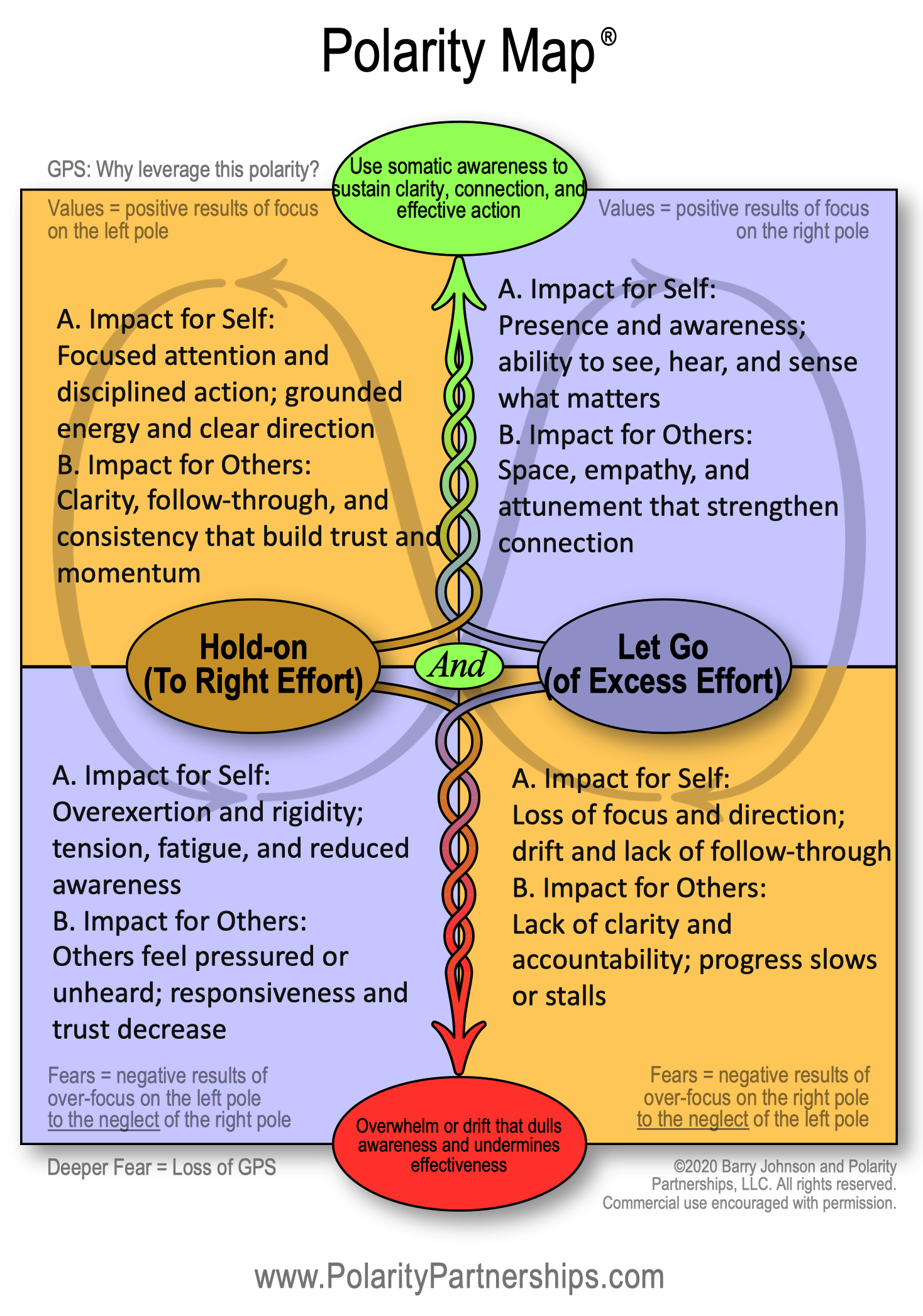
Hold On (to Right Effort) AND Let Go (of Excess Effort).
Without Letting Go (of Excess Effort), everything fills in. We take in more, respond more, do more. It can look like engagement. It can feel like responsibility. But over time, the volume starts to dull our senses. We see more and notice less. We hear more and understand less. We do more and experience less. The very things meant to connect us to life begin to distance us from it.
Without Holding On (to Right Effort), we lose traction. We step back, but nothing holds. We create space, but it doesn’t lead anywhere. Decisions get softer. Commitments loosen. What matters doesn’t move forward.
Both show up in ways that can look reasonable.
And both can take us off track.
This is not about doing less or doing more. It’s about staying aligned with what actually serves.
Are you seeing what matters, or scanning everything?
Are you listening to understand, or reacting to noise?
Are you experiencing what’s in front of you, or moving past it to get to the next thing?
Are you acting from a place of clarity, or from a sense that you just need to keep going?
These are small choices (no 5-Step SMALL Process pun intended).
They add up.
And they shape how we show up with other people.
When we are overloaded, it becomes harder to stay connected. Harder to listen. Harder to see nuance. Harder to respond with care instead of reaction. We can feel it in ourselves, and the people around us can feel it too.
When we lose that connection, something important is at risk.
I can’t not think of Illinois Governor J.B. Pritzker’s State of the State address a day ago where he modeled “Hold on And Let Go” when he said, “love for one’s neighbor is the country’s most powerful tool against the rise of authoritarianism.” Then went on to say, “we are not fighting over policy or political party. We are fighting over whether we are going to be a civilization rooted in empathy and kindness—or one rooted in cruelty and rage.”
That choice doesn’t only show up in big moments. It shows up in how we use our attention. In how we listen. In what we choose to take in, and what we choose to release.
If we are overwhelmed, it becomes harder to choose empathy. Harder to stay grounded. Harder to see the person in front of us instead of reacting to what we assume.
This is where the polarity matters.
To Let Go (of Excess Effort) is not to disengage. It is to release what overwhelms our ability to see, hear, and care.
To Hold On (to Right Effort) is to stay engaged in what builds clarity, trust, and connection.
I still mountain bike. I just do it differently now. I’ve gotten better at holding on to Caution and letting go of the need to prove something on the Risk pole that no longer needs proving. The trail never changed. I did. (For now, anyway.)
This is how we use the senses we have in ways that serve. To see clearly. To listen fully. To experience what is here, instead of rushing past it. To stay grounded in our being, even as we act.
Not perfectly.
But more often.
Because letting go of great excess is what allows us to hold on to great experience.
And in a world that keeps asking us to take in more, do more, and react more, the ability to choose what we hold on to — and what we let go of — may be one of the most important forms of leadership we have.
And that, whether we acknowledge it or not, is up to us.
Here’s a Polarity Map for Holding On (to Right Effort) And Letting Go (of Excess Effort)
INVITATIONS
If you want to take a quick self-assessment for Hold-on And Let Go: CLICK HERE
NOTE: the results include Leveraging Action Steps and Early Warnings (to support maximizing upside benefits and minimizing downside limitations).
Where is Holding-on And Letting Go challenging you now?
Try the “AI-trained Chat w/AI Cliff for support for Step 1, Seeing Polarities
Ready for the Polarity Advantage? Check out our online self-directed Basics, Credentialing, or in-person training with Barry Johnson and me at Kayser Ridge! Certifications and Courses