

See the Series Introduction for Just Tao It, Part I: HERE
See the Just Tao It Series Introduction Tao/It on-ramp, PART II: HERE
See Just Tao It, Chapter 1: HERE
From my interpretation of the Tao Te Ching, Chapter 22 (Unpublished):
Be broken to be whole.
Be empty to be full.
Be small to be great.
Be bent to be straight.
Let the old depart,
the new appears.
What is true—
already here.
Unmoved by appearance—
esteemed.
Unconcerned with reverence—
admired.
Uninterested in applause—
celebrated.
The sage does not contend,
and none contend.
What is bent
becomes whole.
We talk about imposter syndrome like it’s one thing. It isn’t.
There are at least two. I see both in my clients—and in myself.
The first is the All-Knower Imposter. Confident to a fault. Has the answer. Says it cleanly. Demonstrates certainty. It’s tailor-made to look strong all the time. You see it in the quick explanations, the deflections, the shifting of burden. It can pass for strength in the moment, but over time it creates distance. Trust erodes. Conversations tighten. People start managing what they say, and the leader never quite understands why.
The second is the All-Shoulder Imposter. Humble to a fault. Carries everything. Questions everything. Second-guesses decisions. More input. More data. More time. It can look thoughtful, even inclusive. But over time, the delays start to speak for themselves. People begin to wonder if the hesitation is care—or fear. Same result. Trust erodes, just more slowly and more politely.
The reality is, both work—for a while. And both are exhausting to maintain. Neither builds much of anything that actually matters.
Lao Tzu points to it directly:
To be broken is to let go of appearing whole. None of us are.
To be empty is to make room for what you don’t yet know. None of us know everything.
To be small is to stop centering yourself in every outcome.
To be bent is to admit your first answer may not be your best. Sometimes it is. Often it isn’t.
It sounds poetic—until you try to live it.
This doesn’t always look impressive—especially in cultures that reward certainty, confidence, and performance. But it is where something real begins.
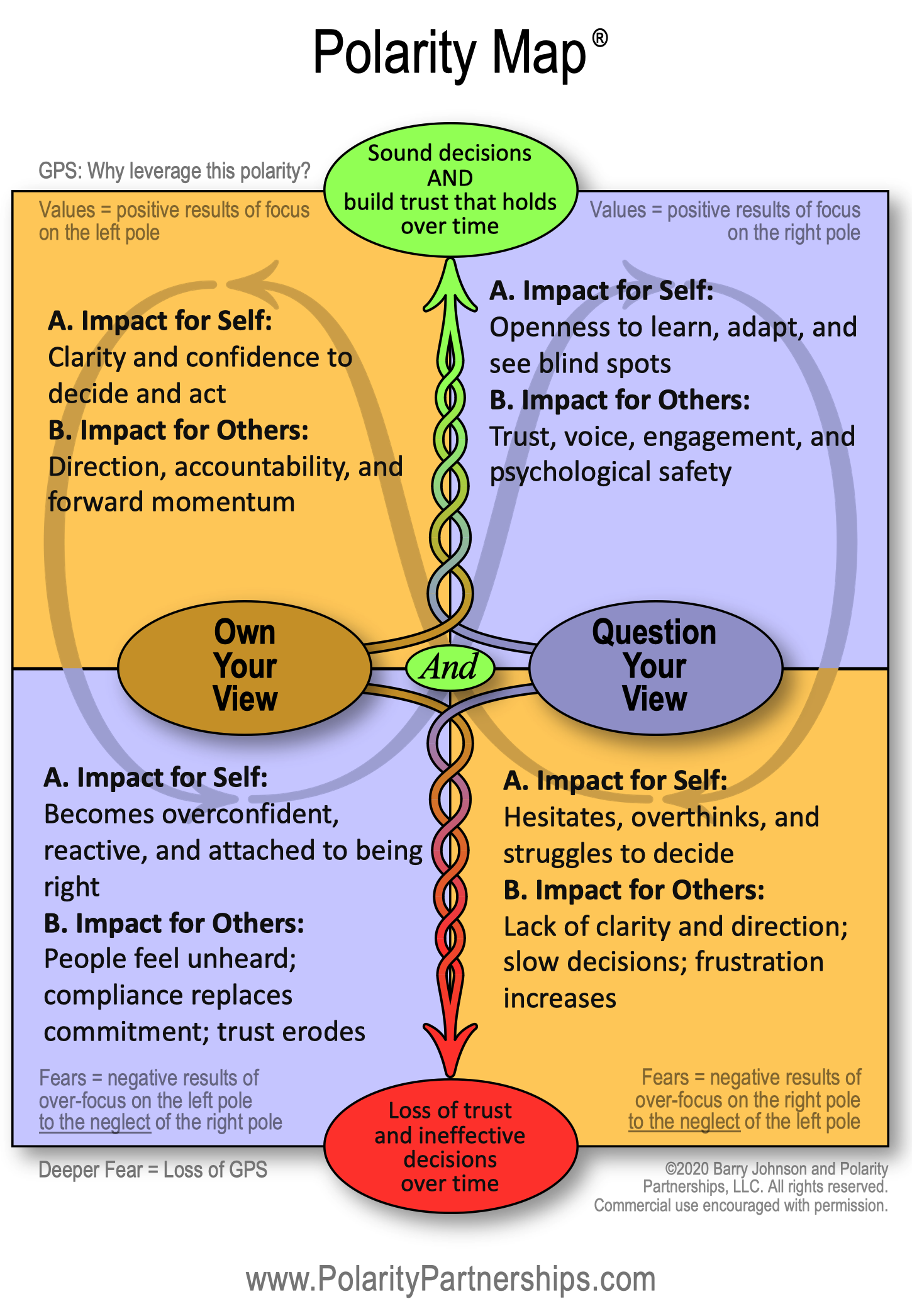
Because the All-Knower Imposter overfocuses on owning—and stops questioning. (“I wonder if I’m seeing the whole picture.“)
And the All-Shoulder Imposter overfocuses on questioning—and stops owning. (“It’s time for me to take a stand.“)
Both can look reasonable.
And over time, both erode trust.
Brené Brown helped bring language to this in a way many of us needed. Vulnerability is not weakness. It is uncertainty, risk, and emotional exposure—and it is the source of trust, learning, and connection. Without it, we protect ourselves. And in protecting ourselves, we create distance.
Jim Collins found something similar in his research on Level 5 Leadership. The most effective leaders combined fierce professional will with deep personal humility. Not one or the other. Both. He even used the Yin–Yang symbol to describe the tension.
Different language. Same pattern.
This is a polarity to leverage. It shows up in different ways:
Confidence AND Humility.
Courage AND Vulnerability.
Showing Up AND Being Real.
Whatever you name the poles, they point to the same thing:
Trust. Trust in yourself. Trust with others. Trust over time.
For me, in this chapter, I’m going to name the polarity this way:
Own Your View AND Question Your View.
When we try to look strong, we’re performing.
When we are willing to be real, something else becomes visible—maybe not immediately, and not perfectly, but reliably, over time.
Lao Tzu simplifies it:
Unmoved by appearance—
esteemed.
Unconcerned with reverence—
admired.
Uninterested in applause—
celebrated.
Not because you are trying to be those things, but because you are no longer organized around them.
That’s the shift—
not trying to be those things,
and no longer organizing around them.
Here’s a Polarity Map for Own Your View AND Question Your View:
INVITATIONS
If you want to take a quick self-assessment for Own Your View AND Question Your View: CLICK HERE
NOTE: the results include Leveraging Action Steps and Early Warnings (to support maximizing upside benefits and minimizing downside limitations).
Where is Own Your View AND Question Your View challenging you now?
Try the “AI-trained Chat w/AI Cliff for support for Step 1, Seeing Polarities
Ready for the Polarity Advantage? Check out our online self-directed Basics, Credentialing, or in-person training with Barry Johnson and me at Kayser Ridge! Certifications and Courses