
I’m not the sharpest tool in the deck, but I know this much: when people at work start talking about pendulums swinging and driving from one ditch to the other, something important is trying to get our attention.
You hear it all the time. “We’ve overcorrected.” “Now we’ve gone too far the other way.” “This feels like whiplash.” These aren’t just complaints. They’re patterns. And they tend to show up right when well-intended people are tired, a little frustrated, and quietly wondering how something that seemed like a good idea turned into such a mess.
Most of the time, what’s happening underneath the pendulums and ditches is pretty simple. We’re using Either/Or problem-solving in situations that aren’t actually problems to solve. Either/Or thinking is incredibly useful. We depend on it constantly. Do I go to the bathroom now, or wait until after the two-hour carpool to the concert? Do I turn left or right to get to my destination? Do we ship today, or delay to fix the bug? These are real problems with real answers. Choose, act, move on.
Work gets harder when we take that same reflex and apply it to tensions that don’t go away. Things like Centralize AND Decentralize, Stability AND Change, Directive AND Participative, Short-term results AND Long-term sustainability. These aren’t decisions you make once. They’re relationships you live inside. When we treat them like problems, the system does what systems always do under pressure: it swings. We overcorrect. We end up in a different ditch and convince ourselves this time we’ve finally learned.
Both/And thinking doesn’t replace Either/Or thinking. It supplements it. It’s what you reach for when the goal isn’t closure, but effectiveness over time. When people start to see the difference, the experience is usually less about insight and more about getting steady in the fluidity of interdependencies — to make wiser decisions for a “Greater Purpose” in the tension. There’s less urgency to push, less need to prove a point, and more capacity to notice what’s being overdone and what’s being neglected.
That steadiness matters because it’s what makes wiser decisions possible. Not flashier ones. Not louder ones. Wiser ones. Decisions with better timing, better proportion, and fewer unintended consequences. You can usually feel the difference when wisdom is present, and you can feel it when it’s missing, especially in how people relate to each other when the tension is real.
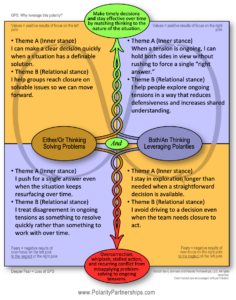
One tension where this shows up constantly is Either/Or problem-solving AND Both/And polarity thinking itself. Most of us use both approaches, but rarely consciously. And it often looks different in ourselves than it does in our relationships with others. That’s not a flaw. It’s just information. Here’s that polarity, mapped on a Polarity Map:
If you’re curious, I’ve put together a short sample assessment that lets you notice how it shows up for you, internally and relationally. It’s not about getting a score or fixing anything. It’s simply a way to see where steadiness is already present, where you might be over-relying on one approach, and where a wiser adjustment could save you from the next pendulum swing.
The questions in the short assessment below come directly from the Polarity Map above. Each one reflects a real, everyday experience described in the quadrants — how you decide, how you engage others, and what tends to happen when pressure shows up. As you answer, you’re not being scored “right” or “wrong.” You’re simply indicating how frequently these experiences show up for you. When your results are plotted back onto the map, they give you a picture of how close you are to the well-leveraged loop — the pattern of steady, effective performance over time — and where you may be drifting into overcorrection, hesitation, or whiplash. The value isn’t the number; it’s the clarity. You’ll be able to see where you’re already steady and where a small adjustment could make decisions feel wiser and a lot less exhausting.
Take the quick 8-question Polarity Assessment for:
Either/Or thinking (to solve problems) And Both/And thinking (to leverage polarities)
https://polaritypracticetools.com/ajTc2bcS
Want to chat about Polarities? Try the Polarity-informed AI Chat w/Cliff.
For those interested in deepening confidence and competence in Polarity Thinking:
www.PolarityResources.com