


See the Series Introduction for Just Tao It, Part I: HERE
See the Just Tao It Series Introduction Tao/It on-ramp, PART II: HERE
See Just Tao It, Chapter 1: HERE
From my interpretation of Chapter 76 of the Tao Te Ching (Unpublished):
Life comes—
soft,
supple.Death comes—
hard,
inflexible.Soft and supple—
living.
Hard and inflexible—
dying.
[Author’s NOTE: This Chapter was written after Chapter 2, which related directly to this story. To hear more about how and when this issue landed, GO HERE]
I used to think strength meant pushing through. Not recklessly, at least not in my own mind, but with a kind of commitment that felt admirable at the time. Take the hit, absorb it, keep moving. There was a steadiness to that identity that made it easy to trust, especially when it produced results. For long stretches of my life, it did exactly that.
What I didn’t see then was what I was pushing against—and what I was pushing past.
Then my spine entered the conversation in a way that no longer allowed me to frame it as just another obstacle to manage.
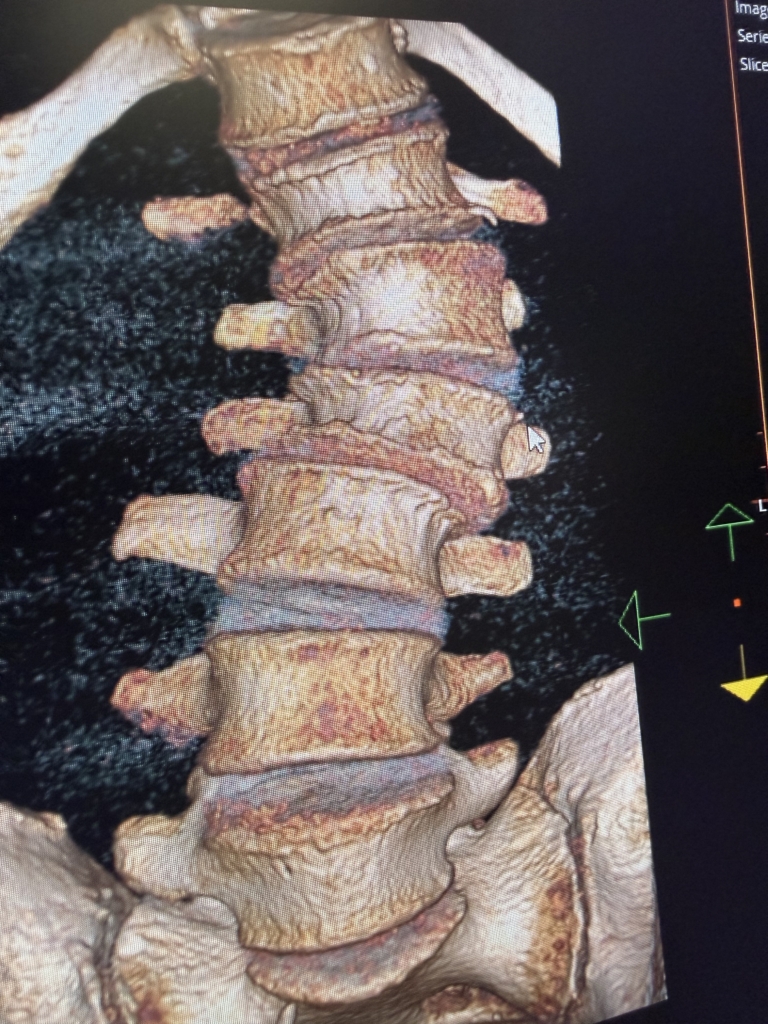
You don’t need a medical background to look at the image and recognize that something fundamental has shifted. It’s not subtle. There’s a visible accumulation there—years of load, compression, decisions, adaptations, and probably more than a few moments where I chose to keep going rather than adjust.
The body doesn’t argue. It records. Every load, every adjustment, every choice to keep going when stopping would have been wiser. Not as judgment—as data. And eventually, the data becomes undeniable.
Pain itself isn’t new. That’s been present for a long time. What’s different is the loss of the assumption that more effort will produce a better outcome. That assumption held up through a lot—surgeries, recoveries, setbacks that eventually gave way to forward motion. It created a pattern that was easy to rely on: push, endure, recover, repeat.
At some point, without any clear announcement, that pattern stopped delivering what it once did.
It shows up gradually. Things take longer. Recovery isn’t as clean. What used to respond to effort becomes less predictable. And then, eventually, unmistakably, the body stops negotiating on terms that used to feel reliable.
There’s a popular phrase that the body keeps the score. Whether or not you’ve read the book, it doesn’t take long, in moments like this, to recognize what that points to.
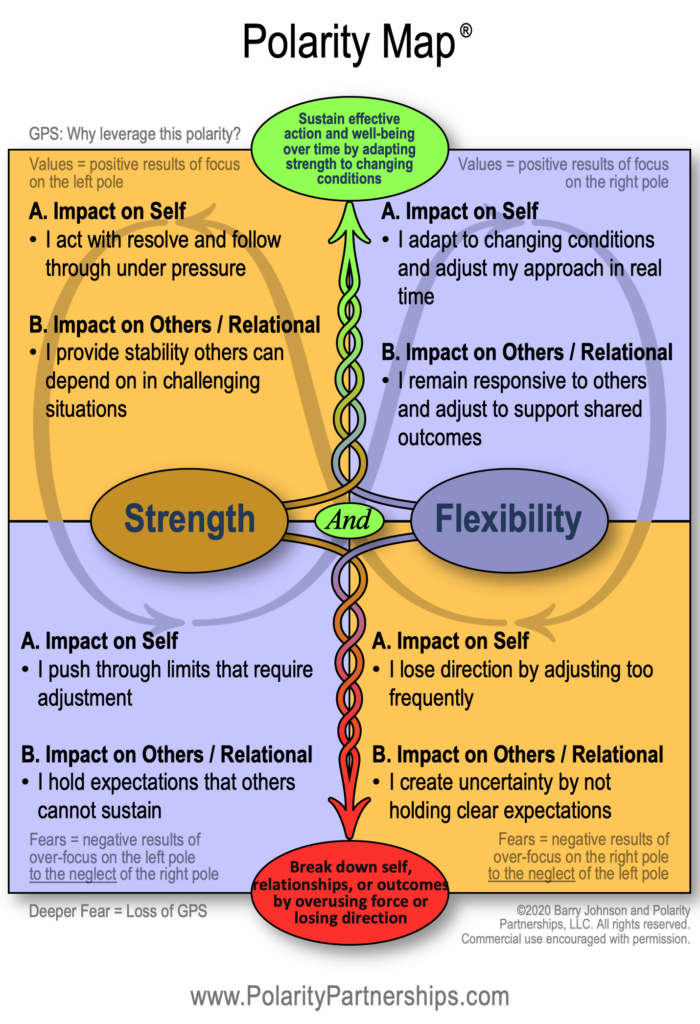
Looking at it now, it’s not hard to see the polarity that was always in play, even if I didn’t hold it that way at the time.
Strength AND Flexibility.
Both in service of the same thing: staying in life. Not just alive, but responsive—to what the moment asks, what the body needs, what cannot be controlled.
When I mapped it—actually drew it out, the way I teach others to do—something shifted. Not the body. Not the pain. But the frame. I could see both upsides: the strength that built capacity, the flexibility that preserved it. And I could see both downsides: the rigidity that breaks, the collapse that gives up.
Neither pole was wrong. But I’d been living in one quadrant so long I’d forgotten the other existed.
There is a form of strength that builds capacity by pressing against limits, expanding what is possible, and staying with something long enough for it to move. That form of strength carried me a long way.
It also broke things I didn’t realize were breaking.
Relationships that adjusted around my capacity rather than being met in theirs. Plans that depended on a version of me that was already fading. A body that kept score in ways I chose not to read—until the score became the only thing I could see.
That’s not where I started. It’s where I arrived after a pattern had time to play out.
There is another form of strength that expresses itself through flexibility—adjusting in real time, responding to conditions, and allowing movement where rigidity would break something that can no longer afford to be broken. That form was available too. It just wasn’t the one I relied on most.
The body keeps track of that imbalance in a way the mind doesn’t always choose to. Not as judgment. More as continuity. What accumulates, accumulates. What’s reinforced strengthens. What’s neglected doesn’t disappear; it waits until it becomes relevant again.
And when it does, it doesn’t arrive alone.
It shows up in conversations that change tone. In plans that need to be reconsidered. In the people around you who adjust, sometimes without saying much, to what you can and cannot do in the same way you once did. It shows up in what gets postponed, what gets taken on by someone else, and what simply doesn’t happen.
Not as failure. As reality.
What’s required now doesn’t feel like a lesson as much as a shift in relationship. Sitting differently. Moving differently. Paying attention in ways that used to feel optional. Letting go of the assumption that intensity is the most reliable path forward, and recognizing that flexibility is not the absence of strength, but one of its expressions.
It would be easy to frame this as loss. In some ways, it is. There are things I can’t do the way I once did them, and there’s no clear path back to that version of capacity. There are also people who feel that change with me—partners, family, those who have come to rely on a version of me that is now less available in the same form.
But that framing only holds part of what’s happening.
Something else is becoming available at the same time.
A different relationship to effort. A different sense of timing. A different appreciation for what the Tao points to here, where life is associated with what remains responsive and adaptable, and decline with what hardens beyond its ability to adjust.
The Tao doesn’t call this failure. It calls it returning. Life comes soft and supple. Death comes hard and inflexible. Not as moral judgment, but as observation: what remains alive stays responsive. What hardens, stops.
Not as a prescription, and not as a rejection of strength, but as a recognition that the form strength takes matters.
If you’ve encountered something in your own life that no longer responds to increased effort in the way it once did, you already know this territory.
It might be a team that tightens the harder you try to align it. A strategy that becomes more entrenched the more you defend it. A relationship that grows more distant the more you try to fix it. Or a body that stops negotiating on terms you thought were reliable.
The details differ, but the pattern is familiar.
What once moved things forward begins to hold them in place.
That’s not where we start. It’s where we arrive after a pattern has had time to play out.
This same pattern shows up in the systems we’re building.
AI increases speed, optimization, automation—forms of strength that push through complexity at scale. But systems, like bodies, accumulate consequences. What gets optimized without presence begins to harden. What scales without feedback begins to break in ways that don’t announce themselves until the damage is systemic.
The discipline required isn’t less automation. It’s greater responsiveness—knowing when to override, when to adjust, when to stop trusting that more of what worked before will work again.
The same shift the body is asking for, the systems are asking for too.
The Tao doesn’t ask for less engagement with life. It doesn’t suggest stepping back from what matters or avoiding effort where effort is needed. It does, however, point to a quality of engagement that remains responsive to what is actually happening, rather than what we expect or prefer to be happening.
That’s the shift I’m in the middle of now.
Not abandoning strength, but letting it take a different form. Not withdrawing from effort, but staying connected to what effort is in service of. Not forcing outcomes that no longer respond to force, and not mistaking persistence for alignment.
Life comes soft and supple. That’s easy to overlook when things are working. It becomes harder to ignore when they’re not.
The body has a way of making that visible over time.
Not all at once, and not in a way that lends itself to a clean conclusion, but steadily enough that, if you’re paying attention, something begins to change.
Not because you decided to change it.
Because what you’ve been doing no longer works the way it used to, and something else is asking for your participation.
Here’s a Polarity Map of Strength And Flexibility to help see the pattern:
INVITATIONS
How do you make decisions under uncertainty, over time? To take a short Polarity Assessment based on the Strength And Flexibility polarity, CLICK HERE
NOTE: the results include Leveraging Action Steps and Early Warnings (to support maximizing upside benefits and minimizing downside limitations).
To use an “AI-trained Chat w/Cliff for Step 1, Seeing” CLICK HERE.
Ready for the Polarity Advantage? Go deeper into Polarity Thinking, see our online self-directed Credentialing and Introduction to Polarity Practice or in-person training with Barry Johnson and me at Kayser Ridge by CLICKING HERE.