
The Book I Gave Away
A few days ago, my partner, Tracy, and I were delayed on our flight home from a short vacation. We ended up at an airport restaurant with another traveler from the same flight. All three of us were killing time.
Delay can create its own kind of opening. With nowhere else to be, we began talking and got to know one another in the accelerated way that sometimes happens in spontaneous situations. Before long, she shared something of the difficult period she was moving through.
I was nearly finished reading Jim Collins’ newest book, What to Make of a Life: Cliffs, Fog, Fire and the Self-Knowledge Imperative. Published in April 2026 and grounded in a decade-long research project, the book follows lives side by side through the cliffs that fracture a familiar trajectory, the fog that follows, and the choices through which a life is gradually reconstructed. Collins explores what we may be encoded for and how an inner fire can remain alive across the long arc of a life.
Among the lives Collins examines is Katharine Graham. That made the book especially personal for me. I had worked with Mrs. Graham at The Washington Post Company, and her life was part of the institutional world in which my own relationship with Collins’ work had begun.
As I listened to her, giving her the book began to feel more important than finishing it myself. So I did.
When we finally boarded the flight home, I had a long stretch of time to reflect. Somewhere in that reflection, a realization arrived with surprising force: Jim Collins had been profoundly influential in my own life and work. The book I had just given away was only the most recent expression of a relationship with his ideas that reached back decades.
What Jim Collins Gave Us
I was Corporate Manager of Human Resources at The Washington Post Company from 1998 to 2002 when Built to Last found me. In 1998, I was completing my MS in Human Resources at American University and trying to find language for patterns I was already watching play out inside a large, storied organization. In 2002, I moved into The Washington Post newspaper as Senior Organization Development Consultant, a role I held through 2006. While there, I began my MS in Organization Development at American University in 2004. Long before any of that, I had spent years with the Tao Te Ching and Tai Chi, disciplines that trained a kind of attention I didn’t yet have a use for in professional life. Collins’ book was the first time that attention found a home there.
It is easy to forget how revolutionary the book felt on first contact. Today, phrases like the Tyranny of the OR and the Genius of the AND are so woven into the language of leadership that their familiarity can make us forget how profoundly they challenged conventional management thinking—including mine.
Collins and Jerry Porras began with a simple question: What distinguishes organizations that remain visionary for decades from those that achieve success for a season and gradually lose their way? They grounded their inquiry in years of disciplined research, comparing enduring companies with carefully selected counterparts.
One of their most enduring discoveries was that visionary companies approached many organizational Tensions differently. Where others assumed they would eventually have to choose between competing values, these organizations repeatedly found ways to honor both over time. Collins and Porras captured that pattern in one of the most memorable distinctions in management literature: the Tyranny of the OR and the Genius of the AND.
Preserve the Core AND Stimulate Progress remains perhaps the clearest expression. Visionary companies stayed deeply grounded in their core ideology while continually finding new ways to express it in a changing world. Continuity gave change coherence. Progress kept continuity alive.
Collins and Porras also turned to the Tai Chi symbol to illustrate interdependence. Their own words convey why the image mattered:
“A visionary organization doesn’t seek balance between short-term and long-term, for example: it seeks to do well in the short-term and in the long-term. A visionary organization doesn’t simply balance between idealism and profitability: it seeks to be highly idealistic and highly profitable. A visionary organization doesn’t simply balance between preserving a tightly held core ideology and stimulating vigorous change and movement; it does both to an extreme. In short, a visionary organization doesn’t want to blend yin and yang into a grey, indistinguishable circle that is neither highly yin nor highly yang; it aims to be distinctly yin and distinctly yang—both at the same time, all the time.”
—Jim Collins and Jerry I. Porras, Built to Last
For someone already steeped in the Tao Te Ching and Tai Chi, that image landed deeply. A pattern I had known contemplatively was appearing inside disciplined organizational research.
That insight represented more than memorable language. It challenged an assumption that had shaped management practice for generations—and an assumption I was carrying into my own new work in Organization Development without fully knowing I was carrying it.
Collins gave leaders permission to question false choices that had long been accepted as inevitable. His evidence mattered. The research came first. The language followed.
For me, his work accomplished something equally important. It awakened a question that would stay with me for years. If these patterns appeared so consistently in enduring organizations, what was it about reality itself that caused them to recur? I didn’t yet have an answer. I simply carried the question with me, from The Washington Post Company into the newspaper and into whatever came next.
When Barry Entered the Question
In 2004, as part of my master’s program in Organization Development, I read Barry Johnson’s book. By then, I was already carrying the Tao Te Ching, Tai Chi, and the question Collins had awakened. Barry’s work offered another visual language for interdependence—and language and mapping processes I could use in coaching leaders, working with teams, and practicing Organization Development.
Years later, while serving as Vice President of Organization Development for the National Cooperative Bank, I had the opportunity to hire Barry. Given the convergence already underway in my life and work, the opportunity felt almost cosmic. What had first reached me through his book could now deepen through a working relationship.
The question I had carried since The Post began to acquire language.
Collins’ Tai Chi image held distinct energies within a larger whole. Barry’s infinity loop made the continuing movement between distinct Poles visible. The images arose from different lineages; together, they helped me recognize interdependence as living energy in continual motion.
Organizations had become my laboratory long before Barry gave me a way to talk about what I was seeing there. Again and again, I had watched meaningful improvements generate new tensions. A solution that brought needed order could gradually constrain initiative. Greater participation could restore voice while making coordination more difficult. The challenge rarely stayed solved.
Barry called some of these recurring dynamics Polarities—distinct from problems that could be solved and set aside. A Polarity involved two interdependent Poles, each carrying benefits worth pursuing and limits that became increasingly visible when one Pole was emphasized to the neglect of the other.
The infinity loop was essential to that understanding. Its purpose was structural: to represent the movement of the reality being mapped. Polarities are energy systems. Their Poles remain distinct and inseparable. When attention settles too heavily on one Pole, the benefits of the neglected Pole begin to disappear and the limits of the preferred Pole emerge, generating energy back toward the other. When that necessary self-correction is mistaken for a permanent solution, the pattern repeats in the opposite direction.
Poorly leveraged, the natural tension becomes a vicious cycle of oscillation and overcorrection. Leveraged with greater awareness, the same energy can become a virtuous cycle supported by earlier recognition, intentional movement, and continuing recalibration.
Barry’s thinking had grown through relationship and a longer intellectual history of its own. Jack Gibb was his mentor, and Gestalt was the tradition Barry returned to after more than twenty years studying interdependent pairs. He returned with a more precise understanding of what he meant by a Polarity and a clearer distinction between ongoing both/and interdependence and ambivalence that could eventually be resolved through choice.
That lineage matters to me. Polarity Thinking reached me carrying the imprint of mentors, relationships, earlier traditions, decades of inquiry, and Barry’s willingness to keep refining his own understanding.
The Genius of Or AND the Genius of And
Barry eventually brought this lens into direct conversation with Collins’ formulation. In Chapter 26 of And: Volume One—Foundations, he described Or-thinking and Solving Problems as one Pole of a Polarity, with And-thinking and Leveraging Polarities as the other.
The first two Polarity Realities are foundational: Or-thinking is essential for learning and for solving problems, and And-thinking is a supplement to Or-thinking. The rejection of Or-thinking becomes another expression of Or-thinking.
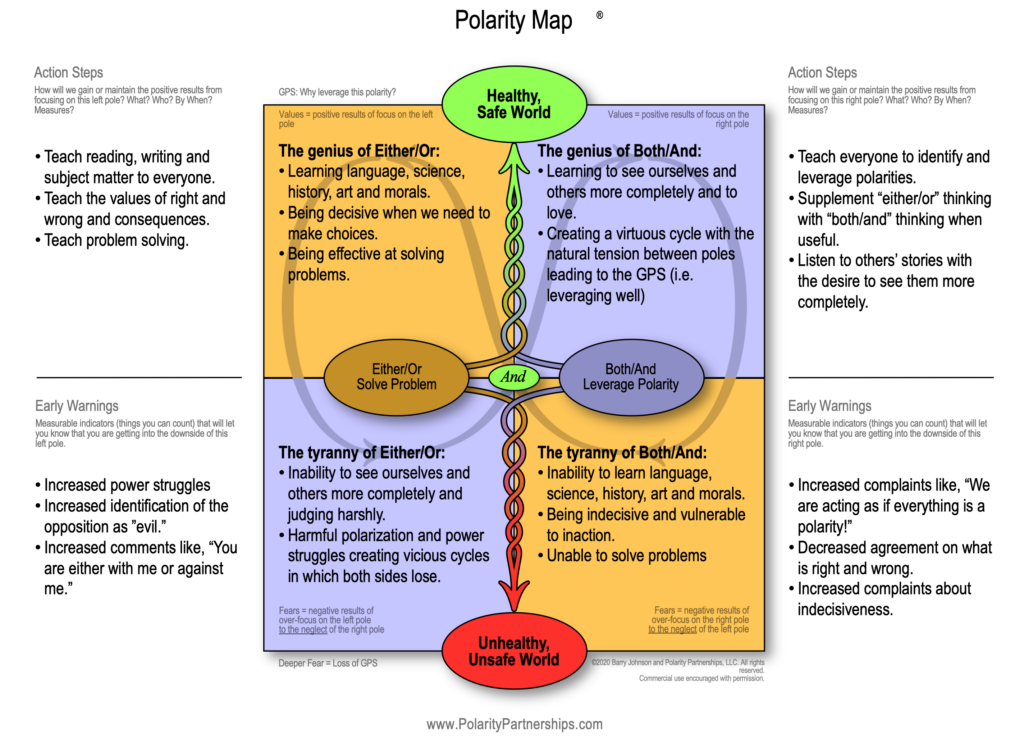
I experience Barry’s next move as an act of appreciation. Collins and Porras gave the world a powerful warning about the Tyranny of the OR and an equally powerful invitation into the Genius of the AND. Barry retained both and asked what else the Polarity Map might allow us to see. Two additional quadrants appeared: the Genius of Or and the Tyranny of And.
The Genius of Or includes learning language, science, history, art, and morals. It includes making necessary choices and solving problems effectively—the capacity survival, learning, accountability, boundaries, and decisive action all depend upon.
The Tyranny of And appears when And-thinking is emphasized to the neglect of Or-thinking. Barry’s early warnings include growing indecisiveness, weakening agreement about right and wrong, and the complaint that everything is being treated as a Polarity. Both/And Thinking loses usefulness when it obscures a problem that genuinely requires a decision.
The OR AND the AND can therefore be understood as an interdependent pair. Or-thinking helps us solve problems. And-thinking helps us leverage Polarities. Wise leadership needs both, together with the discernment to recognize when a problem requires a choice and when a Polarity requires ongoing leverage.
Collins’ formulation performed vital historical work. It interrupted management’s habitual overreliance on OR-thinking and restored the neglected wisdom of the AND—so thoroughly that the Genius of the AND now feels almost self-evident to many leaders. That familiarity is part of Collins’ achievement.
Barry’s work extends the conversation from a place of appreciation, helping protect Collins’ breakthrough from becoming another exclusive choice. Collins revealed, through disciplined research, what enduring organizations repeatedly learned to do. Barry illuminated the energy moving through ongoing interdependence. Collins showed the organizational power of the AND. Barry showed how the AND remains in relationship with the OR.
Their language remains distinct. Collins speaks of Tensions, the Tyranny of the OR, and the Genius of the AND. Barry speaks of Polarities, Poles, upsides, downsides, and leverage. Placed beside one another, their contributions enlarged the question I had been carrying. Some recurring tensions belonged to the nature of the realities we were trying to lead within.
What I know as leverage within Polarity work also finds an important resonance in what Collins calls the Flywheel Effect. Collins describes disciplined action accumulating turn by turn until momentum begins working in the organization’s favor. Polarity leverage attends to how energy moves among interdependent Poles over time so their combined benefits can support a Greater Purpose. The constructs remain distinct. Both direct attention toward cumulative patterns of action, learning, and energy.
When the Tensions Become a Multarity
When I returned to Collins’ work with this understanding, Preserve the Core AND Stimulate Progress no longer appeared as an isolated insight. Across Good to Great and Built to Last, I began hearing a constellation of Tensions—some named explicitly in Collins’ own words, others dynamics I recognize within his findings through a Polarity lens: my naming, not his own.
Collins explicitly gives us Professional Will AND Personal Humility at the heart of Level 5 Leadership, Reality AND Faith in the Stockdale Paradox, Freedom AND Responsibility in a culture of discipline, Short Term AND Long Term, Idealism AND Profitability, and Preserve the Core AND Stimulate Progress.
Only later did I recognize how directly that final Tension lived inside work we were developing at Polarity Partnerships. PACT—the Polarity Approach for Continuity and Transformation—centers the ongoing relationship between Continuity AND Transformation. In Collins’ language, the organization Preserves the Core AND Stimulates Progress. The vocabularies carry different histories, yet they illuminate closely related terrain: how a living system retains what gives it identity while continually transforming how that identity is expressed.
Collins’ research shows what visionary companies learned to do. PACT offers a disciplined approach for Seeing, Mapping, Assessing, Learning, and Leveraging the energy within Continuity AND Transformation over time.
This was where three streams in my life intersected powerfully. The Tao Te Ching and Tai Chi had trained my attention toward continuity, transformation, rhythm, and relationship. Collins’ research showed that same enduring pattern operating inside visionary organizations. Polarity Thinking supplied the language, the infinity loop, and a practice for engaging its energy intentionally. What had begun as separate encounters with ancient wisdom, organizational research, and an emerging discipline became part of one landscape. That convergence became foundational to my life’s work.
I have continued developing the Tao stream through Just Tao It, a Cliff’sNOTES series exploring the Tao Te Ching through Patterns AND Mystery, lived experience, and a Polarity lens. That body of work and Wiser Decisions arise from the same landscape while carrying different purposes and voices.
Alongside these, I hear Polarity names for dynamics his research surfaces without labeling them this way: Self AND Organization, Debate AND Unity, Candor AND Diplomacy, Deep Understanding AND Simplicity, Discipline AND Entrepreneurship, Technology Fads AND Pioneering, and Evolutionary AND Revolutionary. Seen through a Polarity lens, Tensions from Collins’ work can be brought into Polarity Maps and Polarity Assessments to help leaders, teams, and organizations assess how well they are leveraging those Tensions over time—and where attention may strengthen the cumulative momentum Collins calls the Flywheel Effect.
The pattern begins to change when these Tensions are seen in relationship. Professional Humility changes the quality of Debate. Debate improves an organization’s contact with Reality. Reality disciplines Faith. Freedom depends upon Responsibility. Entrepreneurship needs Discipline. Together, they strengthen the organization’s capacity to Preserve the Core AND Stimulate Progress. Pull on any one thread and the others move.
That is where Multarity becomes useful. In my Chapter 42 contribution to And: Volume Two—Applications, Multarities are described as interdependencies of more than two Poles that contribute synergistically to a Greater Purpose that is more than the sum of the parts. A Greater Purpose supported by one Polarity can also become a Pole within a larger Multarity.
One way I am beginning to see Collins’ architecture is as a four-Pole Multarity: Disciplined People, Disciplined Thought, Disciplined Action, and Building Greatness to Last. Each Pole is supported by several Tensions. Together they contribute to the Greater Purpose Collins has pursued across decades of research: organizations that make a distinctive impact and deliver superior performance over a long period of time.
You may see or group the pattern differently. What I currently notice is that Humility, Debate, Reality, Faith, Discipline, Freedom, Responsibility, Core, and Progress are not separate lessons from separate chapters. They participate in one living architecture, and Collins’ disciplined research is what first made it visible.
The Multarity lens invites different questions. Where might an apparent failure of Discipline be connected to weak Unity, diminished contact with Reality, or confusion about the Core? Which Tension, brought into the foreground now, could strengthen several others? What becomes visible when Collins’ findings are encountered as a dynamic system while each remains grounded in the work from which it emerged?
What I Carried Home
Collins, Barry, and the Tao arose from different histories and speak in different voices. Each has helped me recognize patterns I first encountered in the others. Over time, the question Collins awakened became larger than my search for an answer. It became part of how I learned to see.
Only after giving away his newest book did I fully recognize how much of his work I had carried with me. The Tyranny of the OR and the Genius of the AND gave language to something I had sensed but could not yet articulate. Preserve the Core AND Stimulate Progress helped me see continuity and transformation as mutually supporting energies. His many Tensions made interdependence visible within the disciplined study of organizations and lives.
Barry Johnson and Polarity Thinking later helped me see more of the living dynamics within those Tensions. The Tao helped me remain attentive to the mystery beneath every framework. Together, these streams have shaped my work, my questions, and the way I have tried to live.
I began this essay thinking I was writing about Jim Collins’ contribution to a field. Somewhere along the way, I realized I was also acknowledging his contribution to me.
The book I gave away in that airport carried something she may need for the part of life she is living now. What I carried home was gratitude—for the ideas, the questions, and the enduring influence of a body of work that helped me recognize my own.
INVITATIONS:
Want to learn more about Polarity Thinking and explore options for self-paced learning and Credentialing?
CLICK HERE
Want to use an AI-trained “Chat w/Cliff” to support you in Step 1 Seeing?
CLICK HERE