

See the Series Introduction for Just Tao It, Part I: HERE
See the Just Tao It Series Introduction Tao/It on-ramp, PART II: HERE
See Just Tao It, Chapter 1: HERE
Chapter 60 — Frying a Small Fish
Leading a country
is like frying
a small fish.
Too much turning
and it falls apart.
Leave room.
Leave people alone.
Let life happen.
When neither ruler
nor restless spirits
does harm,
Virtue returns.
—
From It: Forty Years in Conversation with the Tao Te Ching by Cliff Kayser, an interpretive rendering of the eighty-one chapters. XperienceIT Press, 2026.chapters. XperienceIT Press, 2026.
—
As I approached the final chapters of this series, Chapter 60 carried unusual weight. It seemed, in some respects, the most important of all because its image moves so directly from ancient wisdom into practical choices about how we recognize, grant, restrain, and share power.
This chapter is longer than most and more spirited. I am at peace with that. The moment asks for more than interpretation; it asks for application. Lao Tzu’s small fish offers a standard for leaders, institutions, and citizens – and, before November, a question we the people in the United States should not leave in the abstract: What kind of hands are we willing to place near the flame?
Lao Tzu gives the leader of a country a fish and one instruction: try not to ruin it.
That is an admirably efficient leadership curriculum. No competency model. No executive retreat. No commemorative fleece vest. A small fish, a hot pan, and the sobering possibility that too much handling by the person in charge will reduce the whole thing to flakes.
The image is funny because nearly everyone recognizes the impulse Lao Tzu is describing. Something important has been entrusted to us. We care. We become anxious. Anxiety reaches for the spatula. One adjustment becomes another, followed by a correction to the adjustment and an announcement describing the correction as unprecedented success. By the time anyone smells smoke, the cook is blaming the fish.
A country makes the metaphor harder to miss. Democracy is messy. People disagree about what is happening, what matters, who belongs, what should change, what must be preserved, and whose turn it is to wash the pan. A democratic leader helps people navigate that mess. A would-be strongman needs it to prove that only one person can save everyone.
Ancient Warning AND Modern Warning
Stay with the Tao here. The authorship and precise dating of the Tao Te Ching remain debated, but the text took shape amid the political turmoil of late Zhou China – fractured authority, intensifying warfare, ambitious rulers, heavy taxation, and cruel punishment. Lao Tzu was not offering serenity from outside political life. He was addressing what power does when fear, appetite, and the need for control seize the person governing.
More than two thousand years later, everything has changed and almost nothing has changed. Weapons are more powerful, communications faster, institutions more elaborate, and audiences vastly larger. Yet rulers still confuse control with order, spectacle with strength, loyalty with truth, and intervention with leadership. Citizens still surrender agency when frightened. Courts still attract flatterers. Leaders still blame the fish.
Staying with the Tao, then, does not take us away from the November elections. It takes us beneath them. Chapter 60 names the recurring human pattern before it acquires a party label, campaign slogan, or television studio. The names change. The temptation does not.
A Dead Fish AND A Live Fish
Chapter 60 is often read as an argument for minimal government. The image reaches further. A small fish is delicate because it already has structure. Its integrity can be destroyed through excessive intervention. Restraint respects the intelligence, relationships, history, and capacity already present in a living system.
Leading a country therefore requires more than leaving people alone. It requires knowing what to leave alone, what to protect, when to intervene, and when the leader’s intervention has become the most destabilizing force in the room. Wu Wei is action fitted to conditions – neither passivity nor compulsive control. The steady flame matters. So does the hand that can resist performing its own importance.
I have watched versions of this in organizations for decades. A new leader arrives, listens for eleven minutes, reorganizes three departments, renames the strategy, changes the measures, and announces a transformation. Six months later, the people closest to the work are exhausted, the original problems remain, and a slide deck reports remarkable momentum. Countries have access to larger slide decks and, in several cases, nuclear weapons.
The scale changes. The human impulse does not.
Jim Collins spent much of his research career asking what separates good organizations and leaders from great ones. His best-known answer is Level 5 Leadership: Professional Will AND Personal Humility. Such leaders bring fierce resolve, but their ambition serves the work more than their visibility. They confront brutal facts without surrendering faith and build momentum that outlasts them.
Collins’ finding belongs beside Lao Tzu’s fish. Professional Will supplies heat, direction, standards, and resolve. Personal Humility keeps the leader from confusing motion with contribution. Will without Humility keeps turning. Humility without Will may never light the flame. Great leadership requires both, in service of something larger than the leader.
Returning to the tensions I explored in Jim Collins’ Multarities, I am struck by how consistently greatness depends on values that need one another. Enduring leadership has architecture. Ego has a publicity department.
That distinction matters in public life because visibility can impersonate leadership. Volume becomes strength. Insult becomes candor. Impulsiveness becomes authenticity. Refusal to learn becomes conviction. Cruelty becomes toughness. Loyalty to a person is demanded where fidelity to law, oath, country, truth, and conscience belongs.
This is the leadership equivalent of repeatedly flipping the fish and calling the pieces evidence of disruption.
Both/And Thinking can be misused here. Some tensions require continuing leverage. Democracy depends on Freedom AND Authority, Justice AND Due Process, Diversity AND Equality, Human Rights AND Communal Obligations, and Participation AND Representation. These values stay alive through disagreement, correction, and learning. Democracy is a developmental practice, not a finished structure.
Other matters require a clear choice. Political violence is not a pole to leverage. Neither are dehumanization, corruption, retaliation against lawful dissent, deliberate contempt for constitutional limits, or the conversion of public power into private possession. They violate the floor that allows democratic tension to remain creative rather than coercive.
This is why Strong Floor AND No Ceiling matters now. A healthy democracy needs a floor of human dignity, lawful conduct, truthfulness, peaceful transfer of power, institutional restraint, and equal standing under law. Above it, let argument, aspiration, dissent, enterprise, reform, and imagination rise. The floor makes the open field possible. The open field keeps the floor from becoming a cage.
We have spent years lowering that floor by inches and congratulating ourselves because the building remains upright. A public lie becomes style. A threat becomes a joke. An abuse of power becomes hardball. An attack on an institution becomes disruption. A daily violation becomes background noise. Normalization trains us to stop reacting to the abnormal.
Organizational scholars call this the normalization of deviance: departures from a standard become accepted when catastrophe does not immediately follow. The first breach alarms us. The fifth becomes familiar. The fiftieth arrives during breakfast, between weather and sports. Eventually, insisting on the standard is treated as the disruptive act.
Somewhere in that progression, calling a fish a fish starts to look like the radical position.
Enough.
That word is an exercise of the steady hand. A boundary does not need rage to be real. It needs enough shared courage to name what has crossed it.
Polarity work asks for a harder discipline: apply the same diagnostic in both directions. A democracy’s floor can also fail when citizens become too exhausted to defend it, or fragment into so many competing certainties that no shared standard survives – Diversity without Equality, Participation without Representation, Freedom without Authority. The evidence available as I write points most urgently toward concentrated, insufficiently accountable power. That does not erase the opposite failure. It identifies the failure in front of us.
Precision matters here. Human beings need the capacities to act, decide, differentiate, protect, listen, relate, reflect, care, integrate, claim power, and share it. No sex, gender, party, or ideology owns those capacities. Leadership fails when directive power is severed from receptivity, accountability, relationship, and care.
That severance converts strength into domination and vulnerability into disgrace. It requires an audience. It experiences correction as humiliation, apology as defeat, empathy as weakness, and another person’s dignity as a possible reduction of its own.
The performance can look powerful for a while. Fear produces compliance. Spectacle captures attention. Simple enemies organize complicated anxieties. A leader can appear enormous by requiring everyone nearby to become smaller.
Riane Eisler’s distinction between the Domination Model and the Partnership Model clarifies the difference. Domination is not strength; it is power hardened against relationship. Partnership can decide and listen, protect and receive influence, establish boundaries and preserve relationship. I explored this more fully in Masculine AND Feminine: The Polarity Leadership Can No Longer Ignore.
My father carried a version of this architecture in his wallet for forty years: John Walter Wayland’s creed of ‘The True Gentleman,’ describing a person who does not flatter wealth, cringe before power, or boast of achievement; whose frankness retains sympathy; whose deed follows his word; and who considers the rights and feelings of others. It is a Multarity of character: Confidence AND Humility, Power AND Restraint, Frankness AND Sympathy, Word AND Deed, Self-Interest AND the Common Good. These capacities belong to no gender, party, or era. They are what character looks like once a person is handed power.
Democracy makes demands that domination avoids. A democratic leader must exercise authority while remaining subject to authority, accept criticism without criminalizing the critic, lose a vote without declaring reality invalid, and lead people who did not vote for them without treating those citizens as an occupying force. This requires strength with enough inner structure to remain influenceable.
A ruler who needs constant praise has handed the country a very expensive emotional-support assignment.
The polarity I hear in Chapter 60 is Steady Hand AND Open Hand.
The Steady Hand protects continuity, exercises lawful authority, sets limits, acts in crisis, and keeps the flame from going out. Overfocused to the neglect of the Open Hand, it becomes rigid, intrusive, punitive, controlling, and convinced that every problem requires more of itself.
The Open Hand listens, receives, allows difference, distributes agency, and leaves room for people and institutions to do what they know how to do. Overfocused to the neglect of the Steady Hand, it becomes avoidant, permissive, fragmented, slow to confront harm, and unable to defend the conditions on which openness depends.
The two hands serve one body. A great leader knows when to hold, when to release, and how to remain answerable for both. This does not eliminate democracy’s mess. It helps a pluralistic people move through the mess without converting one another into enemies or surrendering their agency to someone promising relief from citizenship.
Current evidence gives this ancient image uncomfortable relevance. V-Dem’s Democracy Report 2026 says the United States’ Liberal Democracy Index score fell 24 percent in one year; its rank dropped from 20th to 51st among 179 countries, to a level last recorded in 1965. Freedom House lowered the United States from 84 to 81 on its 100-point scale, among the largest one-year declines for countries still rated Free. Pew found that only 17 percent of Americans trusted the federal government to do what is right always or most of the time, down from 22 percent in 2024 and near a seven-decade low. Different measures, one warning: the fish is receiving much attention and little peace.
Jack Gibb, whose thinking helped shape what became Polarity Thinking, treated trust not as a cultural nicety but as an enabling condition: Trust makes Openness possible; Openness makes Alignment possible; Alignment makes coordinated action possible. Erode trust and the chain fails, however impressive the strategy. A country approaching a seven-decade low in trust is not merely in a bad mood. It is living Gibb’s mechanism at civic scale.
The warning reaches beyond one leader, party, or country. Leaders perform what followers reward. Institutions permit what guardians fail to protect. Citizens can become so accustomed to spectacle that steadiness feels boring. The normalization of deviance is participatory. So is its interruption.
The Future? It’s Now. Plan for it—and be in it.
First, restore the floor in ordinary speech. Refuse dehumanization even when it targets people you oppose. Separate evidence from repetition, disagreement from disloyalty, accountability from revenge, and public service from personal submission. Democratic culture is rebuilt whenever a citizen refuses to make contempt feel normal.
Second, protect the process as seriously as the outcome. Ask whether candidates will honor lawful limits, independent courts, a free press, professional public servants, accurate vote counting, and peaceful transfers of power – especially when those institutions frustrate them. Democratic character is revealed not when power is applauded, but when it remains bounded under opposition.
Third, practice both hands. Use the Steady Hand to vote, organize, speak, verify, interrupt political violence, and defend the floor. Use the Open Hand to listen across difference, resist collective blame, preserve relationship where possible, and leave room for learning. Citizenship is not spectatorship. Before November, each of us is holding the spatula.
What We Are Willing to Call Leadership
The November 3 elections will invite us to evaluate policies, parties, records, and promises. They also offer a more basic examination: what are we willing to call leadership?
Can this person hold power without needing to humiliate? Distinguish strength from domination? Confront reality without manufacturing enemies? Admit error, accept limits, honor lawful opposition, and leave institutions stronger? Do their words enlarge citizens’ capacity to participate in a shared future – or deepen dependence on the leader’s next performance?
These are not partisan questions. They are floor questions.
Democracy will remain messy after every election. That is part of its design and dignity. Millions of people remain free to disagree, organize, protest, persuade, vote, govern, challenge, and try again. The mess is evidence that no single hand owns the whole.
A great leader helps people navigate the mess: steadying without suffocating, opening without abandoning, acting without making action a form of self-worship, and leaving enough room for collective virtue to return.
The fish doesn’t need a savior. It needs leaders who know how to cook.
Here’s a Polarity Map for Steady Hand AND Open Hand: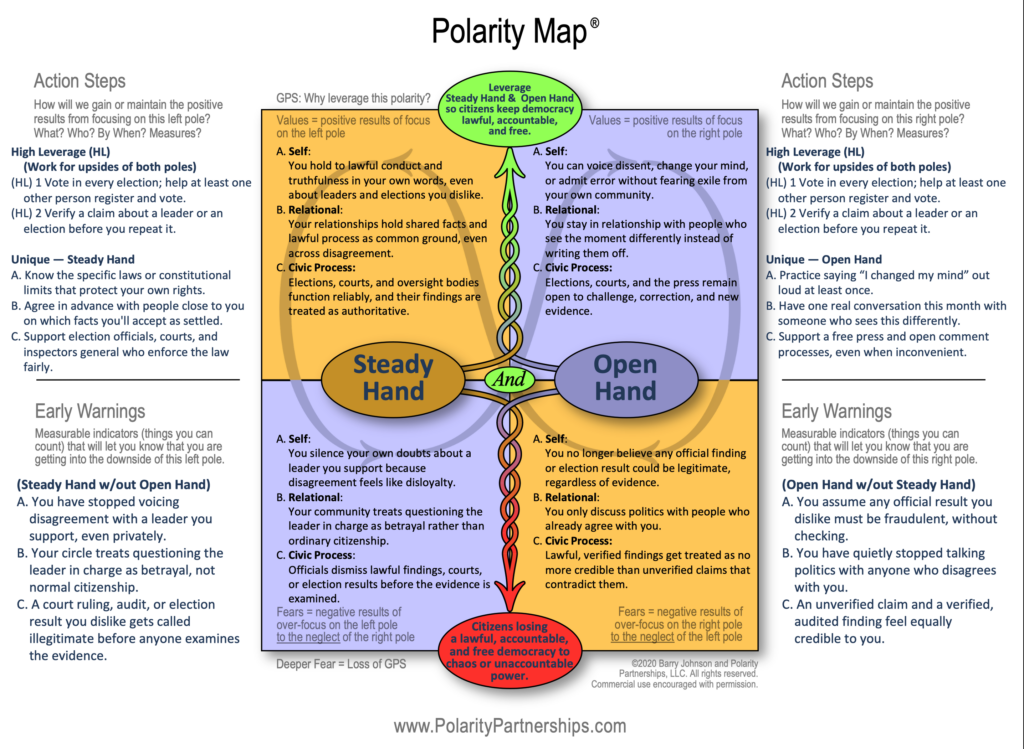
For Reflection:
What have you begun accepting in leaders that once would have crossed a clear floor? What boundary will you name, protect, and act on before November 3?
INVITATIONS:
To use an AI-trained “Chat w/Cliff” for Step 1, “Seeing” CLICK HERE.
Ready for the Polarity Advantage? Go deeper into Polarity Thinking, see our online self-directed Credentialing and Introduction to Polarity Practice or in-person training with Barry Johnson and me at Kayser Ridge by CLICKING HERE.
Notes and Links
- Jim Collins and Jerry I. Porras, Built to Last; Jim Collins, Good to Great. See also Cliff Kayser, Jim Collins’ Multarities, July 25, 2026.
- Bill Benet, Polarities of Democracy Institute, Polarities of Democracy. The five democratic polarities are Freedom AND Authority, Justice AND Due Process, Diversity AND Equality, Human Rights AND Communal Obligations, and Participation AND Representation. See also Cliff Kayser, Democracy Was Never Meant to Be Comfortable, May 16, 2026.
- Cliff Kayser, HOPE! Strong Floor & No Ceiling, Part I, and HOPE…Not a Strategy, Part II, March 19, 2026.
- Diane Vaughan developed the concept of normalization of deviance in her study of the Challenger disaster. See The Challenger Launch Decision (University of Chicago Press, 1996).
- Riane Eisler, The Chalice and the Blade; see also Cliff Kayser, Masculine AND Feminine: The Polarity Leadership Can No Longer Ignore, April 7, 2026.
- John Walter Wayland, “The True Gentleman.” See also Cliff Kayser, The True Gentleman and the Leadership We Are Choosing, Wiser Decisions.
- Jack Gibb’s developmental model of Trust, Openness, Alignment, and Interdependence. See also Cliff Kayser, Trust: Honoring Jack Gibb, Wiser Decisions, May 7, 2026.
- V-Dem Institute, Democracy Report 2026 (U.S. Liberal Democracy Index score declined 24 percent in one year; rank fell from 20th to 51st of 179 countries; the 2025 level was last recorded in 1965). Freedom House, Freedom in the World 2026: United States (score declined from 84 to 81; among the largest one-year declines for countries rated Free). Pew Research Center, Public Trust in Government: 1958-2025 (17 percent trusted the federal government always or most of the time, down from 22 percent in 2024). Accessed August 5, 2026.
- Federal Election Commission, Election and Voting Information; the next regularly scheduled federal general election is November 3, 2026. Accessed August 5, 2026.
- Stanford Encyclopedia of Philosophy, ‘Laozi,’ especially the discussions of date, authorship, political philosophy, and the text’s criticism of war, cruel punishment, and heavy taxation. Accessed August 5, 2026.
- This essay is part of Just Tao It, an eighty-one-part series placing the chapters of the Tao Te Ching in conversation with contemporary life and Polarity Thinking. The complete source text is published in It: Forty Years in Conversation with the Tao Te Ching by Cliff Kayser, the first book from XperienceIT Press.