


See the Series Introduction for Just Tao It, Part I: HERE
See the Just Tao It Series Introduction Tao/It on-ramp, PART II: HERE
See Just Tao It, Chapter 1: HERE
From my interpretation of the Tao Te Ching, Chapter 51 (Unpublished):
It grants.
Virtue shapes.
Earth nurtures.
All things grow.
In granting,
It makes no claim.
In shaping,
It seeks no acclaim.
In nurturing,
It desires no name.
Such is It.
—
I could be forceful when listening was needed, certain when curiosity would have served, and persuasive when another person needed room to find a voice of their own. Good intentions offered no immunity from impact. My understanding of how power works in human systems has taken a long time to form, and it remains partial, built across institutions and encounters with people whose lives and experiences differ greatly from mine. Among the few real regrets I carry is the unnecessary pain that slow learning caused, to people around me and to myself.
What finally helped was a series of people: strong and confident women, men whose strength required no theater, and people who transitioned between genders, all of whom showed me expressions of power I had not been trained to notice, much less respect. I was also born into dimensions of identity and circumstance that placed power within easier reach. Some of that power was visible to me. Much of it operated like the air in a room—present, consequential, and easy for the person breathing comfortably to overlook. The learning has been long, slow, difficult, and unfinished.
Chapter 51 brings that unfinished education into the presence of the Tao. This chapter belongs among those in my interpretation that attempt to describe It, giving its treatment of power particular weight. Lao Tzu is speaking beneath our leadership theories and political arrangements, pointing toward the generative mystery from which life arises. It grants. Virtue shapes. Earth nurtures. All things grow.
The sequence is elemental and immense. Life is brought forth, given form, nourished by conditions, and allowed to become. No single force takes full credit. Nothing in the process claims ownership of what emerges. The Tao’s power is visible through life itself, while its source remains beyond possession and beyond name.
Scholars have called this Xuan De—mysterious Virtue, deep integrity, or profound inner power. Chapter 51 gives it a recognizable shape: to give life without owning it, to act without requiring return, and to guide without dominating. This is among the most demanding descriptions of power I know. Power remains fully present, expressed in a form spacious enough for what it touches to develop a life of its own. A power that gives life and still expects ownership begins to resemble an investment.
Barry Johnson’s work and my long association with him have shaped so much of what I do and, to some degree, who I am. In And, Volume One, he names this polarity Claiming Power And Sharing Power. Claiming Power affirms the right and responsibility to take up power, especially where it has been denied.
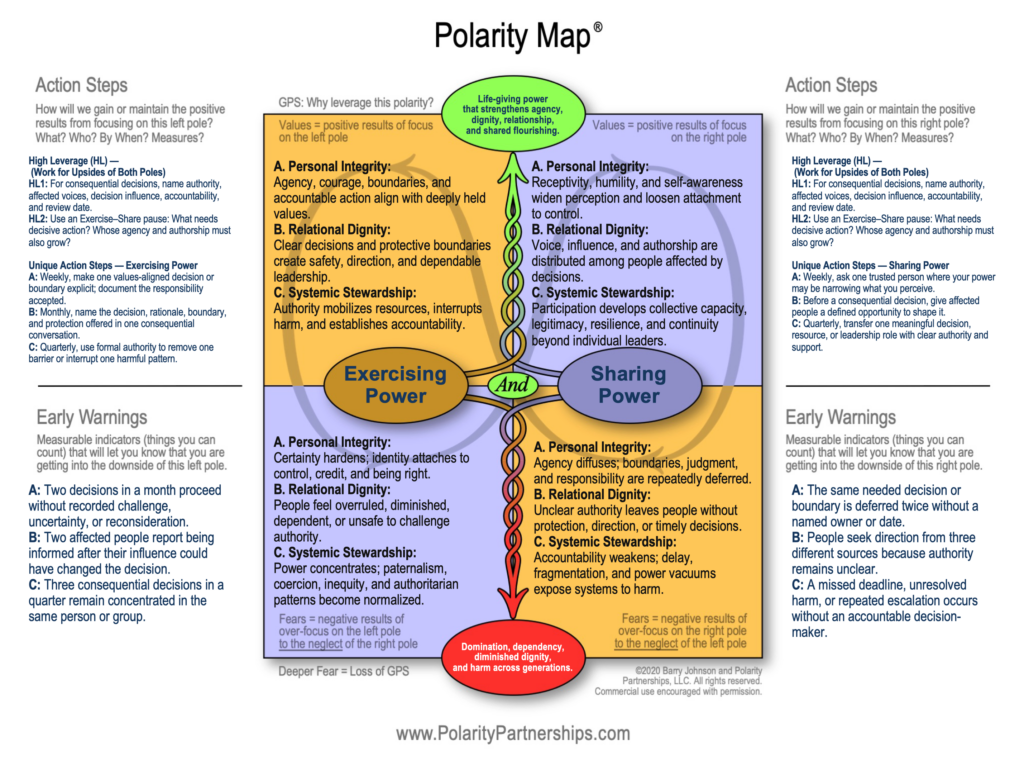
That distinction belongs to the larger weave of this series: Patterns And Mystery (see the Just Tao It Introduction, Part II, click here or above). Polarity Thinking helps me recognize recurring patterns moving through human systems. The Tao keeps me in relationship with Mystery, including what no pattern, name, or map can fully contain. Through Chapter 51 and my own forty-year relationship with the Tao, I hear a closely related naming for this essay and its map: Exercising Power And Sharing Power. Exercising Power is the capacity to act, decide, lead, establish a boundary, and take a stand. Sharing Power is the capacity to include, develop others, distribute voice, and allow people affected by decisions to help shape them. Xuan De offers an image of both at work in the same act: enough power to create something real, enough release for the creation to become more than an extension of its creator.
Each Pole carries life-giving value. Each also creates predictable harm through overfocus to the neglect of the other. The downside of Exercising Power to the neglect of Sharing Power includes coercion, dependency, domination, and abuse. The downside of Sharing Power to the neglect of Exercising Power includes avoidance, unclear accountability, unprotected boundaries, and decisions that arrive too late to matter. The resulting vacuum is usually filled by whoever is most willing to exercise the power others have declined to hold.
I recognize what happens when power protects itself because I have watched it, experienced it, and sometimes enforced it without knowing that was what I was doing. Tema Okun and her colleagues documented organizational patterns that protect power once it stops sharing: power hoarding, paternalism, defensiveness, fear of open conflict, either/or thinking, urgency, and a presumed right to comfort. Okun is careful about the reach of these patterns. They can be carried by white people and people of color, by those holding formal authority and by those harmed by the systems that formed them. Culture gains power through patterns that remain unnamed.
I recognize several of those habits in institutions I have served and in myself. The one right way can feel reassuring when I am the person who knows it. Urgency can make participation look inefficient. Paternalism can disguise itself as care. Power hoarding can sound like responsibility. Comfort can masquerade as civility when someone else is naming harm. The Tao interrupts this self-protective logic: in granting, it makes no claim; in shaping, it seeks no acclaim; in nurturing, it desires no name. Its power does not depend on keeping others small enough to confirm its size.
Riane Eisler’s distinction between domination and partnership adds another layer. Domination organizes people through rigid hierarchy, fear, and the presumption that some lives carry greater worth. Partnership distributes power and creates conditions in which more people can contribute their capacities. In the Domination Model, the downside of Exercising Power to the neglect of Sharing Power has hardened into a system. At a national scale, the patterns Okun named inside organizations become harder to escape: dissent becomes disloyalty, disagreement becomes punishable, and the people living with the consequences of decisions lose influence over the decisions shaping their lives.
Barry’s writing on poverty, racism, and sexism makes this cycle even more explicit. A group can exercise power to protect Us while withholding from Them the same right to safety, dignity, opportunity, and voice. Once those categories harden, power over Them begins to feel like protection for Us. Harm can then be rationalized as duty. A different cycle becomes possible when we hold Exercising Power And Sharing Power together, and help others do the same.
For people whose identities and positions already receive the benefit of a system, sharing power asks for more than participation offered after consequential decisions have been made. It includes transparency about who decides, whose experience counts, who bears the impact, how authority can be challenged, and how power will be transferred or shared. For people whose power has been denied or taken, the Tao offers no invitation to remain small. The Tao grants. Virtue shapes. Earth nurtures. Growth carries power. Exercising that life-giving capacity is part of It.
We are living through a decade in which the downside of Exercising Power to the neglect of Sharing Power has been normalized in plain sight and defended as strength. Public cruelty earns attention. Boasting passes for capability. Loyalty to a leader can be demanded above loyalty to law. Dissent is treated as betrayal, expertise as an inconvenience, and history as material to erase or revise when it threatens the preferred story. The danger is measurable as well as felt. Freedom House’s 2026 assessment still classifies the United States as free while documenting further erosion in political rights and civil liberties, including weakened oversight, extreme assertions of executive authority, pressure on courts and media, and persistent barriers to equal participation. Freedom House, United States: Freedom in the World 2026.
Xuan De was never a delicate ideal reserved for peaceful times. It speaks directly to what happens when power grants little of itself, acts mainly to be seen acting, and leads by insisting on being followed. Such power can produce compliance, spectacle, and fear. It cannot nourish the trust, agency, correction, and shared responsibility on which living systems depend.
Democracy depends on power that can be exercised, shared, limited, contested, and peacefully transferred. It institutionalizes distrust through checks and balances and cultivates enough trust for people to accept legitimate outcomes, correct mistakes, and remain in relationship across disagreement. Its tensions are tiring. A single strong hand can feel attractive when shared governance becomes slow, uncertain, and uncomfortable.
Chapter 51 offers another measure of legitimacy. Does power help life grow? Does it increase the capacity of people and communities to shape their conditions? Can it act without demanding worship, guide without domination, and protect without possession? Does it leave behind greater agency, deeper relationship, and stronger conditions for those who come next?
These questions apply to presidents and parents, executives and teachers, coaches and movement leaders. They also apply to me. Formal authority can be surrendered while informal power remains intact. A person can speak softly and still dominate a room. A person can advocate sharing while controlling the terms of the conversation. The Tao’s challenge reaches beneath our stated values into the effects of our presence.
I return to the people who taught me the difference. Few of them lectured me about power. They embodied a strength I had not been raised to recognize: strength that required no performance, could hold a boundary without dominating the room, and could be fully claimed without asking anyone else to disappear. Some offered trust. Some offered resistance. Some refused the version of me that wanted credit for being helpful. Their influence lives in whatever capacity I now have to notice when my strength is becoming force, my care is becoming control, or my confidence is crowding out someone else’s knowing. Those who know me will tell you — I remain capable of all three. And, I will continue work in my improvement efforts.
This chapter sits centrally among the chapters that describe It. Lao Tzu offers no technique for appearing humble. He describes the mystery through which life is continually granted, shaped, nurtured, and released. Its greatness requires no captive audience. Its influence leaves the distinct life of what it influences intact.
For those of us who carry power that arrived before we earned it, Chapter 51 offers an enduring practice: become conscious of what moves through us; exercise enough power to interrupt harm; share enough power for others to shape the future; and loosen our grip on ownership, acclaim, and control.
Power will always move through human systems. The question is what grows in its wake.
In granting, make no claim.
In shaping, seek no acclaim.
In nurturing, desire no name.
Such is It.
Here’s a Polarity Map for Exercising Power And Sharing Power:
INVITATIONS:
To use an AI-trained “Chat w/Cliff” for Step 1, “Seeing” CLICK HERE.
Ready for the Polarity Advantage? Go deeper into Polarity Thinking, see our online self-directed Credentialing and Introduction to Polarity Practice or in-person training with Barry Johnson and me at Kayser Ridge by CLICKING HERE.