

See the Series Introduction for Just Tao It, Part I: HERE
See the Just Tao It Series Introduction Tao/It on-ramp, PART II: HERE
See Just Tao It, Chapter 1: HERE
From my interpretation of the Tao Te Ching, Chapter 50 (Unpublished):
Too cautious,
Life missed.
Too reckless,
Life lost.
What is chased,
Is reversed.
What’s clung to
Feeds fear
Of loss.
In the embrace
Of fear,
The fear
Recedes.
—
I met Cathy Yu in China in 2023, when she attended an open-enrollment program I delivered with our Strategic Partner, IOC/IOCC. In 2025, she came to Kayser Ridge for a Polarity Certification with Barry and me. During one of our many collaborations since then, Cathy gave me an extraordinary gift: a Chinese edition of the Tao Te Ching, with the Chinese text and an English translation of each chapter presented side by side. Its silk paper feels more like cloth, and its ornamentation, illustrations, and embossed details are incredibly beautiful. Of all the versions of the Tao Te Ching I own, this one has become the most meaningful to me.
The volume also provides historical context beyond my compressed interpretation above. In one longstanding reading, Chapter 50 opens with an arithmetic puzzle that translators have wrestled with for centuries. It can be understood this way:
Of every ten people, three chase life so forcefully that they hasten their own decline. Three are so afraid of losing life that they never quite live it. Three more, trying to manage the outcome carefully, stumble into the danger they were maneuvering to avoid. One in ten moves through the world carrying no surface for its dangers to grip.
The chapter’s second half describes that tenth person traveling where rhinoceroses, tigers, and armed soldiers pose mortal danger. The horn finds no place to enter. The claw finds no place to tear. The blade finds no opening. Lao Tzu’s image can sound like supernatural immunity. I hear a person who remains fully mortal and has loosened the desperate grip through which fear so often creates its own target.
I recognize the other nine because I have been most of them, sometimes within the same year. In 2021, on a mountain-bike descent I had ridden many times, I fractured my C2 vertebra, tore an artery in my neck, and sustained a traumatic brain injury that put my life on pause for months. I was moving fast enough that I did not have to feel how close to the edge I already was. During recovery, I overcorrected into vigilance that could treat ordinary Risk as the death-ground itself, checking and rechecking dangers that were no longer growing. Only my grip on them was.
A genuine love of challenge had become entangled with an OCD-fueled compulsion to keep going. Risk brought vitality, discovery, confidence, and memorable experience. Caution protected healing, restored discernment, and helped keep consequence visible. My difficulty came when either became the whole story.
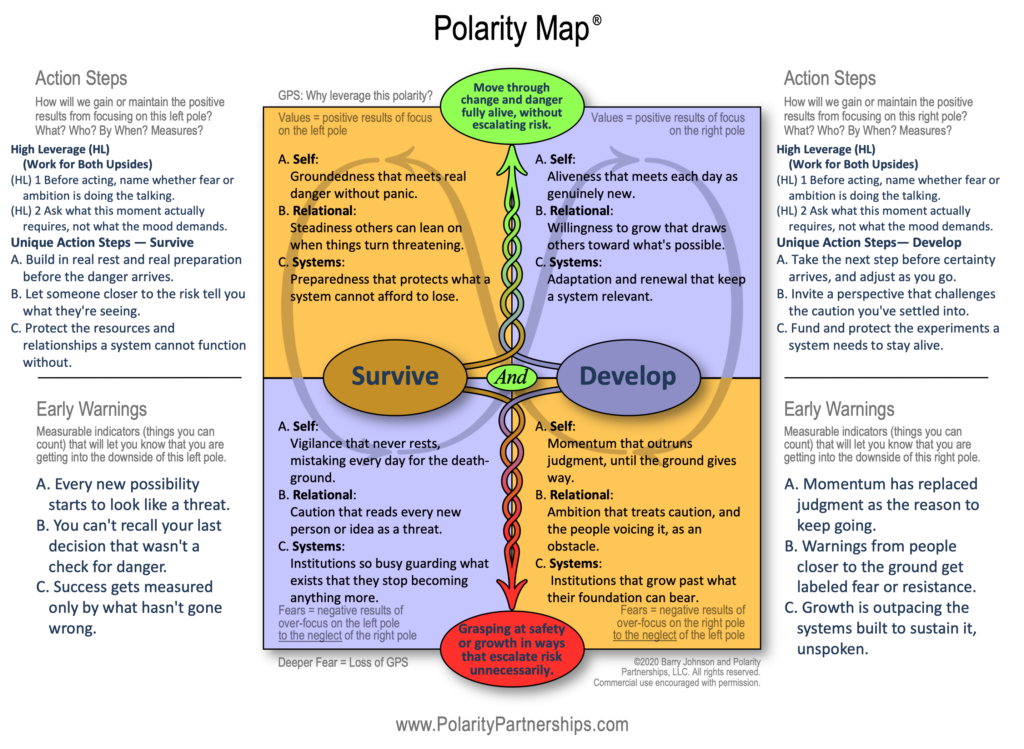
Two Barrys shaped how I understand this chapter. Barry Johnson’s Polarity Thinking helped me see patterns moving within the mystery of the Tao. In Chapter 50, the particular Polarity I hear comes from Barry Oshry’s study of human systems: Survive AND Develop. Survive is the capacity to cope with real danger. Develop is the capacity to prospect for what is possible. I mapped Oshry’s distinction through the 5-Step SMALL Process in Chapter 36 of And: Volume Two—Applications.
Over-focus on Survive to the neglect of Develop, and Caution can harden into vigilance, paralysis, and a life organized around what might go wrong: life missed. Over-focus on Develop to the neglect of Survive, and aspiration can outrun judgment, capacity, and the conditions required to continue: life lost. Lao Tzu had already rendered both failure modes in a few spare lines.
Risk AND Caution remains present as a closely related Polarity in my life. So do Activity AND Rest, Masculine AND Feminine, Power Processes AND Love Processes, Vision AND Reality, and Idealism AND Realism. I no longer fold these distinct interdependencies into one another. I have, however, come to recognize how my preferred Poles can travel together. Under pressure, Develop can recruit Risk, Activity, and forceful Masculine energy. Survive can recruit Caution, Rest, and protective control. Preferences can form a coalition, and the coalition can begin to feel like identity.
The stronger the value we place on one Pole of an interdependent pair, the more vulnerable we become to fear of the opposite Pole’s downside. If I strongly value the aliveness of Develop, I may become highly alert to stagnation, timidity, or a life unlived. When Or-thinking enters, the relationship contracts into a false choice: Develop or diminish. The benefits of Survive fade from view, and the accumulating downsides of Develop become easier to rationalize.
Someone hooked on Survive can experience the mirror image. Develop appears irresponsible. Possibility begins to look like threat. Protection starts consuming the life it was meant to preserve. In either direction, evidence loses its power to revise the story. Concern from people who love us sounds like limitation. The downside of our preferred Pole becomes tolerable, while the people advocating for the other Pole become embodiments of what we fear.
That is the pattern I call How We Get Hooked and Stuck. Barry later incorporated my articulation of it into the Polarity Realities as Reality 51, acknowledging my contribution in his description. The irony remains close to home. Apparently, I was committed to learning this particular Reality through field research. A person chasing vitality can injure the body through which vitality is experienced. A person seeking safety can inhabit a life increasingly governed by fear. A system protecting survival can stop developing the very capacities its future requires. What is chased is reversed.
Arnold Beisser’s Paradoxical Theory of Change gave language to a truth Barry Johnson encountered during his Gestalt training: meaningful change becomes possible as we more fully recognize what is already here. Johnson has described the disorientation of meeting this idea after years spent training to be a change agent. The role he had prepared to occupy could interfere with the change he hoped to support.
Applied to Chapter 50, the paradox becomes practical. Surviving well begins by meeting the ground already under our feet. Developing well begins from the same ground. Fear may be warning of actual danger. It may be protecting an old wound, carrying a value we have neglected, or repeating a lesson whose conditions have changed. Remaining present to fear creates the possibility of discerning which.
Barry Johnson’s five-step Getting Unstuck Process begins by seeking the value being held and understanding the legitimate fear beneath it. Only then do we ask how to gain the upside of the other Pole while retaining what deserves protection, in service of a Greater Purpose shared by both. The order matters. Movement gains trustworthy footing when the place we are standing has been seen.
The same sequence works inside one person standing at their own death-ground. What is being protected? What is feared? What becomes possible when Survive is assured enough to risk Develop, and Develop remains alive enough to keep Survive connected to purpose? Chapter 50 offers an even more elemental version: embrace fear and observe what happens. What is clung to feeds fear of loss. What is fully encountered no longer requires the same grip.
I have watched this dynamic in individuals and organizations. A system focused only on coping with danger can stop prospecting for anything better and call that discipline. A system focused only on prospecting can lose its ability to cope with what threatens it and call that vision. Each description contains truth. Each is partial. The systems that endure keep Survive AND Develop in an ongoing relationship.
This is where the Tao’s mystery and the patterns illuminated by Polarity Thinking mutually support one another. A Polarity Map can help us see the value-and-fear diagonals organizing perception. The Tao asks for a quality of presence no map can provide. It asks us to loosen our grip, receive what is here, and let action arise with the conditions.
The Tao Te Ching emerged from a world familiar with political disorder and violence. Chapter 50 offers no escape from mortality. Danger, injury, grief, aging, and death remain part of being alive. The chapter changes our relationship with the fear that can make us absent from life before death arrives.
I am still learning to loosen my grip before consequence raises its voice. My body remembers the cost of getting hooked on Develop. Other parts of me remember the cost of retreating too far into Survive after being hurt. Survive can ground courage. Develop can keep protection connected to life. Together they offer vitality, discernment, renewal, and the capacity to continue.
Life will end. Until then, the practice is to meet it without clinging so tightly that fear becomes the shape of living.
Too cautious, life missed. Too reckless, life lost. Somewhere within Survive AND Develop, life is received.
Here’s a Polarity Map for Survive AND Develop:
For Reflection:
Where in your life are you gripping so tightly—to safety or to progress—that you may be creating a target for what you are trying to avoid?
INVITATIONS:
To use an AI-trained “Chat w/Cliff” for Step 1, “Seeing” CLICK HERE.
Ready for the Polarity Advantage? Go deeper into Polarity Thinking, see our online self-directed Credentialing and Introduction to Polarity Practice or in-person training with Barry Johnson and me at Kayser Ridge by CLICKING HERE.