


See the Series Introduction for Just Tao It, Part I: HERE
See the Just Tao It Series Introduction Tao/It on-ramp, PART II: HERE
See Just Tao It, Chapter 1: HERE
From my interpretation of the Tao Te Ching, Chapter 59 (Unpublished):
In caring service,
Practice restraint.
Presence
Bears witness.
This gift
Knows no limit.
To give It,
Is to embody
The Mother spirit.
Deep roots.
Firm foundation.
From there,
Branches,
And leaves.
The one letting go
Moves freely.
Caring deeply.
Leading,
And following.
Naturally.
—
There is a particular temptation near the end of any long undertaking: to push it out—to ‘git ’er done,’ as people say in West Virginia, with a directness I appreciate. I feel it now as I near the completion of work I have carried for years. Chapter 59 counsels otherwise. Its subject is what happens beneath a finish line long before anyone can see it: years of unannounced accumulation and deep-root growth that make a strong ending—and a new beginning—possible.
The movement from deep roots to branches and leaves traces Lao Tzu’s counsel. It also traces a developmental pattern I often lived before recognizing it—one that writing this series, and Wiser Decisions alongside it, helped make visible.
Lao Tzu calls this central discipline sè: moderation, frugality, restraint, conservation, husbandry. None of those words is sufficient alone. The image is agricultural: preserving what an abundant season provides because lean seasons will come. Sè is not deprivation for its own sake. It is refusing to squander what life will need later.
Applied to a person or a country, the discipline turns inward and outward at once. Do not spend down vital energy chasing every appetite or emergency. Do not exhaust people’s resources through vanity, conflict, or spectacle. Conserve what matters. Let it accumulate as Te — inherent virtue, stored capacity — until the reserve is larger than the demands placed upon it.
The chapter closes with the Mother, and with deep roots and a firm foundation. A tree that rises quickly from shallow roots can look impressive for a season and topple in the first real storm. A tree that spends its early years growing roots no one can see may outlast centuries of weather. The apparent stillness is continuous work. Sè is the discipline of growing roots before anyone is watching, so branches and leaves can arrive later without apology.
In his research, Jim Collins calls this a constellation of encodings: durable capacities built into a person’s construction long before life provides a frame wide enough to draw them out. The people he studied rarely developed those capacities at the moment they became useful. More often, the capacities had been forming for years—undiscovered or underused—until circumstances finally called them forward. Lao Tzu offers an older image for a related patience: roots growing before branches become visible.
You may recognize this movement in your own life. A practice repeated without visible reward suddenly becomes available when a difficult moment finally gives it a frame wide enough to show through. Something a parent, teacher, mentor, or tradition gave you years ago begins speaking with new authority. A capacity you could not name while it was forming becomes part of how you meet the world. Development often becomes visible only after it has already changed us.
For more than forty years, I have been immersed in the Tao Te Ching, much of that time overlapping with learning and helping advance Polarity Thinking. The work traveled through the cumulative passion and persistence of a community: respect it, tend it, keep learning, and show up when an opportunity comes to share it. Sè beneath strategy.
Two experiences made the reach of that root system visible, and neither happened because I went looking. In China, a participant in a program with one of our strategic partners told me she had encountered Polarity Thinking through the Inner Development Goals (IDG) Guide. She congratulated me — and Polarity Partnerships — for being included. A little sheepishly, I admitted that I had never heard of IDGs.
She looked surprised. “Being included in the IDG framework is a big deal.”
The following month, in Brazil, essentially the same thing happened. A different participant, on a different continent, spoke with admiration about Polarity Thinking’s inclusion in the Thinking dimension. Two people recognized a connection to our work in the IDGs before I understood its significance. At some point, humility requires treating repetition as information.
I set out to learn more, joined the first IDG Ambassador program as part of the Aconcagua cohort, and later helped establish Kayser Ridge as the IDG Washington, D.C. Polarity Retreats Hub. What began as a surprising conversation in China became a community, a responsibility, and another place for the work to take root.
Perhaps you have known a version of this surprise: discovering that an idea you offered, a person you encouraged, or a passion you followed traveled farther than you knew. We rarely see the whole root system of influence. Sometimes another person reveals a branch we did not know existed.
Restraint is not passivity. Once the root system became visible, the fitting action was clear: reach toward what had already reached toward me. In 2025, the IDG Summit adopted “Bridging Polarities” as its theme. Barry and I supported conversations leading up to the Summit, I presented at the Unconference that preceded it, and our work in Brazil became a teaching case. I was helping carry a conversation I had only recently learned I was already part of.
The Brazil case is its own roots-and-branches story. In 2014, Rosangela Angonese and Julio Agostini of SEBRAE encountered Polarity Thinking in a leadership program I taught at American University. Through their curiosity and commitment, one module grew into an ongoing collaboration serving business leaders across Brazil. They carried the work far beyond the room in which it began. The roots had traveled farther than I knew; the branches had simply become visible above ground.
Collins calls this kind of movement simplex stepping: taking the best next step visible without needing to see the entire path, then looking again from the place where that step brings you. Katharine Graham spent seven years stepping into her leadership of The Washington Post Company, one decision at a time, before Watergate revealed what she had already become. Development often works that way. The path becomes coherent in retrospect even though it could not have been planned from the beginning.
In 2015, the United Nations adopted seventeen Sustainable Development Goals: a shared agenda addressing poverty, health, education, inequality, climate, peace, institutions, partnership, and the conditions for a flourishing planet. The goals describe essential external outcomes. They tell us, with considerable clarity, what humanity needs to accomplish.
The Inner Development Goals emerged from a different question: what human capacities are needed to make sustainable change possible? The framework organized those capacities through Being, Thinking, Relating, Collaborating, and Acting. It named an uncomfortable gap. Technical knowledge and public policy matter enormously, but they do not implement themselves. Our outer ambitions can exceed our inner capacity to hold complexity, work across difference, regulate fear, share power, persevere, and learn.
I hear Chapter 59 inside that relationship. The IDGs cultivate roots. The SDGs call forth branches, leaves, fruit, and shade. The metaphor works only if we refuse to turn it into a hierarchy. Roots without branches serve no living future. Branches without roots cannot endure.
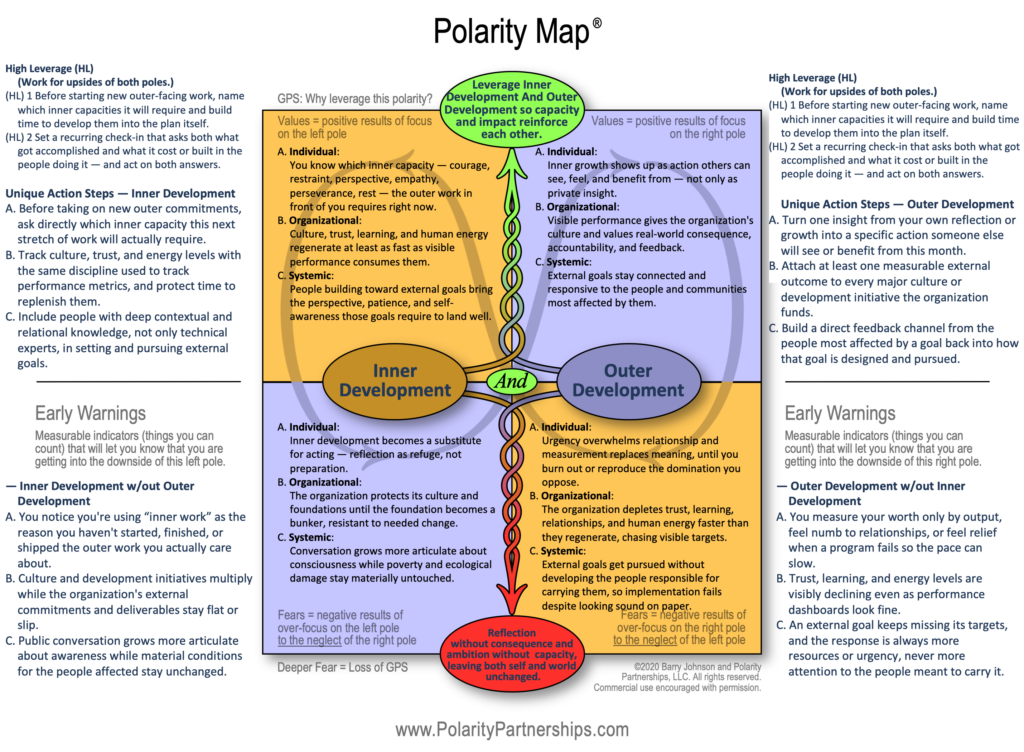
Regardless of level or scale, I hear in Chapter 59 a polarity rooted in:
Inner Development AND Outer Development.
Overfocus on Inner Development to the neglect of Outer Development can become private enlightenment without public consequence. Reflection becomes refuge. Privilege disguises itself as transcendence. We become increasingly articulate about consciousness while poverty, violence, institutional failure, and ecological damage remain materially untouched.
Overfocus on Outer Development to the neglect of Inner Development can produce plans without the human capacity to carry them. Urgency overwhelms relationship. Measurement replaces meaning. Action outruns trust. People burn out, polarize, reproduce the domination they oppose, or discover that the system they changed externally remains alive within them. This describes pretty closely the very problem the IDGs were created to address.
Leveraged together, Inner Development gives outer action depth, adaptability, courage, and ethical grounding. Outer Development gives inner work purpose, consequence, accountability, feedback, and service. The inner changes what we are capable of doing. The outer reveals what our inner work has actually become.
This is not only the work of global frameworks. You can feel the polarity whenever the life you want to affect asks you to become more capable of affecting it. Outer demands expose inner limits; inner growth presses toward expression. One without the other eventually becomes either exhaustion or escape.
Sometimes that relationship is disrupted by what Collins calls a cliff: an event that ends life as we knew it and removes the frame through which we understood ourselves. The cliff may be chosen or imposed, sudden or visible from far away. What follows is often fog: a genuine transition in which the old identity no longer fits and the next one cannot yet be seen. Fog is not a moral failure or a lack of discipline. It is what a real transition feels like from the inside. Collins tried to find long lives without a major cliff and could not. Human development is not the avoidance of these passages. It is learning how to move through them without demanding premature clarity.
There is a danger in reading restraint as a command to preserve ourselves indefinitely. Conservation can become fear with excellent vocabulary. A person can spend a lifetime protecting energy for work that never begins. An organization can defend its foundations until the foundation becomes a bunker. For Lao Tzu, sequence matters: deep roots and firm foundation; from there, branches and leaves. The store of Virtue is not accumulated so we can admire the reservoir. It becomes available for caring service. The leader conserves what matters so it can be given without destroying the source from which the giving comes.
The questions then become immediate: What inner capacity does our outer work require? Where has inner development become an elegant substitute for acting? Organizations can ask what invisible resources are being depleted to sustain visible performance. Whole systems can ask which ambitions cannot be reached without developing the people responsible for carrying them. The work is not inner first and outer later, or outer first with inner development added after implementation fails. Roots and branches develop in relationship. Each reveals what the other needs.
Do not leap merely to escape the discomfort of not knowing. Restraint protects us from forcing a future before it has disclosed itself; action keeps restraint from becoming hiding. Deep roots do not eliminate fog. They help us take the next honest step within it.
At the Summit, that larger root system became personal. I was joined by Polarity Mastery graduate Riet Portengen and her partner, Timo; Riet’s niece Marenka; and Thomas Schumacher, who has since become a Strategic Partner of Polarity Partnerships. The trip also coincided with the formal establishment of the Polarity Fun Foundation in the Netherlands, envisioned by Riet as an enduring contribution of her life’s work focused on reinforcing the existing polarity fluency children possess. The presence of a community carrying shared work across relationships, countries, and generations was life giving energy.
In a brief window, many strings came together: China and Brazil, Barry’s lifetime of work, a new foundation, old friends, new partners, and a retreat center that had become a home for learning. I do not need to decide whether the timing was providence, coincidence, emergence, or some combination of the three. The moment felt received as much as made. It did not prove that everything would work. It revealed that roots tended over time can support branches no one could have designed in advance.
My father carried a different kind of root system folded into his wallet for forty years: John Walter Wayland’s creed of the True Gentleman. Who can know how many times he must have read the card before I came to understood what it had grown and how it had grown in him. Its deepest effect showed up only later: in the character he practiced, long after he had a need to pull it out again to look at it.
You may carry something like that, too: a sentence, ritual, wound, promise, discipline, or example whose meaning has changed as you have changed. Some inheritances strengthen us. Some require healing. Some do both. Human development is rarely a clean ascent. It is a continuing relationship with what formed us — choosing what to deepen, what to repair, what to release, and what to pass on.
A close colleague, Dr. Gemma Jiang, has been sharing chapters from an unpublished book while I have been writing several of these Just Tao It chapters. Each of her chapters stay with me before they settle into me. The story is hers to tell, and I will not give away in my voice what readers should discover in hers. It is enough to say that her story begins with a child enduring losses and conditions no child should have to hold, and follows an adult gradually learning to meet the visible and invisible consequences of those experiences. Through a polarity lens, it is a developmental movement: fragmentation toward fluency, protection toward fuller participation in life.
The distinctions matter. The long cultivation of professional work is not equivalent to the pain Gemma endured as a child. Nor does every hardship become a gift. What I recognize across her story, my father’s life, and many lives — including, perhaps, yours — is a pattern of development: consequential growth is often underway long before its direction or reach becomes visible. Roots can be damaged, replanted, nourished, and deepened. Leaves may appear years later as voice, discernment, relationship, service, and the capacity to help others see their own lives differently.
That pattern belongs to no one story. Your circumstances may resemble none of ours, yet you may recognize the movement: surviving before understanding, practicing before embodying, tending before seeing, or discovering that what once protected you now needs to develop into something more. Recognition does not erase difference. It lets distinct lives meet within a shared human process.
Thomas first pointed me toward Gemma after learning of my interest in the Tao and Polarity Thinking: “There’s a woman in the United States who is writing about Polarity and Tao.” No Polarity Map could have predicted what followed. Now I am reading the emerging chapters of her book and imagining years of learning and collaboration ahead. That movement — from an introduction to a relationship carrying real work — is itself a small expression of Chapter 59. We tend what is alive between us. We cannot command what it will become.
Several strands of this series have converged here: the Tao, Polarity Thinking, my father’s influence, Gemma’s unfolding work, the IDGs AND SDGs, relationships spanning countries and generations, and the reader I cannot yet know. I could not have arranged that convergence when I began. I can only recognize it now — and ask what it makes possible beyond me.
Collins found something in his research that I needed to hear. Across the biographies written about Benjamin Franklin, fifty-three percent of the pages remain when Franklin turns sixty; more than half of what was most worth writing about his life had not yet happened. The people in Collins’ research who burned brightest late were rarely preoccupied with how they would be remembered. They were preoccupied with what they were still choosing to be responsible for. Completion does not close the path. It can clear a frame for whatever comes next to show through.
The work will not prove that it matters. Sharing it will not guarantee that it travels. Forty years do not entitle an idea to another person’s attention. The work must meet you where you are and become useful in your hands, or not. That uncertainty is not a diminishment of the offering. It is what makes the offering real.
Still, something real has happened. What lived for years in conversations, classrooms, organizations, maps, relationships, and practice is becoming visible enough to share. Gemma’s manuscript sharpened that recognition for me: work does not remain ours in the form in which we offer it. It enters another life, meets another history and wisdom tradition, and may return with language and possibilities we could not have produced alone. That is not replication. It is relationship, development, and emergence.
Perhaps that is where you enter this chapter most fully. You are not standing at the edge of someone else’s finish line. Your reading becomes part of what happens next. What these roots support in you — agreement, resistance, recognition, practice, or a question worth carrying — will take a form neither of us can determine in advance.
Deep roots. Firm foundation. From there, branches and leaves.
Naturally.
For Reflection
Where is your outer ambition asking for deeper inner capacity, and where is your inner development asking to become visible through action? What frame is drawing forth more of what is already within you — and where do you feel out of frame? If you are in fog, what is the next honest step you can see? What are you choosing to be responsible for now?
Here’s a Polarity Map for Inner Development AND Outer Development:
Notes and Links
- Tao Te Ching, Chapter 59. See James Legge, Tao Te Ching; Roger T. Ames and David L. Hall, Dao De Jing: A Philosophical Translation; and other translations treating sè through moderation, frugality, conservation, restraint, or husbandry, and the chapter’s image of deep roots and firm foundation.
- Inner Development Goals, About the IDGs and Inner Development Guide. The framework connects inner capacities with progress toward sustainable outer change through the dimensions of Being, Thinking, Relating, Collaborating, and Acting. Accessed August 5, 2026.
- United Nations, Transforming Our World: The 2030 Agenda for Sustainable Development, adopted in 2015, with 17 Sustainable Development Goals and 169 associated targets.
- Barry Johnson, And, Volume One: Foundations; see especially the principles of leveraging interdependent values over time.
- John Walter Wayland, “The True Gentleman.” See also Cliff Kayser, The True Gentleman and the Leadership We Are Choosing, Wiser Decisions.
- Gemma Jiang, unpublished book manuscript shared privately with the author.
- Jim Collins, What to Make of a Life: Cliffs, Fog, Fire, and the Self-Knowledge Imperative (Harper Edge, 2026). See also Cliff Kayser, Jim Collins’ Multarities, Wiser Decisions, July 25, 2026.
- This same movement between restraint and action shows up elsewhere in this series: see Chapters 13, 16, 27, 38, 43, 44, 46, and 48.
Invitations
Use an AI-trained “Chat w/Cliff” for Step 1, Seeing: CLICK HERE
Want to go deeper into Polarity Thinking? See our online self-directed Credentialing and Introduction to Polarity Practice: CLICK HERE