


See the Series Introduction for Just Tao It, Part I: HERE
See the Just Tao It Series Introduction Tao/It on-ramp, PART II: HERE
See Just Tao It, Chapter 1: HERE
From my interpretation of the Tao Te Ching, Chapter 35 (Unpublished):
When abiding in It,
Every moment
Holds within
The ease of a peaceful condition.
Compared to
Music or delicious cuisine—
It will taste bland and without seasoning,
Look plain and without coloring,
Sound flat and without tuning.
Yet experiencing It
Brings peace and ease.
And you discover that
You never want
It to cease.
—
Chapter 35 confronts me with a possibility I have spent much of my life resisting: we already have what we need to feel at ease.
The chapter says this plainly. Music and delicious food catch the attention of a traveler. The Tao appears bland beside them—without seasoning, coloring, or tuning. Yet experiencing It brings a peace and ease we do not want to lose.
I understand the traveler. In Chapter 69, I wrote about years spent mistaking intensity for strength—the bodybuilding, boxing, Toughman contests, and bouncing. Another part of that same pattern ran beside it. I often mistook stimulation for being fully alive. Ease felt like the absence of something. I had not yet learned to recognize the presence within it.
In Chapter 1, I shared how another OCD-fueled mountain-biking pursuit culminated in a near-death accident in 2021. The accident put my life on pause—a traumatic brain injury, a fracture at C2, an arterial dissection, and months of recovery. That forced stillness opened something I did not know I needed, eventually gave rise to this series, and left me more attentive to the patterns that can reassert themselves.
Music and delicious cuisine are among the pleasures of being alive. Chapter 35 places them beside something less immediately compelling and far more enduring. That distinction feels especially important now.
Much of modern life is organized around what can capture and retain attention. A screen can reach us before our feet touch the floor in the morning. Messages wait beside headlines selected to provoke a response. A clip promises astonishment. An advertisement names a lack we had not felt a moment earlier. Somewhere, someone is outraged, triumphant, terrified, or certain.
Much of this is useful. Some of it is beautiful. Technology connects us across distances that once seemed impossible. It also learns what makes us pause, what keeps us engaged, and what draws us back. Artificial intelligence increases that capacity. The systems are becoming more responsive to us at the same time that many of us are becoming less aware of how responsive we are to them. Chapter 35’s passing pleasures now travel at the speed of an algorithm.
Intensity can begin to feel like evidence of importance, and novelty like aliveness. A conversation takes too long. A relationship requires too much patience. The practices that actually sustain health, community, and the living world—attending, listening, telling the truth, repairing harm, remaining in relationship long enough to be changed by it—can look unimpressive beside the technologies and crises commanding our attention. They still carry life.
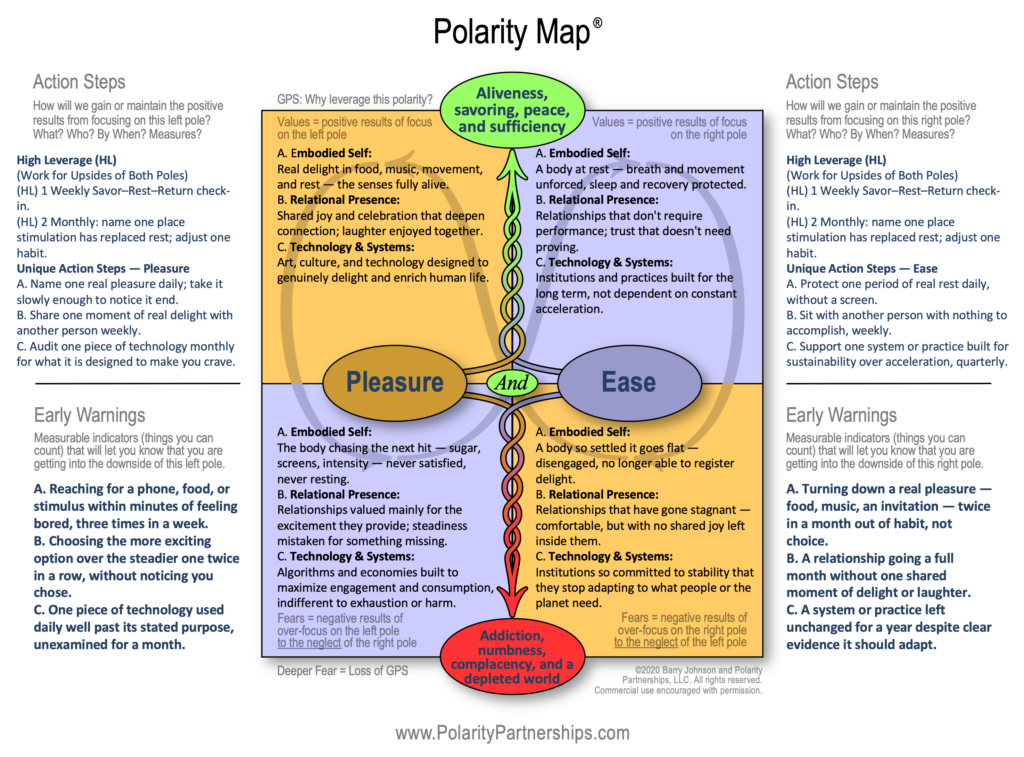
Through a polarity lens, I hear Pleasure AND Ease in this chapter. Pleasure brings joy, delight, energy, discovery, and the capacity to savor what is here. Ease brings peace, sufficiency, renewal, and the capacity to act without being driven by constant inner friction. Pleasure animates us. Ease steadies us.
An overfocus on Pleasure to the neglect of Ease can become restless consumption—stimulation pursued for its own sake, intensity mistaken for aliveness, and the feeling that wholeness is always one more experience away. An overfocus on Ease to the neglect of Pleasure can become insulation—complacency, disengagement, muted vitality, and avoidance of the difficulty through which life also grows.
Together, Pleasure AND Ease support a life that can delight in what arrives without becoming dependent upon what arrives next.
Barry Johnson offers a closely related lived story in Chapter 33 of And: Volume One—Foundations, “Making a Difference AND Enjoying Life.” In 1994, he expected a celebratory lunch after completing a major client engagement. His wife, Dana, and two close friends arrived with a different purpose. They loved him, they were angry with him, and they confronted him with the cost of his preoccupation with bringing Polarity Thinking to the world. He had worked through the night, driven long distances without sleep, placed himself and others at risk, and repeatedly sacrificed time with family and friends.
Barry recognized the irony. Two years after publishing his first book about leveraging polarities, he was overfocusing on Work to the neglect of Home. Over time, he renamed the poles Making a Difference AND Enjoying Life. The new names reached beneath a schedule-management issue into a lifelong tension: contributing to the quality of life on the planet AND participating in the relationships, renewal, sunlight, meditation, kayaking, and ordinary pleasures that made his own life worth living.
Pleasure AND Ease and Making a Difference AND Enjoying Life are distinct polarities touching some of the same terrain. Barry’s story reminds me that devotion to meaningful work can become another form of intensity. The desire to serve can outrun the body, the people we love, and the conditions that sustain our service. Enjoying life replenishes the capacity to make a difference. Ease helps us recognize that our worth is already present while we are making it.
The chapter also helps me see why this personal tension has collective consequences. Systems built by restless people can carry restlessness into everything they scale. Technologies built by people unable to recognize enough can become remarkably effective at multiplying insufficiency. Institutions can pursue growth, influence, speed, and innovation while drawing down the human and ecological conditions that make any of them sustainable.
In Chapter 54, I described this as scaling outward what has not been cultivated inward. Human beings have created systems with extraordinary reach, speed, and power. Our inner capacities have not always developed at the same rate.
We can communicate across the planet and struggle to listen across a table. We can produce more information than any person could absorb and lose confidence in what is true. We can alter ecosystems at planetary scale and resist the limits that sustain them. We can create machines capable of extending human intelligence while remaining uncertain about the consciousness, wisdom, and ethical maturity directing their use.
The Sustainable Development Goals give the world a shared expression of the conditions human systems need to create: health, education, dignity, equity, peace, justice, ecological well-being, and partnerships capable of carrying the work. The Inner Development Goals bring attention to capacities within and among us that this work depends upon. Being, Thinking, Relating, Collaborating, and Acting all matter when the challenges are global, interconnected, and beyond the reach of any single nation, institution, profession, or person. One gives shape to the world we hope to create. The other helps cultivate who we need to become while creating it.
I became an Inner Development Goals Ambassador as part of the first Ambassador cohort, Aconcagua. That involvement has been among my most meaningful recent engagements because the community itself is global. People enter from different cultures, professions, histories, and conditions, carrying concern for a future none of us can secure alone.
Kayser Ridge, the retreat center I created and have shepherded in Berkeley Springs, West Virginia, is registered with IDG as the IDG Washington, D.C. Polarity Retreats HUB. A hub connects. A retreat creates room to step outside ordinary momentum. The relationship feels natural to me. Kayser Ridge has become one place where people can gather with the tensions they are living and practice seeing more of the whole.
In the lead-up to the October 2025 IDG Summit, Barry and I gave two presentations—one in June, one in September—exploring polarities within the IDG framework. In breakout rooms, participants mapped a related but distinct polarity: Being AND Doing.
The questions arrived from across the world and carried the conditions people were living: war in Ukraine, cultural differences, polarized dialogue, power, justice, mercy, and the difficulty of applying Both/And Thinking when life appears starkly black and white. “Bridging Polarities” was more than the Summit’s theme. For many participants, the quality of that bridging was connected to safety, dignity, belonging, and survival.
Those conversations also reinforced something important about the IDG framework. Its dimensions do not develop in isolation. Being influences Thinking. Thinking affects Relating. Relating shapes Collaborating. Collaborating changes what becomes possible through Acting. Each dimension contains polarities of its own, and the dimensions interact as a Multarity—interdependencies of more than two contributing to a Greater Purpose.
Pleasure AND Ease is one of the tensions within that larger field of human development. Our capacity to experience pleasure matters. So does our capacity to experience enough. Without Pleasure, sustainable development can become grim duty. Without Ease, it can become another restless pursuit conducted by people and systems unable to inhabit the well-being they are trying to create.
I wrote in Chapter 39 about a technology leader in Florianópolis, Brazil, who wondered whether artificial intelligence could have drawn our Polarity Maps faster than we did. It was a good question then and an even better one now. AI can help us perceive patterns, expand access to knowledge, translate across languages, accelerate discovery, and support consequential decisions. It can also amplify persuasion, dependency, concentration of power, and disconnection from the sources of our own knowing.
The speed of the map is only part of its value. The people creating it must still decide what Greater Purpose matters, whose values and fears enter the map, what consequences deserve attention, and how responsibility will be shared. AI can support that work. The consciousness directing it remains consequential.
This is where my work with the Tao Te Ching, Inner Development Goals, Sustainable Development Goals, and Polarity Thinking converges. Polarity Thinking helps me recognize recurring patterns within complexity. The Tao reminds me that no map contains the whole of reality. Pattern AND Mystery belong together. One offers language and practice. The other keeps the practice connected to a source that exceeds our explanations.
Chapter 35 brings that relationship home through an image simple enough to miss. The music and food attract the traveler. The Tao sustains without display. Pleasure draws us toward experience. Ease allows experience to pass through us without leaving us empty and reaching immediately for more.
Humanity is at a crossroads. I experience that crossroads less as one dramatic decision and more as billions of choices about what we train ourselves and our systems to value. We are shaping technologies that will influence attention, relationship, work, learning, power, and truth. We are also shaping ourselves through the way we use them.
The Sustainable Development Goals require outer transformation. The Inner Development Goals require inner transformation. Pleasure AND Ease influence whether we can remain alive to the work without becoming consumed by it.
The passing traveler will always hear the music and smell the food. I will too. Chapter 35 asks what holds us after the flavor fades.
Where in your life is Pleasure waiting to be fully savored? Where is Ease already present, asking only to be recognized?
Here is a Polarity Map for Pleasure AND Ease:
 INVITATIONS:
To use an AI-trained “Chat w/Cliff” for Step 1, “Seeing” CLICK HERE.
Ready for the Polarity Advantage? Go deeper into Polarity Thinking, see our online self-directed Credentialing and Introduction to Polarity Practice or in-person training with Barry Johnson and me at Kayser Ridge by CLICKING HERE.