


See the Series Introduction for Just Tao It, Part I: HERE
See the Just Tao It Series Introduction Tao/It on-ramp, PART II: HERE
See Just Tao It, Chapter 1: HERE
From my interpretation of the Tao Te Ching, Chapter 4 (Unpublished):
Draw from It—
empty, yet never dry.
A well, of all sources.
From It, the ten thousand things.
Before beginnings.
After endings—
the Great Mother.
—
Most mornings, the phone gets checked before both feet hit the floor. Before coffee. Before the first real breath of the day. A quick scroll for whatever arrived overnight—a message, a notification, a fresh reason for the pulse to quicken before the body has even stood up.
Nothing ever quite feels finished. There’s always one more email, one more thread, one more thing pulling at the edge of attention. Fatigue arrives without anyone lifting a single box or walking a single mile. And some nights, the body lies down exhausted while the mind keeps running, wide awake long after it has every reason to rest.
If any of that sounds familiar, it’s not a personal failing. It’s a symptom of something larger.
We are living through the first period in human history where many of the dominant systems shaping human life no longer participate in human rhythms. They do not sleep, withdraw, recover, grieve, or reflect. They continue endlessly, generating streams of stimulation, reaction, prediction, optimization, and emotional activation at speeds no human nervous system was designed to sustain indefinitely.
Human beings do not work that way.
We remain organic creatures shaped by cycles of restoration. We require sleep, silence, nourishment, relationship, grief, reflection, recovery, and periods where awareness settles deeply enough for renewal to occur. Yuval Noah Harari has warned that one of the great dangers of the AI era may emerge less through dramatic destruction than through exhaustion. Human beings and institutions gradually lose the capacity for wise judgment because they are pulled into rhythms that erode the conditions necessary for discernment itself. Attention fragments. Reaction begins replacing reflection. Emotional reactivity intensifies while depth of perception narrows.
I see this tension everywhere now. The nurse working another double shift who slowly loses the ability to see patients as human beings rather than tasks requiring completion. The teacher overwhelmed by institutional pressure until students begin dissolving into behavioral management problems. The executive making consequential decisions while chronically exhausted and emotionally depleted. The parent unable to disengage from endless streams of stimulation long enough for genuine rest to occur.
Something in human beings begins deteriorating when renewal disappears.
And there is often no technique powerful enough to compensate for prolonged separation from receptivity.
I think about Charleston. I think about what Chief Greg Mullen navigated after the Emanuel AME Church massacre. A city saturated with grief, fear, rage, shock, and historical pain stood dangerously close to further rupture. Moments like that reveal something important about leadership. The deepest tests of leadership rarely ask whether someone can project strength convincingly enough to calm a room. They ask whether someone can remain grounded enough to stay human while standing inside conditions capable of producing fear, rigidity, emotional contagion, or the desperate need for control. (See .pdf’s at the end of this post: Oxford Handbook Chapter and And Volume 2, Chapter 24.)
Watching Chief Mullen during that period, what struck me was steadiness. He did not appear driven by the need to dominate the moment emotionally or politically. He acknowledged uncertainty. He allowed grieving voices space. He remained present without pretending he could control what could not be controlled.
There are moments when leadership begins depending upon something more profound than expertise, training, or stamina.
Some leaders respond to instability by tightening control. Others remain connected to source.
Draw from It—
empty, yet never dry.
The Tao describes something paradoxical here: emptiness that does not deplete.
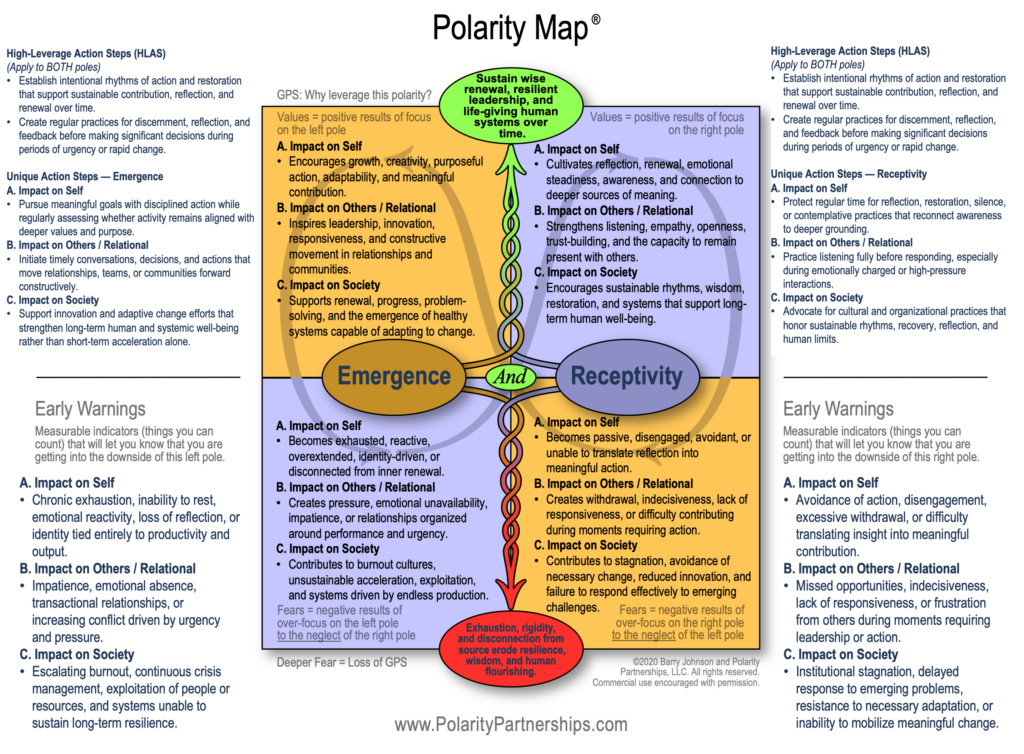
What carried Chief Mullen through that week ran deeper than procedure or training. It drew on a relationship with something steadier than the moment itself—what the Tao names as two sides of the same relationship: Emergence AND Receptivity.
Emergence gives rise to movement, creativity, and response. Receptivity creates the conditions for restoration, reflection, and renewal.
Human life requires both.
Without emergence, people and institutions can drift toward withdrawal, passivity, disengagement, or the inability to respond when action, courage, or participation becomes necessary. Without receptivity, emergence eventually becomes exhausting. Activity loses depth. Production outruns renewal. Human beings begin operating without meaningful relationship to the sources that sustain wise action over time.
Life appears to renew itself through the relationship between them.
Modern culture often trains us to associate value with accumulation—achievement, visibility, productivity, certainty, influence, expertise, and performance. Before long, identity itself can become organized around external reinforcement until reality eventually exposes how little those structures can sustain under prolonged pressure.
A more informed awareness becomes necessary in those moments.
A form of groundedness capable of remaining open without disintegrating and steady without becoming rigid.
The Tao repeatedly returns to images of yielding, spaciousness, receptivity, and emptiness because life itself appears to renew through these rhythms. Systems organized entirely around force frequently become brittle under sustained pressure. Organizations driven by endless urgency eventually lose the capacity for thoughtful response. Exhausted people struggle to hold nuance. Fear compresses perception. Relationships deteriorate into transactions. Complexity gets flattened into simplistic binaries because depleted minds often lose the ability to remain spacious enough for deeper discernment.
The Tao keeps pointing toward another possibility.
A well of all sources.
That line feels increasingly important to me. Chief Mullen didn’t hold Charleston together by himself—he drew on his officers, his faith, his family, a city’s grief counselors, and decades of relationships built long before that Wednesday night. None of us generate ourselves independently. We emerge from relationships, communities, and histories we did not create ourselves. Life depends on connection to sources beyond individual control, and the fantasy of total self-sufficiency tends to break apart under enough pressure—grief, suffering, leadership, or simply too much acceleration for a person to integrate.
This is one reason I continue returning to Gestalt theory alongside the Tao. Gestalt reminds us that awareness itself depends upon rhythm. Human beings require cycles of engagement and withdrawal, contact and recovery, action and restoration. When those rhythms collapse, awareness deteriorates. Reactivity begins replacing presence.
Barry Johnson wrote that we live inside polarities and they live inside us. Even our brains depend upon interdependent modes of perception working together rather than one dominating the other. When one mode overwhelms the other, perception itself becomes distorted. We either lose the larger pattern or lose contact with the living details inside it. (See .pdf for Chapter 11 of And Volume 1 at the end.) Exhaustion does something similar. Human beings pushed into continuous acceleration often lose the spaciousness necessary for reflection, nuance, and deeper discernment. Urgency narrows perception itself.
The Tao understood something similar long before modern psychology developed language for it.
From It, the ten thousand things.
One of the deepest paradoxes in this chapter is that emergence arises from receptivity. Modern systems frequently respond by demanding more production, more optimization, greater speed, and more extraction, even while the human capacities required for wisdom steadily erode.
Yet wisdom frequently disappears precisely when overload becomes chronic.
Without space, stillness, reflection, and recovery, human beings gradually lose relationship with depth itself.
This may become one of the defining human questions of the AI era: how do human beings remain connected to forms of renewal that cannot be accelerated?
How do leaders remain grounded while operating inside systems increasingly organized around continuous stimulation and endless response?
How do institutions preserve human rhythms inside environments rewarding perpetual availability?
The Tao does not reject emergence, action, or participation in the world. But it repeatedly warns against separation from the conditions that renew life itself.
Perhaps resilience has less to do with becoming harder and more to do with remaining connected.
Connected deeply enough that when terrible moments arrive, something within us still knows how to draw from the well that does not run dry.
Before beginnings.
After endings—
the Great Mother.
One pattern continues returning. Human beings are not machines. We cannot live indefinitely at the pace of systems that never sleep. When receptivity disappears, we gradually lose relationship with the sources that make wise emergence possible.
Most of us don’t notice this separation all at once. It arrives gradually. A little less patience. A little less curiosity. More reaction than reflection. We assume we need another technique, another strategy, another burst of effort. Sometimes the invitation is much simpler. Return to the well. Life has always renewed itself there.
Here’s a Polarity Map for Emergence AND Receptivity:
INVITATIONS:
And_V1_PEEK_C11
And_PEEK_V2_Seidler
Self-assess by taking a custom Polarity Assessment for this chapter, HERE.
To use an “AI-trained Chat w/Cliff for Step 1, Seeing” CLICK HERE.
Ready for the Polarity Advantage? Go deeper into Polarity Thinking, see our online self-directed Credentialing and Introduction to Polarity Practice or in-person training with Barry Johnson and me at Kayser Ridge by CLICKING HERE.