

See the Series Introduction for Just Tao It, Part I: HERE
See the Just Tao It Series Introduction Tao/It on-ramp, PART II: HERE
See Just Tao It, Chapter 1: HERE
From my interpretation of the Tao Te Ching, Chapter 45 (Unpublished):
So perfectly there,
It looks ever-partial.
So completely full,
It looks hollow —
Yet giving
Without end.
So faultlessly straight,
It looks ever-bent.
So greatly skilled,
It looks unpracticed.
So eloquent and clear,
It sounds like a stammer.
Its movement meets the cold,
Its stillness meets the heat.
Being with It
In each season,
Clarity opens
To all creation.
—
I had been working on this chapter for weeks when a conversation with Dr. Thomas Schumacher blew its focus wide open. Thomas is a strategic partner in Germany whose work with technology organizations places him directly at the intersection of AI and human systems. We were preparing related materials when our conversation turned toward artificial intelligence, decision-making, and what organizations—and humanity more broadly—do not yet understand about what we are creating.
Somewhere in that back-and-forth, I said that humanity feels a little like the cat in Schrödinger’s famous thought experiment. A cat is sealed inside a box with its fate connected to a quantum event. Until the box is opened, the mathematical description holds two incompatible possibilities together: the cat is alive AND dead.
We are living inside a condition whose possibilities have not fully resolved. AI may contribute to extraordinary advances in health, learning, creativity, accessibility, and human coordination. It may also weaken human agency, overwhelm institutions, deepen manipulation, and contribute to conditions we do not yet know how to reverse.
I was reaching for an image large enough to hold the uncertainty. We are creating something powerful while learning what it is, what it can become, and what it is already doing to us. Even the people closest to the technology cannot see all of its future uses, interactions, incentives, or consequences. In an important sense, humanity is entering the age of AI from a condition of Unconscious Incompetence. We do not know what we do not know. Some of what we do not know may matter enormously.
Another phrase surfaced in our conversation: whistling past the graveyard. Thomas seemed to resonate with it. The expression describes making noise in the dark to keep fear at bay—projecting confidence while passing something we would prefer not to examine too closely. Some of our public certainty about AI carries that quality. We speak confidently about what it will do while remaining far less certain about what it is already changing, what we may be surrendering, and who will be accountable for what follows.
Chapter 45 arrived differently after that conversation. Its images are ancient: fullness that looks hollow, skill that looks unpracticed, eloquence that sounds like a stammer. They speak directly into a moment when polished answers can be produced in seconds and apparent competence can travel much faster than the understanding required to evaluate it.
“Don’t judge a book by its cover” is familiar enough to become invisible. Chapter 45 restores its force. We often judge mastery by its cover: fluency, certainty, speed, vocabulary, credentials, confidence, and the ability to command a room. The Tao asks us to look again. What is complete may appear partial. What is full may look hollow. Great skill may carry no need to perform itself. The person closest to the truth may speak with care because the truth is larger than the sentence.
Appearance AND Essence name the tension running through these images. Appearance matters. It helps us recognize, communicate, and respond to what is present. Essence carries the substance beneath the presentation. Trouble begins when appearance becomes our primary evidence of essence. A polished cover can conceal an empty book. A worn cover can carry a lifetime.
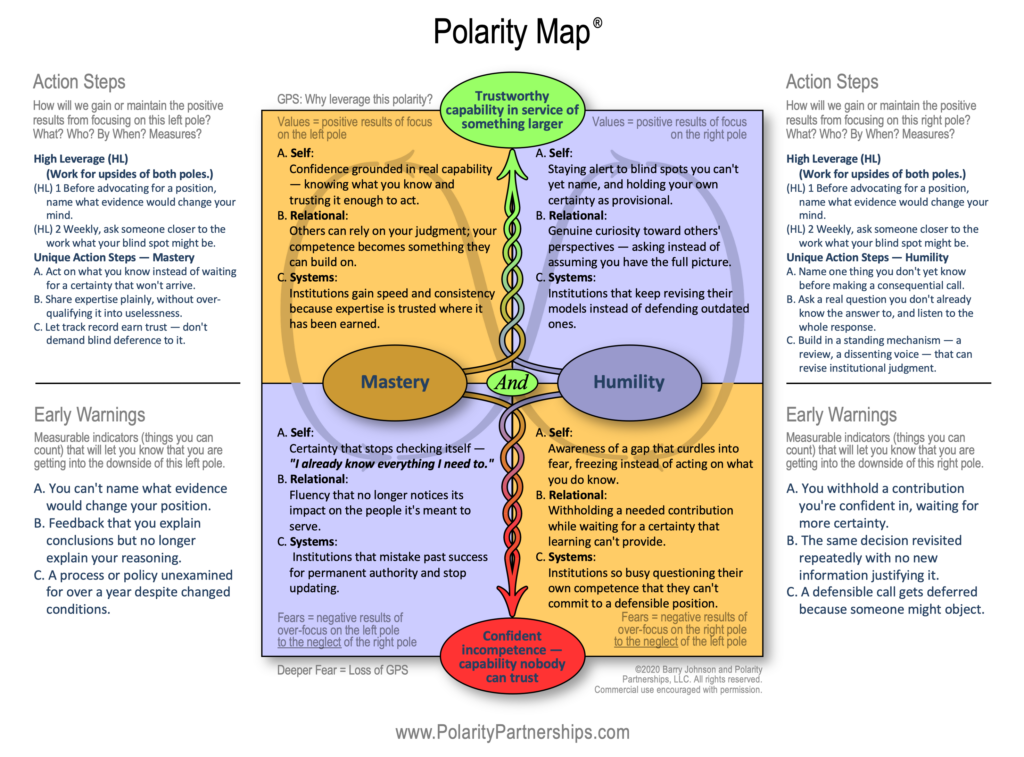
The relationship I hear beneath that tension is Mastery AND Humility. Mastery develops the capacity to see, choose, and act well. Humility keeps that capacity receptive to what remains unseen. Mastery without Humility can become certainty that no longer checks itself. Humility without Mastery can become self-doubt that withholds a needed contribution. Together they allow us to offer what we know while remaining available to what may change it.
Psychologists Justin Kruger and David Dunning gave modern language to one part of this pattern. In their 1999 study, people who performed poorly on tests of logic, grammar, and humor substantially overestimated their performance. Their explanation was as consequential as the finding: some of the knowledge required to perform well is also required to recognize that one has performed poorly.
The popular Dunning–Kruger curve often turns this into a cartoon: the fool at the peak of confidence and the expert bowed beneath doubt. The original work is narrower and more useful. Limited skill can also limit our ability to recognize our limitations. Learning changes what we can do and what we can see about our doing.
Contemporary leadership offers no shortage of people who learned the vocabulary on Tuesday and were explaining the universe by Thursday. Confidence travels well on camera. Competence takes longer, asks more questions, and rarely arrives with its own theme music. We have also created cultures in which admitting uncertainty can look weaker than being confidently wrong. The pattern extends beyond the person at the microphone. Audiences, organizations, markets, and media systems frequently reward the performance.
Chapter 45 offers a philosophical mirror. “So completely full, it looks hollow” describes the spaciousness that can accompany real depth. The more someone learns, the more visible the surrounding field of uncertainty may become. “So greatly skilled, it looks unpracticed” points toward capability that has become integrated enough to shed performance. “So eloquent and clear, it sounds like a stammer” honors the pause of someone weighing complexity before turning it into words.
Hesitation doesn’t prove wisdom. Confidence doesn’t prove ignorance. Covers provide information without revealing the whole. Discernment requires more than reversing the judgment and assuming that the least polished person must be the master. It asks us to remain interested in the relationship between what is displayed and what is there.
The familiar learning sequence begins with Unconscious Incompetence: I do not know what I do not know. Conscious Incompetence follows when I can see the gap. With practice comes Conscious Competence: I know what I know and can apply it deliberately. Over time, some knowledge becomes Unconscious Competence: in flow, I know.
The sequence is often drawn as a ladder toward mastery. My experience is closer to a cycle. Every new capacity exposes another frontier. Expertise in one domain can leave us newly unaware in an adjacent one. Conditions change. What once worked becomes insufficient. Competence must remain open to learning.
In a Polarity Map I have used for this learning process, the Poles are Productive Incompetence AND Productive Competence. Productive Incompetence allows us to recognize what we do not know and remain aware of blind spots we cannot yet name. Productive Competence allows us to use what we know and enter the flow of practiced capacity. The High-Leverage practices are simple and demanding: be Confident AND Humble; be Curious AND Listen.
Productive Incompetence AND Productive Competence describe the learning process. Mastery AND Humility describe the posture that helps us leverage it wisely. One follows how competence develops. The other asks who we become as it develops.
The map gives me language for the process. Chapter 45 gives me the image I am less likely to forget. The person furthest into mastery may remain the most aware of the surrounding unknown. The person performing certainty may simply have reached the place where a little knowledge feels completely full.
Jim Collins encountered a related pattern in the leaders associated with the good-to-great transitions he studied. He described Level 5 Leadership as a combination of Personal Humility and Professional Will. These leaders carried ambition, discipline, and resolve while directing that energy toward a cause or organization larger than themselves.
The connection to Chapter 45 feels direct. Level 5 capacity may look less impressive on the surface because it does not need the leader to remain at the center. Will gives Humility force. Humility gives Will perspective. The work advances while the person leading it remains capable of learning, sharing credit, and facing evidence that complicates a preferred conclusion.
Mastery AND Humility is broader than leadership, yet Collins gives us a recognizable organizational expression of it. Capability becomes more trustworthy when it is paired with an honest relationship to limitation.
AI complicates the relationship among appearance, essence, competence, and confidence. A novice can now produce work with the surface features of expertise before developing the judgment required to assess it. An expert can use the same capability to extend research, test alternatives, translate knowledge, and perceive patterns that would otherwise take months to find. The output may look equally polished. The difference lives in the questions asked, the sources examined, the assumptions surfaced, the consequences considered, and the responsibility retained.
Our conversation brought me back to the Ladder of Inference, developed through the work of organizational theorist Chris Argyris and later popularized by Peter Senge. Picture an actual ladder. You begin on the bottom rung with observable data—the events anyone in the room could see. Climbing from there, you select certain data, add meaning to it, form assumptions, draw conclusions, adopt beliefs, and act. Most of us climb that ladder in seconds without noticing the climb. A colleague does not respond to your idea in a meeting, you decide it means she disagrees, and by the end of the day you have told two other people she is difficult to work with. None of it required a lie. Each rung simply narrowed what remained visible from the one below it.
With AI, some of that climb can happen before a human enters the process. A system selects, retrieves, weights, summarizes, interprets, and recommends. The human receives a conclusion dressed up as observable data—it looks like the bottom rung when it is really close to the top.
The Ladder has not disappeared. Its lower rungs have become harder to see. What data entered? What was excluded? Which instructions shaped the response? What patterns came from the model, the training material, the organization, or the person writing the prompt? A fluent answer can move us from uncertainty to action before we have noticed how the decision was framed.
Inquiry AND Advocacy becomes essential here. Advocacy allows us to state a position, make reasoning visible, and act. Inquiry asks what the position rests upon, what it excludes, and what evidence would change it. AI can support both. It can generate a clear recommendation, and it can help test that recommendation from multiple perspectives. Human beings remain responsible for ensuring that inquiry is more than a ritual performed after closure has already occurred.
Niklas Luhmann’s work offers another way to understand what happens when uncertainty meets decision. Organizations cannot keep every possibility open. A decision absorbs uncertainty by turning one contingent choice into a premise upon which other choices can be built. The system can move because something has become stable enough to plan around. This brings Openness AND Closure into view. Openness allows us to question the frame, consider alternatives, invite dissent, and revisit a decision as conditions change. Closure allows commitment, coordination, accountability, and action.
AI can intensify the downsides of either Pole. It can produce endless analysis, keeping us in perpetual reconsideration. It can also produce an answer so quickly and persuasively that a genuinely undecidable question is mistaken for a calculation. Luhmann’s lens leaves me with three questions worth carrying into every consequential AI-assisted decision:
1) What future decisions does this enable?
2) What future decisions does it foreclose?
3) What evidence would lead us to reopen it?
Historian Yuval Noah Harari has placed this learning challenge on a civilizational scale. In Nexus, he examines AI as non-human intelligence entering the information networks through which human beings create institutions, authority, cooperation, and shared reality. His warning reaches beyond individual mistakes. AI-generated fictions could become part of the cultural environment within which future generations decide what is true.
Harari’s concern is existential, and he also refuses technological determinism. The future remains influenced by choices we are making now. That combination matters. Alarm without agency can produce paralysis. Confidence without humility can produce recklessness. The scale of the risk asks for seriousness AND the continued belief that wiser action remains possible.
Humanity’s present Unconscious Incompetence is therefore neither an accusation nor a reason for despair. It is a starting condition to recognize. Productive Incompetence allows us to admit that the downstream effects exceed our present knowledge. Productive Competence allows us to use what we already know about governance, safety, human development, systems, ethics, learning, and interdependence. Mastery AND Humility allow both to remain in relationship.
Chapter 45 closes with Movement AND Stillness. Its movement meets the cold. Its stillness meets the heat. Wisdom appears as responsiveness to conditions, free from attachment to one preferred response.
Our encounter with AI will require movement: experimentation, learning, collaboration, governance, and the development of capabilities equal to the moment. It will also require stillness: the capacity to interrupt acceleration, examine what is shaping our attention, recover the rungs of inference, and remain present to consequences that speed can conceal.
Chapter 45 keeps appearance in perspective. Ignorance carries real consequences, and incompetence deserves honest recognition. Real fullness can retain space. Real skill can remain available to learning. Real eloquence can pause before complexity. Real mastery can carry humility without losing its will.
Humanity presently displays a cover of technological mastery. We can build systems that speak, generate, predict, persuade, and increasingly act. Chapter 45 directs my attention toward the book still being written beneath that cover: whether our wisdom, restraint, courage, and capacity for relationship will develop alongside our power.
Being with It in each season leaves what comes next uncertain. It can help us remain teachable while we participate in creating it.
Where are you mistaking the appearance of competence for its substance? Where might greater mastery ask for greater humility?
Here is the related Polarity Map for Mastery AND Humility:
INVITATIONS:
To use an AI-trained “Chat w/Cliff” for Step 1, “Seeing” CLICK HERE.
Ready for the Polarity Advantage? Go deeper into Polarity Thinking, see our online self-directed Credentialing and Introduction to Polarity Practice or in-person training with Barry Johnson and me at Kayser Ridge by CLICKING HERE.