


See the Series Introduction for Just Tao It, Part I: HERE
See the Just Tao It Series Introduction Tao/It on-ramp, PART II: HERE
See Just Tao It, Chapter 1: HERE
From my interpretation of the Tao Te Ching, Chapter 55 (Unpublished):
The wise are like newborns.
Without fear,
They trust.
Their bodies,
Soft and agile,
Their grip,
Remarkably powerful.
Unaware of desire,
They remain whole.
They can cry all day
Until the need gives way,
Their voices
Seldom growing hoarse.
They live harmoniously,
They embody
Simple power.
Rooted simply
In being
Who they are.
—
The Tao Te Ching offers guidance for living and leading. In Chapter 55, Lao Tzu begins with a newborn. He places the child at the source of the teaching: soft-bodied and unguarded, with a remarkably powerful grip; able to cry until a need is expressed, then release fully into rest. The child embodies vitality, harmony, and inner power.
Lao Tzu was speaking to adults, including those entrusted with authority. He asks them to learn from a being with no title, status, strategy, or capacity to command—fully present, unmistakably alive, and powerful without performance.
My friend and colleague Riet Portengen has spent decades working with children and families in the Netherlands, including within child protective services. When Riet speaks about what children already know, she speaks from years spent listening to them.
A number of years ago, Riet introduced her young niece Marenka to the idea of Polarity Thinking. Marenka was about six or seven. After explaining the basic concept, Riet asked a simple question: What polarity do you see?
Most adults reach first for something from their own world—leadership, organizations, political divisions. Marenka looked up and said: Sun and Moon.
She explained that the Sun helps things grow. The Moon lets things rest. You need both. She had noticed something true and said it aloud, the way a child says a thing she already knows. Flowers, tides, and seasons participate in ongoing relationships.
Riet begins where Lao Tzu does: with wisdom already present in the child. She gives that wisdom language, attention, and conditions in which it can remain alive.
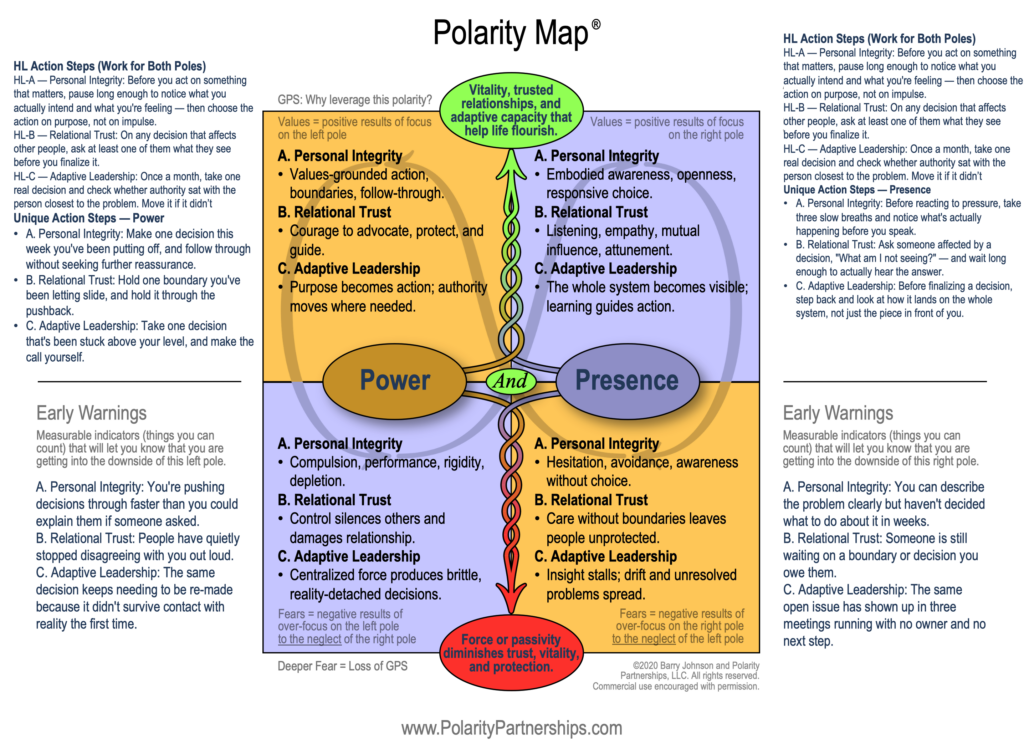
The newborn in Chapter 55 carries Power AND Presence in the same body, at the same time. Its grip is powerful—strength enough to hold on, cry out, and insist on being fed. Its whole manner is rooted in being who it is: trusting, unguarded, and fully present.
Anyone who has spent time with a newborn also knows that small size is a poor measure of influence. Meals move. Sleep disappears. Conversations stop in mid-sentence. A being weighing eight pounds becomes chair of the household without reading a single leadership book.
Adults hold most of the formal power in the relationship. They control the schedule, food, transportation, money, and rules. Children still influence them beyond anything those arrangements would predict. Their needs interrupt plans. Their questions expose contradictions. Their presence rearranges what we thought mattered.
Parenting is one of life’s most dependable encounters with adult hypocrisy. “Use your words,” we say while barely speaking to someone we are angry with. “Be patient,” we insist as we hurry a child out the door. “Calm down” sometimes arrives with a volume and intensity that make the instruction especially memorable.
Adults teach children how to survive in the world. Children reveal where survival has hardened into habit. Adults offer boundaries, discernment, memory, and protection. Children bring trust, openness, play, and an astonishing capacity to begin again after falling. Each influences the other, often without a lesson plan.
Power protects, guides, establishes boundaries, and acts. Presence listens, notices, receives influence, and responds to the life in front of us. Power without enough Presence can silence the intelligence an adult claims to be developing. Presence without enough Power can leave a child without needed guidance and protection. Children need adults who can hold a boundary and remain influenceable inside it.
The Polarity Fun Foundation grew from Riet’s recognition that children often see interdependence intuitively. One kit invites them to build a kite while discovering the relationships that let it fly—pull and give, structure and wind. Its shape echoes the Polarity Map. Marenka is now an adult working in healthcare in the Netherlands and serving on the Foundation’s Board and Management Team, helping preserve that way of seeing for other children.


There is something deeply Taoist in Riet’s legacy. She approaches children as bearers of wisdom already moving through them. Adults teach, protect, and provide structure. They also learn to recognize what is already there.
Here is Riet receiving a rarely awarded Dutch civilian medal in recognition of her lifetime of achievement and dedication to children’s well-being.

Archetypes offer another view of this journey. The Innocent carries optimism, trust, hope, and simplicity. The Orphan brings realism, caution, resilience, and the knowledge that painful things happen. Innocent AND Orphan each carry gifts and shadows. Innocence without experience can become naivete or denial. Experience without renewed innocence can harden into cynicism and suspicion.
I have some standing to speak about the extended adolescence of the Innocent. I seem to have required a generous amount of remedial coursework in Idealism AND Realism. My optimism has helped me imagine and create things that sober judgment alone might never have attempted. It has also occasionally treated warning signs as decorative scenery.
Maturing has meant keeping trust and wonder in relationship with my capacity to assess risk, test assumptions, count the cost, and accept what reality is saying. Some of my best work exists because the Innocent remained alive. The work has been to help him grow companions.
Years ago, I began using retired Army General Stanley McChrystal’s Team of Teams in my teaching at American University’s KEY Executive Leadership Programs. Senior leaders recognized highly capable institutions confronting conditions their established habits could no longer master. Technical expertise, efficiency, hierarchy, and control had produced extraordinary results. Complexity exposed their limits when applied without adaptability.
McChrystal described Shared Consciousness AND Empowered Execution: broad visibility and common purpose working with authority distributed closer to the action. His leader-as-gardener captures Power AND Presence beautifully. The gardener shapes conditions, tends boundaries, and intervenes when needed while watching, listening, and working with life that has intelligence of its own.
Using Team of Teams significantly accelerated conversations with senior leaders about the limits of Technical Either/Or thinking when applied to Adaptive Both/And realities. Technical competence remained essential, held with trust, transparency, experimentation, shared purpose, and local judgment. Power gained reach through Presence. Presence gained consequence through Power.
Jim Collins found a related pairing in Level 5 leaders: Professional Will AND Personal Humility. Their humility made room for others; their will appeared in relentless follow-through. Capability could remain unassuming and consequential.
These modern expressions extend Lao Tzu’s lesson. Living and leading well require strength that can stay soft, authority that can receive influence, and action grounded in attention. Power and Presence strengthen one another when their relationship remains alive.
The closing movement of the ancient chapter warns against forcing life. When vitality is driven beyond its natural course, harmony becomes strain. What is pushed toward excess begins to age before its time. This is true of bodies, ambitions, relationships, institutions, and children whose lives adults sometimes attempt to engineer into evidence of successful parenting.
Riet has a way of gently reminding us adults about something we spend a long time finding we need to relearn. A child can be helped to keep a natural perception of interdependence, and the help travels in both directions. The parent gets taught by a two-year-old’s refusal to be rushed. The leader gets taught by the one plain question asked in a room full of careful ones. Maturity widens the circle around that early perception and carries it forward.
Marenka is grown now, and she still looks up. Somewhere tonight, a newborn is gripping a finger with everything it has and will let go just as completely when it is time to sleep—a power that endures without hardening, held by someone too young to know there was ever a choice to make.
Soft body.
Strong grip.
Open heart.
Capable hands.
Power AND Presence.
Simple power.
Here is the related Polarity Map for Power AND Presence:
INVITATIONS:
To use an AI-trained “Chat w/Cliff” for Step 1, “Seeing” CLICK HERE.
Ready for the Polarity Advantage? Go deeper into Polarity Thinking, see our online self-directed Credentialing and Introduction to Polarity Practice or in-person training with Barry Johnson and me at Kayser Ridge by CLICKING HERE.