

See the Series Introduction for Just Tao It, Part IHERE
See the Just Tao It Series Introduction Tao/It on-ramp, PART IIHERE
See Just Tao It, Chapter 1HERE

From my interpretation of Chapter 66 of the Tao Te Ching (Unpublished):

Streams and rivers
flow down
to valleys.

Valleys hold
the sea
by staying low.

Those who stay low
stand not above.

So they lead
without standing over.

And in this way
trust flows.

Water never tries to convince anyone it should flow downhill. It just does it.

My mentor, Barry Johnson, once told me about one of his mentors, Jack Gibb, who spent much of his life studying trust and wrote a book by that title, Trust: A New View of Personal and Organizational Development. (SEE Wiser Decisions Series on TRUST.) Jack eventually reached a conclusion that surprised a lot of people. If there is enough trust in a system, people don’t even need leaders. The system simply flows. People see what needs doing and step in. Responsibility moves where it’s needed. Leadership appears and disappears naturally. No announcements required.

When Barry first shared that with me, the idea stayed in the back of my mind for years before I recognized how deeply it connects with what the Tao Te Ching has been pointing to for centuries. The text describes rivers and seas becoming rulers of the valleys precisely because they stay low. By not placing themselves above others, they become the place where everything gathers.

It’s a simple image, but it captures something I’ve watched play out in organizations for decades. Standing over people may produce compliance for a while. Standing with people creates the conditions where trust begins to grow. And trust, it turns out, changes everything about how systems actually work.

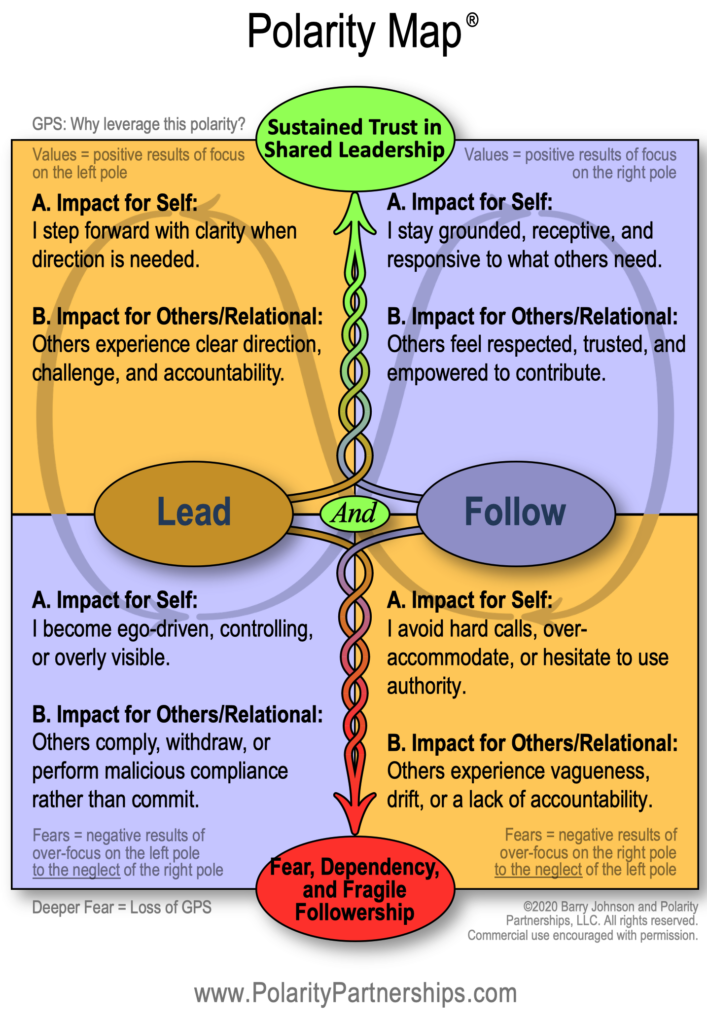
Once you begin seeing systems through the lens of polarity thinking, the pattern becomes easier to recognize. Human systems live inside tensions that cannot be solved once and for all but must be leveraged over time. One of the most important is Lead AND Follow.

Lean too far toward Leading to the neglect of Following and authority hardens into domination. Lean too far toward Serving to the neglect of Leading and responsibility dissolves into avoidance. Healthy systems move between the two.

In polarity work we often describe the outcome we’re trying to sustain as the GPS—the Greater Purpose Statement. The GPS names the meaningful result that becomes possible when the strengths of both poles reinforce each other over time. A polarity is not a problem to solve but an interdependent system to steward. When the upsides of each pole support the other, the system produces something neither pole could generate alone.

Trust turns out to be the GPS for several of the most important polarities in human systems. Trust sits at the center of Competence AND Character. It sits at the center of Power AND Love. It also sits at the center of Lead AND Follow. When trust is strong, these tensions reinforce one another and the system becomes more capable over time. When trust erodes, the same tensions begin producing suspicion, friction, and breakdown.

Barry Oshry’s work on systems adds another layer to this understanding. He observed that every human system expresses two fundamental energies: Power and Love. Power differentiates; it encourages initiative, independence, and movement. Love integrates; it fosters connection, coordination, and shared purpose. Systems need both. When Power expands to the neglect of Love, competition becomes corrosive and people begin protecting themselves rather than serving the whole. When Love expands to the neglect of Power, the system drifts toward sentimentality and groupthink. Either way, trust erodes.

And here’s where this gets especially relevant right now.

As organizations integrate artificial intelligence into leadership and decision-making, we’re seeing a familiar pattern emerge. AI excels at the Lead pole—directing workflows, optimizing processes, executing at scale with precision and speed. What it cannot do is Serve—reading the room, sensing when trust is fraying, knowing when stepping back creates better conditions than pushing forward, discerning when the moment calls for someone else to step in.

I’ve watched organizations deploy AI management tools that track productivity, assign tasks, monitor performance, flag inefficiencies. Everything gets more efficient. And quietly, trust starts eroding. Not because the AI is bad at leading. Because the system optimizes for leadership without asking whether it’s serving what people actually need.

The capacity to sense when authority should circulate, when someone else is better positioned to act, when the moment calls for stepping back rather than stepping in—that’s still deeply human. And it’s disappearing from systems that treat leadership as a technical problem to solve rather than a relational capacity to develop.

Trust grows through the steady interaction of Competence AND Character. Competence matters because people need confidence that those around them can handle what the moment requires. Character matters because people need confidence that power will be used responsibly. When both develop together, trust accumulates and the system begins to change. People stop waiting for instructions. They begin acting because they know others will act responsibly as well. Leadership circulates rather than concentrating in one place.

You can’t build systems where trust flows without developing the people inside them. The capacity for presence, discernment, character—what we might call Inner Development—has to grow alongside the systems we’re asking those people to navigate. And you can’t sustain that development in people without designing structures that honor both leadership and service, both power and connection—the Outer Impact, the work that actually gets done in the world. Part AND Whole. Both required. Both over time.

The absence of trust produces a very different pattern. When power is misused, compliance often replaces commitment. One of the most revealing symptoms of that breakdown is something many organizations know all too well: malicious compliance. People follow instructions exactly as given while quietly withdrawing their judgment, creativity, and care. On the surface everything appears orderly. Beneath the surface the system is weakening. Malicious compliance is not a sign of discipline. It is a signal that trust has already been damaged.

Another signal appears when leaders begin demanding loyalty rather than earning it. Loyalty tests emerge. Time and energy are spent proving allegiance instead of solving problems. Entire organizations can become absorbed in demonstrating who is loyal enough and who is not. The irony is that these efforts almost always produce the opposite of what they claim to protect. Loyalty that must be constantly tested is not loyalty at all. It is fear wearing the costume of commitment, and it drains enormous energy from the system while steadily undermining trust.

Over the years I’ve also noticed something else. When I see a leader making themselves visible everywhere, all the time, flags start flying in my mind. That leader clearly believes the story is about them. The spotlight becomes the goal. That pattern is almost always driven by ego and rooted in insecurity. When those traits combine with a lack of character, everyone around them eventually pays the price. Systems built around that kind of leadership become fragile very quickly.

The systems that function best tend to show a different pattern. Leadership is present, but it does not dominate the stage. Responsibility moves throughout the group. People step forward when the moment calls for it and step back when someone else is better positioned to act. The work progresses because people trust one another enough to take initiative.

Jack Gibb’s observation begins to make even more sense in that light. When trust crosses a certain threshold, leadership no longer needs to push the system forward. The system moves. People see what needs doing and do it. Authority circulates. Responsibility becomes shared.

Ancient wisdom captured this pattern in a line that has echoed across centuries: The best leaders are those whom people barely notice. When the work is done, the people say, “We did it ourselves.”

That statement signals something profound. Leadership succeeded not by drawing attention to itself but by building the conditions where collective capability could flourish.

This insight also helps explain why democracy, despite all its imperfections, remains one of humanity’s most remarkable governance experiments. Democracy assumes that power must circulate rather than concentrate permanently in one place. Citizens must both lead and serve at different moments if the system is to remain healthy. When the system works well, people participate actively and responsibility moves throughout the community. When trust erodes, power begins consolidating again and the system weakens.

The ancient image of water still captures the pattern best. Rivers do not argue about where they should flow. They follow the shape of the land. Over time they carve mountains, nourish valleys, and sustain life along their banks. The lowest place becomes the gathering place.

Leadership, viewed through that lens, has less to do with standing above others than with creating the conditions where trust gathers. When that happens, people begin acting together in ways that no single leader could orchestrate.

Those are the decisions that hold. Not because someone forced them. Because the system trusted itself enough to act. Not just once, but when conditions shift, when pressure increases, when what seemed certain becomes uncertain. That’s what makes decisions wise—not that they worked perfectly the first time, but that they continue to work as reality changes.

And when the work is done, the most satisfying outcome is hearing the people say, without hesitation, “Look at all this—done together, by us.”

That’s leadership that stands the test of time.

Here’s a Polarity Map to help see the pattern:
INVITATIONS
Use an “AI-trained Chat w/Cliff for Step 1, Seeing, CLICK HERE.

Take a quick self-assessment for Lead And Follow CLICK HERE
NOTE: the results include Leveraging Action Steps and Early Warnings (to support maximizing upside benefits and minimizing downside limitations).

Go deeper into Polarity Thinking? See our online self-directed Credentialing and Introduction to Polarity Practice, CLICK HERE.

Ready for the Polarity Advantage? Check out our online self-directed Basics, Credentialing, or in-person training with Barry Johnson and me at Kayser Ridge!   Certifications and Courses