

Seeing AND Using the Energy System of Polarities
I first learned about rip currents when my family moved from Wheaton, Illinois to Sarasota, Florida during high school. Rip currents form where waves break onto the shore from opposite directions and the returning water finds a narrow channel back out to sea. From the beach, the surface often looks calmer than the water around it. That is part of what makes them so dangerous. The flow is real. The danger is real. And almost everything that makes a rip current lethal happens inside the swimmer who does not know how they work or how to respond when caught in one. Fighting a rip current is the instinctive response — and the fatal one.
When the pull catches you and you realize you are heading out to sea, the impulse is completely logical. Swim back toward shore. Swim harder. Swim faster. Try to overpower the situation with effort. That impulse drowns even strong swimmers. Fighting the current exhausts the swimmer faster than the current ever could.
Surfers who know how rip currents work do something different. They do not fight them; they use the energy. They ride the current out to where the swell is forming, exit at the right moment, and let the same energy that drowns inexperienced swimmers carry them back in to catch the next wave. The current is no longer an enemy. It is a conveyor belt the surfers play inside.
This piece is about a different kind of current — the one most leaders, most citizens, most institutions, most of us, on most days, fight without recognizing.
I call it the Hooked-and-Stuck dynamic. Barry Johnson formalized it as Reality 51 in the Polarity Realities, kindly crediting me for describing the pattern — a generous attribution from a generous teacher. The deeper truth is that the dynamic itself was already alive in his work and in the work of the community of polarity practitioners going back decades. What I contributed was a vocabulary — How We Get Hooked and How We Get Stuck — for what I had experienced inside myself, and witnessed in the leaders and teams I coached, for years. Once the language existed, the pattern became easier to see in time to do something about it.
My hope for this piece is to provide a reference that dynamic across other Cliff’sNOTES, and my Just Tao It and Wiser Decisions series.
A Note Before We Begin
You may want to read what follows as a description of someone else — a leader you have worked with, a public figure, a member of your family. That reading is useful. It is also incomplete.
The Hooked-and-Stuck dynamic is universal because it is built into how the human nervous system processes value, fear, and choice. There is nothing inherently wrong with holding a value strongly. Three things are worth knowing about a strongly held strength before reading further.
First. Strengths come in pairs. There is an interdependent strength to every strength. Activity needs Rest. Clear needs Flexible. Certainty need Inquiry. Freedom needs Authority. The pair is not a problem to solve. They are energy systems we live in, work in, and live inside us.
Second. The greater your value for a preferred strength, the greater your vulnerability to getting hooked and stuck in the downside of that strength. The value/fear coupling is the engine. The stronger the engine, the more carefully it must be understood.
Third. With some knowledge of Polarity Thinking and how polarities work, you can be more like a surfer and less like someone exhausting themselves swimming against the energy. The current does not change. Your relationship to it does.
I have been hooked many times. I have been stuck many times. I am writing this from inside the experience, not from outside or somewhere above it.
PART 1 — THE PATTERN
The Pattern, Plain
Every polarity has two upsides and two downsides arranged in an infinity loop. The upside of one pole pairs with the downside of the opposite pole across a diagonal. Activity (upside of one pole) pairs with Laziness (downside of the other pole) across one diagonal. Rest (upside of the other pole) pairs with Burnout (downside of the first) across the second diagonal.
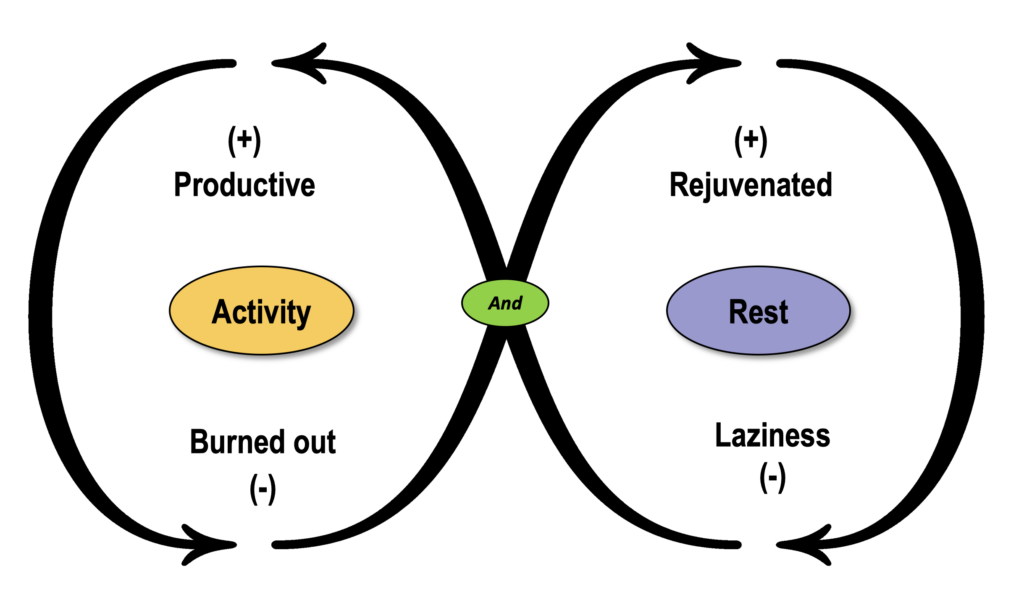
Whatever upside you value strongly, you fear the loss of equally strongly. The stronger the value, the stronger the fear. The reverse holds too. This is the predictable pattern in the way all polarities work — Reality 50 in Appendix C of And: Volume 1: Foundations. It is also lived. You already know which value you would defend hardest, and you already know which downside makes your stomach tighten when you imagine living inside it.
That value/fear coupling forms a diagonal across the polarity map. When the diagonal is powerful and Or-thinking gets layered on top of it, the diagonal becomes the entire world. The mind stops asking, “Activity AND Rest, in what proportion, for which conditions, in service of what?” and starts asking, “Activity VS Rest” or Activity OR Rest?” For a strong preference for Activity, the answer is of course always Activity. There is no real choice. There never was. The diagonal makes the answer feel inevitable.
This is the beginning of the hook. It is not a moral failure. It is not a thinking error of the ordinary kind. It is a structural feature of how a strongly held value pair, combined with Or-thinking, organizes perception. It happens to me. It happens to you. It happens to entire institutions. It happens to nations.
Reality 51: A powerful value/fear diagonal, combined with Or-thinking, hooks us by a false choice between the poles. We become blind to the other value/fear diagonal and over-tolerate the downside of our valued pole. We then get stuck there — unable to access the upside of the pole that is feared.
The Diagonal You May Not See
Once hooked, something specific happens to perception. You become blind to the other diagonal.
The Rest upside — recovery, integration, sustainable performance, long capacity — becomes invisible. Or it stays technically visible while losing its weight, its felt reality, its claim on your attention. Yes, you say, Rest is important. And then you continue to operate as if it isn’t.
The Activity downside — errors, exhaustion, brittle relationships, diminishing returns — becomes invisible the same way. You see it; you rationalize it away. “It’s not that bad.” “We’ll address it after the deal closes.” “Most of those people would have left anyway.”
This selective blindness is what makes Hooked-and-Stuck so durable. The information that would correct your course is in the field, available, often being spoken aloud by people who care about you. You cannot use it. The blindness is not about access. It is about which inputs the hooked perception will allow to land.
That selective blindness is also what makes the dynamic so hard to recognize from the inside. You do not experience yourself as blind. You experience yourself as someone who has thought about it carefully and arrived at the right answer.
Projection: Where the Downside Goes
Then a second thing happens. Because the downside of your pole IS accumulating — the team IS exhausting itself, the system IS fraying, the consequences ARE landing somewhere — the energy of that downside has to go somewhere. It cannot land on you, because you are committed to your valued pole. So it lands on someone else.
You project the downside onto a category of people, and you negate the upside of the opposite pole at the same time.
The leader hooked on Activity sees Laziness everywhere — in team members who ask for recovery time, in colleagues who take vacations, in cultures that protect rest.
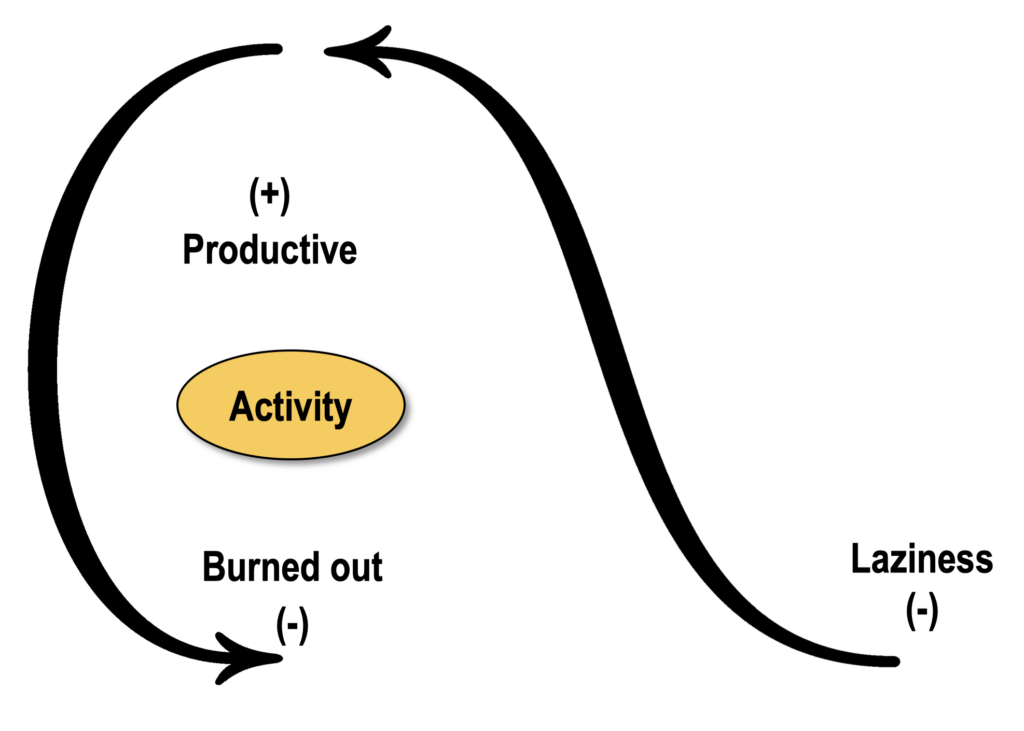
The same dynamic operates in reverse. The leader hooked on Rest — running from the fear of Burnout — sees task-masters and grinders everywhere, projects exploitation onto anyone advocating for momentum, and over-tolerates the downsides of complacency in the name of protecting people from harm. The hook can land on either side of the polarity. The mechanism is identical.
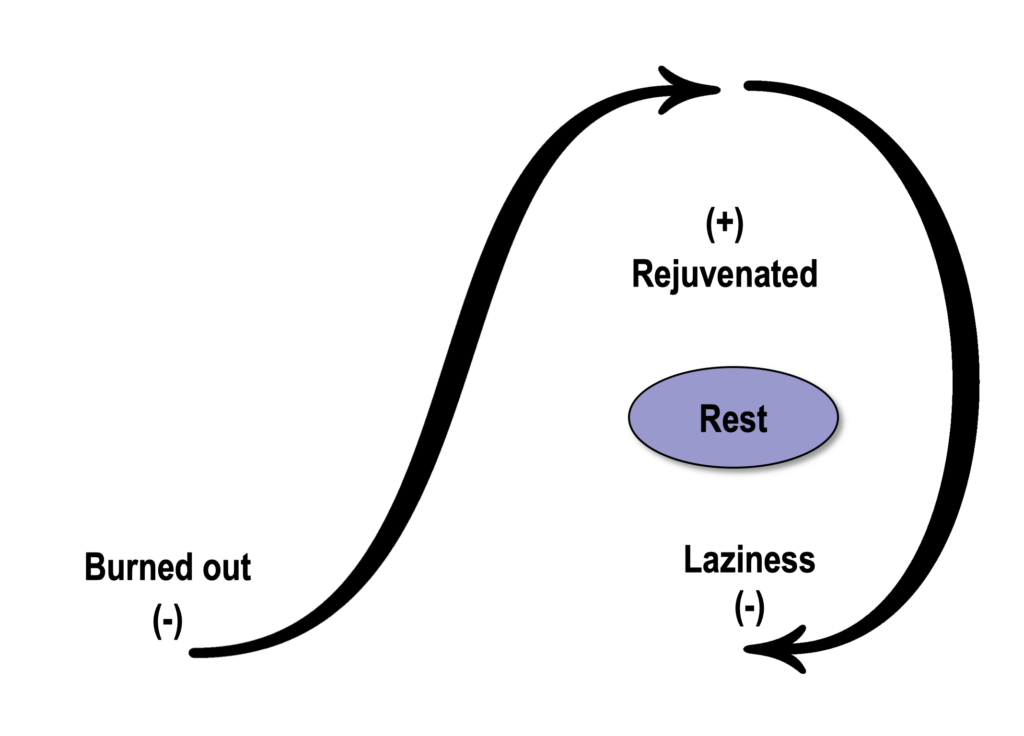
The leader hooked on Clear sees Chaos everywhere — in subordinates with initiative, in adaptive teams, in any process that is not centralized. The leader hooked on Certainty sees Confusion everywhere — in dissenters, in inquiry, in the slow work of admitting one does not yet know.
When the dynamic moves from the individual into the political, the projection scales. Whatever pole a hooked group fears most, they will see embodied in the people advocating for that pole. The fear gets a face. The face gets demonized. The advocate becomes the enemy. The benefits of the pole the advocate is offering become invisible. We deflect — it is “not as bad” as they are saying, or it is “fake news.” The contempt becomes a kind of certainty that feels indistinguishable from clarity.
This happens on the Right and on the Left. In red states and blue states. In conservative and progressive movements. Inside organizations, inside families, and inside individual nervous systems. The mechanism is identical. Only the poles change.
The Mirror: Two Naïve Complainers
Here is the harder recognition, which I owe to Barry’s account of his own early years as a change agent. When two groups are both hooked on opposite poles of the same polarity, each side sees the other as a “naïve complainer.” The advocates for the upside they value see the resistors as naïve about what the future requires and complaining about losing what should be relinquished. The resistors see the advocates as naïve about what the past has given them and complaining about something that is actually working.
Each side sees the other as the problem. Each side sees itself as the solution. Each side is partly right and partly blind. The dysfunction is not in either party. It is in the polarity treated as a problem to solve.
When I introduced the language of Hooked-and-Stuck into leadership work, this mirror was the part that landed hardest for the leaders I was coaching. They could often see the diagonal. They could sometimes see the over-tolerated downside of their own pole. The piece that broke the dynamic open was recognizing that the people they had been privately contemptuous of — the lazy ones, the chaotic ones, the confused ones — were almost never those things. They were advocates for the upside of a pole the leader had learned to refuse.
The contempt was the tell.
Stuck
So we get stuck. The other pole is right there — available, named by people around us, often near at hand. What we cannot do is see it. We are committed to a pole, blind to the other pole’s upside, in active contempt for the people advocating for it, accumulating the downside of our own pole while telling ourselves the situation is not really that bad.
This is not oscillation. It is a quality of fixed perception that wears the costume of conviction.
Stuck can last for years. It can last entire careers. It can last across the lifespan of an institution. The longer it lasts, the more the downside accumulates, the more energy is required to keep denying it, and the more rigid the perception becomes. The cost of admitting being hooked starts to feel higher than the cost of staying stuck.
That math is the engine. As long as admitting it costs more than continuing it, the system stays hooked.
Ditch-to-Ditch Driving
Sometimes the math finally tips. The cost of staying becomes unbearable. Something breaks. A board intervenes. A spouse leaves. An election rebukes. A team walks out.
When that happens, the system often flips. Not toward integration — toward the opposite pole. The Activity-hooked leader becomes Rest-protective. The Clear-hooked organization becomes Flexible-religious. The Certainty-hooked culture becomes Inquiry-romantic. And within months or years, the same dynamic re-establishes itself with the poles reversed.
I call this ditch-to-ditch driving. It is the dysfunction relocated to the opposite shoulder of the road. The vehicle is no longer in the right ditch; it is in the left one.
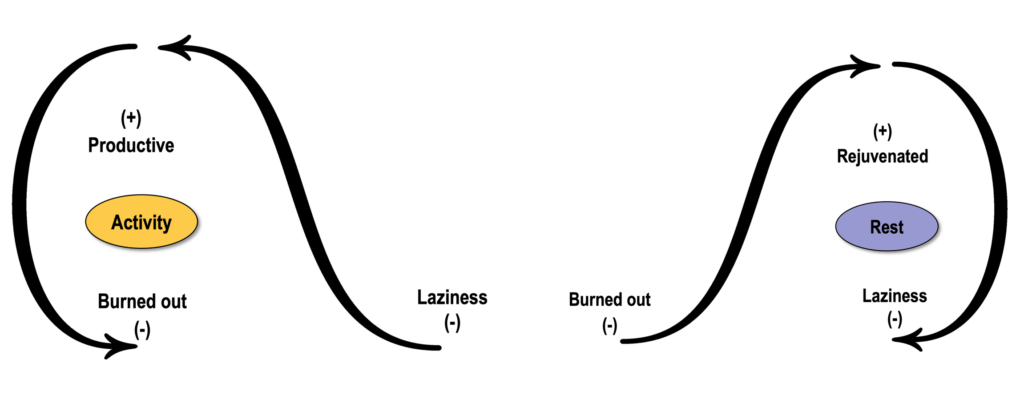
Without the developmental capacity to see the whole infinity loop — both diagonals, both upsides, both downsides, and the Greater Purpose the polarity is serving — the swing simply moves the dysfunction to a new address. Ditch-to-ditch driving is what most leadership development calls “learning the lesson.” It is not. The lesson, when it comes, looks different. The lesson looks like the capacity to be on the road, with the ability to switch lanes when conditions require.
The Polarity Underneath All Change: Continuity AND Transformation
Every change effort — personal, organizational, civilizational — sits inside a polarity Barry Johnson identifies as Continuity AND Transformation. The Continuity pole holds what is valued and proud and worth preserving. The Transformation pole goes after what is missing and worth becoming. Both poles are necessary. Both have legitimate upsides. Both have legitimate downsides.
Most efforts to make a difference run aground on this polarity. The change agent goes after the Transformation upside (vision, the preferred future, what is missing) and treats anyone defending the Continuity upside (what is valued, what is proud, what is being protected) as resistance to be overcome. The resistors do the mirror move in reverse — they defend Continuity and treat the change agent as a threat to what they value.
Hooked-and-Stuck is the dynamic that locks this polarity into a vicious cycle. The change agent gets hooked on the Transformation diagonal (vision over what is missing) and becomes blind to the legitimate value of Continuity. The resistors get hooked on the Continuity diagonal (pride over what would be lost) and become blind to the legitimate value of Transformation. Both sides see the other as the obstacle. Neither side is wrong about what they value. Both sides are blind to half the field.
Every Hooked-and-Stuck pattern this piece describes is operating inside the larger Continuity AND Transformation polarity. Understanding that nested structure is what allows the Getting Unstuck process described later to work. The way out is not winning. The way out is engaging the polarity Continuity AND Transformation is generating, in service of a Greater Purpose both sides can recognize.
When Multiple Hooks Interlock: The Multarity Challenge
Most writing on this dynamic treats Hooked-and-Stuck as a single-polarity challenge. In practice, leaders, organizations, and democracies are usually hooked on multiple polarities simultaneously, with the hooks reinforcing one another and creating hyper-vicious cycles of compounding negative impact.
A leader hooked on Activity-over-Rest migh often be hooked on Clear-over-Flexible, Certainty-over-Inquiry, and Strength-over-Tenderness. Each hook reinforces the others. Letting any one of them go feels like letting all of them go, because the diagonals together have been woven into a self-image, an identity, a story about what kind of leader the person is.
In the framework I have been developing on top of Barry Johnson’s foundation — described in Chapter 42 of And, Volume 2 — this is a Multarity: an interdependency of more than two poles whose dynamics synergistically contribute to a Greater Purpose that is more than the sum of the parts. Multarity Hooked-and-Stuckness begins with a process requirement — supplementing Either/Or Thinking with Both/And Thinking. That supplementation unlocks the possibility of leveraging each of the polarities in the multarity in service of the Greater Purpose all of the interdependent polarities are jointly serving.
In the United States, democracy is the largest Multarity most of us experience living inside. There are many interrelated polarities are at play in a thriving democracy. Dr. Bill Benet identified five interdependent polarities that form a multarity crucial to the Greater Purpose of Advancing Healthy, Sustainable, and Just Communities:
- Freedom AND Authority
- Justice AND Due Process
- Diversity AND Equality
- Human Rights AND Communal Obligations
- Participation AND Representation
Each polarity is vulnerable to getting hooked on a single pole. The five interact, frequently reinforcing one another’s downsides at scale. Treating any of them as an isolated single-polarity problem misses the field. The companion piece in the Wiser Decisions series, “Democracy Was Never Meant to Be Comfortable,” develops the Multarity work in detail.
Why Or-Thinking Is the Lever
It is worth pausing on why Or-thinking, specifically, is the catalyst inside this dynamic.
The human nervous system did not evolve to think about polarities. It evolved to detect threats and resolve them quickly. A choice between “Activity (good) and Laziness (bad)” is exactly the kind of choice the threat-detection system can resolve in milliseconds. It is the same architecture that lets a deer decide whether to bolt.
A choice between “Activity AND Rest, leveraged over time, in proportion to the conditions of the day and the larger purpose I am serving” is a different kind of choice entirely. It requires sustained attention, ambiguity tolerance, perspective-taking, and the willingness to be wrong in increments. The nervous system does not love this kind of choice.
So when Or-thinking is applied to a polarity, the nervous system breathes a small sigh of relief. The complexity goes away. A clean answer becomes available. The cost — losing access to the other pole — does not show up until later, in the form of consequences the system will then project onto someone else.
This is why Hooked-and-Stuck is not a thinking error you can correct by thinking harder. The harder you think with Or, the deeper the hook. The work is to shift the kind of thinking — from Or to AND when AND is what the situation requires.
What the Tao Says About This
The Tao Te Ching has been describing this dynamic for twenty-five hundred years. Two chapters in particular keep returning to me when I am thinking about Hooked-and-Stuck.
From my interpretation of the Tao Te Ching, Chapter 78 — Paradoxical Truth:
There is nothing
as soft and yielding
as water.
Yet against the hard
and rigid,
nothing works
better.
What appears weak
overcomes the strong.
What appears soft
endures long.
Many know this.
Few live it.
The rip current returns here in a different key. Water does not break the rigid by becoming rigid itself. It breaks the rigid by being precisely what it is — yielding, present, persistent. The leader hooked on a single pole hardens against the other pole, exhausts themselves defending it, and is eventually broken by what they were trying to overpower. The Tao’s invitation is the opposite: stay soft enough to keep moving. Many know this. Few live it.
From my interpretation of the Tao Te Ching, Chapter 13 — Content:
At the far edge
of great success or suffering,
ground and balance
grow precarious.
At either edge,
attachment grows.
At the edge of desire or fear,
aspiration begins to veer.
With desire,
it reaches too far.
With fear,
it stays where you are.
A steady source
comes from neither
desire nor fear.
It rests between
what pulls away
and what holds here.
This is the same mechanism the Polarity Realities describe, rendered as practice. The hook is desire pulling toward an upside and fear holding you in place inside one diagonal. The steady source — what the chapter calls Content — is the capacity to rest between what pulls away and what holds here. That capacity is the foundation of every wiser decision over time.
The Tao does not give us a polarity map. The polarity map does not give us a Tao. Held together, they describe the same energy from two sides — the Tao tells us how the energy moves; the polarity map tells us where we are standing inside it, and how well or how poorly we are moving with it.
PART 2 — THE WAY THROUGH
The Paradoxical Theory of Change
Anyone who has tried to change something by force — including themselves — knows the strange fact that effort applied in the obvious direction often produces the opposite result. The harder I push, the more the system pushes back. The clearer I make my case, the more the resistance hardens. The more I try not to feel angry, the angrier I become.
Arnold Beisser named this in 1970 in an essay that has been steadily shaping serious change work ever since:
“Change occurs when one becomes what he is, not when he tries to become what he is not. By rejecting the role of change agent, we make meaningful and orderly change possible.” — Arnold Beisser, M.D., Gestalt Therapy Now
Barry Johnson encountered Beisser’s paradoxical theory of change during his two-year Gestalt training in the 1970s and has described the moment as a kind of professional disorientation — he had spent years training to be a change agent and was now reading that the role itself was getting in the way of the change. The truth in it could not be ignored.
From a polarity perspective, Beisser was naming the other pole of the Continuity AND Transformation polarity. The change agent has been hooked on Transformation, blind to the legitimate value of Continuity. The way through is not to push harder on Transformation. It is to first stand on the Continuity pole — to be where you are — in order to move toward where you are going.
Reality 55 in the Polarity Realities states the practice version of this: if you want to embrace the other pole, first embrace the pole where you are. The premise, in Beisser’s words, is that “one must stand in one place in order to have firm footing to move, and it is difficult or impossible to move without that footing.”
That is what the rip current taught the surfers. They do not become the water in order to swim out of it. They stop fighting the water and let it carry them where it is already going, at which point they can do what they were trying to do all along.
There Is Wisdom in the Resistance
If the Paradoxical Theory of Change is the foundation, Reality 13 is the operating principle: there is wisdom in the resistance.
This is not a rhetorical move. It is a polarity-thinking diagnosis. Resistance to your preferred change is almost always carrying information you have stopped being able to see — the legitimate value of the pole you have learned to refuse, and the legitimate fear of losing it. The resistor is not blocking you out of stubbornness, ill will, or stupidity. The resistor is, often without knowing it, holding the part of the polarity you have stopped holding.
That recognition changes what you do next. Resistance stops being something to overcome, get around, or manipulate. It becomes a resource to engage. The wisdom is in there. Your work is to surface it, name it, and find a way to gain what you are going after without forcing the resistor to lose what they value.
Why Clearer Communication Creates More Resistance
There is a counterintuitive insight in the Polarity Realities that almost every change agent has to learn the hard way. Barry names it in Reality 71:
Reality 71: When we treat a polarity as a problem to solve, the clearer the communication, the greater the resistance.
This makes no sense from inside a problem-solving frame. If the change agent’s argument is logically airtight, surely making the argument more clearly will reduce resistance? Surely a better Power Point deck will move people?
It does the opposite. Because the underlying situation is not a problem; it is a polarity. The change agent is not making a clearer argument for both poles of the polarity. The change agent is making a clearer argument for one pole and dismissing or attacking the other. The resistor, hearing this, becomes more certain than before that their valued pole is under attack — because it is. They dig in. The vicious cycle accelerates.
This is one of the most useful insights in the polarity canon for anyone trying to make a difference. If you are encountering escalating resistance to a change you are pursuing, you are very likely treating a polarity as a problem and arguing for one pole. The fix is not more clarity. The fix is engaging the polarity.
Competing Commitments: Why People Won’t Change Even When They Want To
Robert Kegan and Lisa Lahey, working from a developmental psychology lens parallel to the polarity work, describe a phenomenon they call Immunity to Change. Their finding, after decades of research with managers and leaders, is that what looks like simple resistance to change is almost never simple. The person resisting frequently holds a sincere commitment to the stated change. They also hold a competing commitment they may not be conscious of, operating in the opposite direction in service of self-protection.
The manager who genuinely wants to delegate more is often also genuinely committed to not losing control of outcomes she has been held responsible for. The leader who genuinely wants to listen better is often also committed to not having to hear about problems he cannot fix. Each competing commitment is held in place by what Kegan calls a Big Assumption — a belief held since childhood about what would happen if the protection were dropped.
From a polarity perspective, the competing commitment is the diagonal made of the valued pole’s upside (the legitimate strength) and the opposite pole’s downside (the legitimate fear). The leader who values control is committed to avoiding chaos. The leader who values activity is committed to avoiding being seen as lazy. The Big Assumption is the deepest layer of the value/fear coupling — the unexamined belief that produces the diagonal in the first place.
Kegan’s framework and the polarity canon point at the same dynamic from two angles. The polarity canon describes the energy system; Kegan describes the psychological architecture inside the individual holding it. Both arrive at the same practical implication. You cannot get unstuck by trying harder to do the stated commitment. You have to engage the competing commitment, surface the Big Assumption, and find a way to honor what is being protected while still moving toward what is wanted.
Resistance is rarely opposition. It is almost always a sincere commitment in service of self-protection — and the protection is usually pointing at a legitimate value worth holding.
Getting Unstuck: The Five-Step Practice
Barry Johnson formalized a 5-step practice for getting unstuck in Chapter 13 of And, Volume One. It is canonical (Reality 72 in APPENDIX C of And, Volume 1). It works because it embodies the Paradoxical Theory of Change — it engages resistance as wisdom and starts from the pole where the resistor is, before moving toward the pole the change agent is going after. The practice is described below in its canonical form, with brief notes on how to apply it in your own thinking when you are the one who is hooked.
Step 1 — Seek out the value being held.
Listen — to the resistor, or to the resistance inside yourself — for what is being protected. What is valuable on this pole? What is being defended that deserves to be defended? Affirm the value. This is not a tactical move. It is an accurate recognition. The value being held is real.
Step 2 — Understand the legitimate fear.
Once you can affirm the value being held, the wall becomes a bridge to the fear underneath. What is the resistor afraid of losing? What downside on the other pole are they protecting against? Name the fear. Respect it. It is not irrational. It is the diagonal partner of the value being held.
Step 3 — Ask the polarity question.
After steps 1 and 2 have given resistance a place to stand, ask the integrative question: How might we (together) gain what we are going after — the upside of the other pole — …
Step 4 — Without letting go of what the resistors value.
…without losing the upside the resistor is rightly protecting…
Step 5 — In service of a Greater Purpose that works for both.
…in order to move toward a Greater Purpose that both poles are jointly serving?
This sequence is the operationalization of the Paradoxical Theory of Change. It refuses to ask the resistor to let go of their pole as the precondition for moving. It does the opposite. It guarantees the resistor’s pole first. Only then does it ask the integrative question. Because Continuity has been honored, Transformation becomes accessible. Because the pole where the resistor stands has been affirmed, the resistor can risk moving.
The same five steps apply intra-personally. When you find yourself stuck — committed to a change you cannot make, undermining your own stated commitment — the practice is the same. Seek out the value you are holding. Understand the legitimate fear. Ask how you might gain what you are going after without losing what you value, in service of a Greater Purpose. The resistance inside you is carrying wisdom. The practice is to engage it, not overpower it.
The SMALL Discipline as the Larger Context
The Getting Unstuck process sits inside the larger polarity practice — what we call the SMALL Process: Seeing, Mapping, Assessing, Learning, Leveraging. SMALL is the broader discipline that organizes how Polarity Thinking is practiced.
S — Seeing. Distinguish problems (where Or-thinking is correct) from polarities (where AND-thinking is required). Name your diagonal. Name the diagonal you have been blind to. Get the value/fear pairings into the open.
M — Mapping. Build the four-quadrant Polarity Map — two upsides, two downsides, Greater Purpose, Deeper Fear. The map makes the whole infinity loop visible at once.
A — Assessing. Honestly read where the system is sitting inside the loop. Which pole is currently over-emphasized? Which downsides are accumulating? Which upsides are missing?
L — Learning. Make meaning of the assessment. Reconnect to Greater Purpose. Surface the projections. Name what the contempt is telling you.
L — Leveraging. Build Action Steps that support both poles. Build Early Warnings that flag over-emphasis before the downside accumulates into a crisis. Practice the movement.
The Getting Unstuck 5-step process operates primarily inside steps 1–4 of SMALL — Seeing, Mapping, Assessing, and Learning. The Greater Purpose work happens in Learning. The Action Steps and Early Warnings that sustain the unstuck position happen in Leveraging.
You are not aiming for perfect balance. You are aiming for skillful movement between the poles, governed by conditions and Greater Purpose. The poles will keep moving in relationship to each other. Your work is to keep moving with them, neither hardening into one pole nor abandoning both. This is the polarity equivalent of the surfer using the rip current. The energy is no longer a threat. It is what carries you.
What This Looks Like in Real Time
Same scenario as the one inside many leadership case studies. The team is exhausted. The data shows the pace is not sustainable. Someone asks for a different approach.
Hooked response: “We can’t slow down now. We’ll lose momentum. People need to push through.”
Unstuck response, out loud, in the meeting: “I am hearing that we need more Rest. My first reaction is a contracted kind of fear — that we will become lazy, lose momentum, fall behind. That is my hook. I want to name it before I let it run the meeting. I also see that Rest has real upsides we have been missing — recovery, integration, sustainable performance — and that Activity has real downsides we have been tolerating — the exhaustion, the errors, the people who are leaving. What we need is not less Activity. What we need is Activity AND Rest, leveraged for sustainable high performance. Let’s design what that looks like together.”
What changed in that exchange is not the facts. The leader’s perception of the whole polarity map changed. The diagonal that was running the room got named. The other diagonal got named. The Greater Purpose got named. The work then moved into mapping and action.
In my experience, the team in front of that leader will not have a uniform response in the moment. Some people will exhale. Some people will reserve judgment until the change is sustained over months. Some people will privately wonder what just happened. That is normal. Getting unstuck in public is a different event for everyone watching it. The work is to keep doing it.
A Note on My Own Hooks
I would feel dishonest finishing this piece without naming a few of my own. I have OCD-fueled pole preferences – recent ones — that have had painful and even life-threatening. This piece is not being shared from outside the dynamic. It is from inside it, after enough rounds of getting hooked, getting stuck, almost ditch-to-ditching, and slowly — very slowly — learning to recognize how to operate in polarity energy dynamics like a surfer in a rip current.
Do I still get hooked? Yes. Stuck? Yup. And I expect I always will. The difference now is that I notice it earlier more often, and the people closest to me feel safer reminding me of it when they see it. That feels like enough of an outcome to keep practicing. To keep learning.
Why This Matters
The capacity to recognize being hooked, to see the whole polarity map (or the combined field of preferred poles in a multarity), and to move skillfully between poles and across strategically aligned polarities is one of the most important developmental capacities a leader, a team, or an organization can build. It is also one of the most important capacities a democracy depends on.
Teams get hooked. Organizations get hooked. Families get hooked. Nations get hooked. The mechanism is identical at every scale. The poles change. The energy dynamic operates the same way.
You cannot legislate the capacity to get unstuck. You cannot force it. You cannot outsource it to artificial intelligence. It can only be developed — one person, one leader, one decision at a time. That is why this work matters, and why it is unlikely to be done by anything other than human beings willing to be honest with themselves and with one another.
What diagonal is hooking you right now?
Cross-References
Companion and follow-on pieces, and source references, for the Hooked-and-Stuck dynamic described here:
- Wiser Decisions Series — “Democracy Was Never Meant to Be Comfortable.” Hooked-and-Stuck applied to the five Polarities of Democracy and the Multarity field.
- Just Tao It — Chapter 13: Content. The steady source between desire and fear.
- Just Tao It — Chapter 78: Paradoxical Truth. Water, yielding, and the rigid.
- Just Tao It — Chapter 16: There. Stillness, returning, and reckless movement.
- Just Tao It — Chapter 48: Effort AND Ease.
- And, Volume One, Chapter 5 — Organization as the Whole (Barry Johnson). Canonical source for Realities 47–56, including Reality 51 (Hooked-and-Stuck).
- And, Volume One, Chapter 13 — Paradoxical Change and Getting Unstuck (Barry Johnson). Canonical source for the Paradoxical Theory of Change applied to polarities, Reality 71, and Reality 72 (the 5-step Getting Unstuck process).
- And, Volume Two, Chapter 42 — Multarities. Cliff Kayser’s framework for interdependent polarities and Greater Purpose.
- Beisser, Arnold R. — The Paradoxical Theory of Change. In Gestalt Therapy Now (Shepherd & Fagan, eds.).
- Kegan, Robert and Lisa Laskow Lahey — Immunity to Change. Harvard Business Review and the Harvard Graduate School of Education’s Change Leadership Group.
INVITATIONS:
Want to learn more about Polarity Thinking and explore options for self-paced learning and Credentialing?
CLICK HERE
Want to use an AI-trained “Chat w/Cliff” to support you in Step 1 Seeing?
CLICK HERE