


See the Series Introduction for Just Tao It, Part I: HERE
See the Just Tao It Series Introduction Tao/It on-ramp, PART II: HERE
See Just Tao It, Chapter 1: HERE
The unforced finisher,
Is It.
Much unfolds,
With less effort.
If leaders
Followed It.
—
There’s a pollinator garden at Kayser Ridge that took years to settle into being what it is now. I prepared the ground and cleared some invasive growth decades of inattention had allowed to spread. With advice from friends and colleagues who understood these things far better than I did, I added a few native species that seemed likely to thrive in similar soil. Over time I stopped aggressively weed-whacking too close to the borders and allowed what was already trying to organize itself to organize itself. And somewhere along the way, bees, butterflies, and hummingbirds began arriving in numbers that still surprise me.
I originally started calling it “my pollinator garden,” though in truth I cannot honestly claim that level of intention. I did not design it in the way architects design buildings or engineers design systems. Mostly, I prepared the conditions, listened to people wiser than I was, and interfered less with what already seemed to know how to live there.
Chapter 37 of the Tao Te Ching has been settling into me through that experience. The lines are deceptively small — the unforced finisher, much unfolds, less effort, leaders following It — though they keep returning in ordinary moments. In the meeting where my actual contribution would have been silence. In my difficult-to-mask irritation about something that was taking too long. In the email I almost sent before recognizing that a little more time and attention inside the relationship would likely accomplish far more than another attempt at clarification.
Wu wei is often translated as “non-action,” and that translation has probably discouraged many people from ever finding the practical usefulness inside this chapter. Lao Tzu is not pointing toward passivity, disengagement, avoidance, or withdrawal from responsibility. Life requires action. Leadership requires action. Parenting, coaching, governance, consulting, citizenship, and trying to keep a piece of land healthy all require movement, decisions, boundaries, participation, effort, and the willingness to be wrong publicly when necessary.
The unforced finisher still finishes.
Something gets done.
What changes is the relationship to the doing.
Through more than twenty years of organizational consulting I have watched leaders make remarkably similar mistakes from opposite directions. Some impose Structure so aggressively that the system loses its ability to respond to anything the Structure did not anticipate. Others pull back so far in the name of autonomy, trust, or emergence that the system loses the ground necessary to organize itself coherently at all. Neither side usually suffers from bad intentions. Both eventually experience the consequences of neglecting an interdependent tension that does not disappear simply because one pole feels morally superior in the moment.
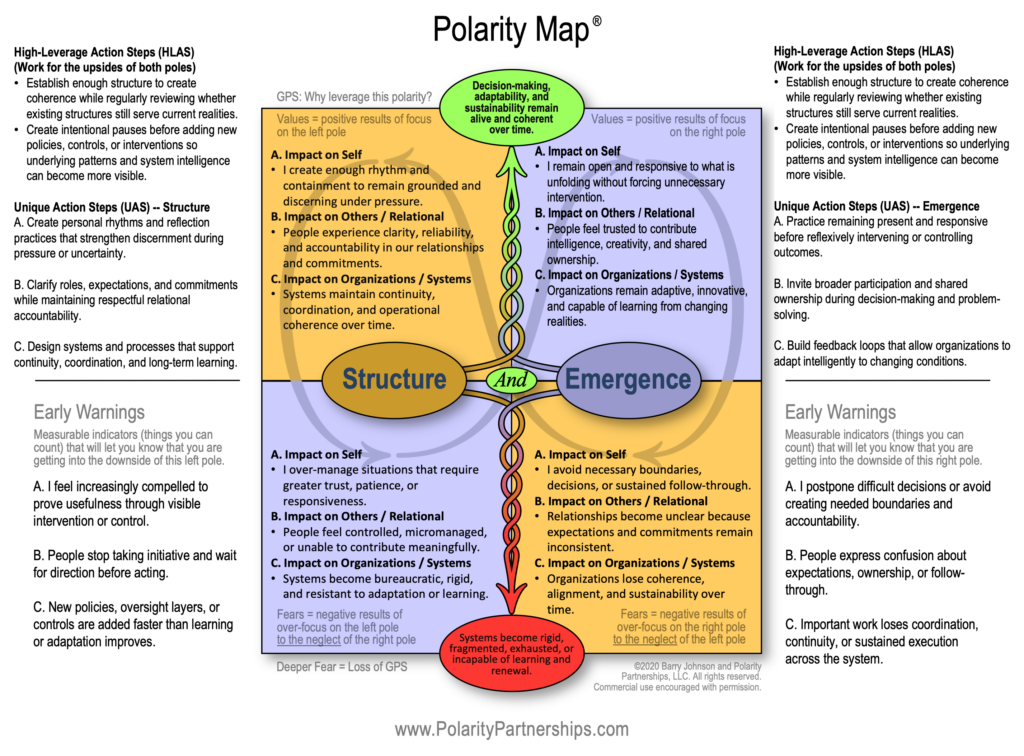
The polarity underneath Chapter 37 increasingly feels to me like Structure AND Emergence.
Structure carries continuity, accountability, containment, rhythm, memory, standards, and enough coherence for distinct things to grow at all. Emergence carries adaptation, vitality, discovery, responsiveness, and the self-organizing intelligence capable of sensing what no architect, planner, policy, or leader could fully anticipate ahead of time.
Held together over time, the two generate something resembling the living quality Lao Tzu keeps pointing toward throughout the Tao Te Ching. Structure to the neglect of Emergence gradually produces the well-organized system that has stopped making anything alive. Emergence to the neglect of Structure eventually produces motion without continuity and energy without ground.
Through Barry Johnson’s work on Polarity Thinking I eventually learned language for something I had already been sensing in the Tao for decades. Polarities are not problems to solve. They are interdependent pairs existing in ongoing relationship. The infinity loop in a Polarity Map represents the movement itself. One pole creates conditions that eventually invite the strengths of the other. Much of the unnecessary suffering inside that movement becomes optional once the dynamic itself becomes visible. I learned most of that the long way through what I eventually came to call the University of Hard Knocks. Some of those loops took decades.
I have probably been overidentified with the Emergent pole for most of my life. Looking back, that may partially explain my attraction to the Tao Te Ching in the first place. I tended to notice the fluid, adaptive, spacious dimensions first. Polarity Thinking deepened my appreciation for the Structure already present underneath the patterns the Tao was revealing. What once looked like pure spontaneity increasingly started revealing rhythm, containment, sequence, reciprocity, and invisible forms of coherence I had previously underestimated.
What remains harder for me to recognize in real time is the smaller chronic version of the same imbalance. Adding a process where attention would have been enough. Sending clarification where deeper listening might have allowed clarity to emerge from inside the group itself. Drafting another policy when the existing policy is being violated for reasons worth understanding before adding more Structure. These moments rarely look dramatic. They accumulate slowly as the daily texture of well-intentioned interference.
The chapter, on its better days, helps me notice that texture before adding to it.
Robert Kegan and Lisa Lahey describe something important here in Immunity to Change. Many behaviors persist long after they stop serving the larger system because hidden commitments are protecting something psychologically important underneath. For me, one of those hidden commitments has been the belief that usefulness is proportional to visible doing. The bees require conditions, participation, stewardship, and restraint. They do not require me performing usefulness continuously in front of them. That remains one of the harder forms of contribution for me to trust.
This tension feels increasingly alive across nearly every system human beings are now trying to navigate.
Inside organizations, the reflex increasingly becomes adding Structure every time something surprising or uncomfortable appears: another reporting layer, another oversight committee, another process, another guardrail, another form of managerial intervention. Eventually the system loses enough breathing room that learning itself becomes difficult.
Inside AI development, similar dynamics appear as systems become increasingly tuned, constrained, monitored, moderated, corrected, and layered in response to accelerating uncertainty and fear. Inside democratic governance, similar instincts emerge through both authoritarian overreach and highly credentialed attempts to regulate every dimension of human life from above. The underlying reflex remains remarkably similar across contexts: something difficult appears, and the instinctive response becomes adding more Structure. Sometimes that is wise. Sometimes it accelerates the very imbalance the Structure was intended to address.
Yuval Noah Harari points toward a related danger in his recent work on AI and human systems. The issue extends beyond technological capability itself. Human beings increasingly reorganize themselves around rhythms no organic nervous system was designed to sustain, including the rhythm of perpetual structural intervention. Algorithms do not tire. Human systems do. Continuous Structure-making at machine speed eventually exhausts the human beings attempting to hold those structures together.
Authoritarian systems understand the appeal of over-structuring exceptionally well. Flood a system long enough with directives, urgency, certainty, surveillance, and centralized control and people gradually lose capacities healthy systems depend upon: discernment, trust, slower judgment, self-organization, mutual accountability, and the confidence to participate responsibly without awaiting the next instruction. Similar patterns appear inside organizations operating in chronic crisis mode and inside families that have forgotten how to let one another make ordinary mistakes.
Lao Tzu points toward something deeply practical here. Authority built primarily through over-design requires continuous effort to maintain itself. Authority emerging from deeper understanding of what a system is already trying to become tends to require less force and often outlasts the person holding the role. The leaders I increasingly trust are usually the people capable of building enough containment for genuine intelligence to move through a system and then resisting the temptation to keep intervening once that intelligence starts doing its work.
That kind of leadership rarely looks dramatic in the moment. Over time, however, it creates something increasingly rare: the trust that coherence can exist without continuous coercion and that adaptation can occur without a system losing itself entirely.
The question from the Part II on-ramp to this series remains one of the most practically useful questions I know:
Where am I out of sync with what is already moving?
Where am I adding Structure to a system already correcting itself?
Where am I withholding Structure from a system that genuinely needs it in order to organize at all?
The chapter offers no formulas for answering those questions. It does suggest, however, that leaders willing to remain with them longer than feels emotionally comfortable may gradually discover forms of participation that feel less like force and more like alignment.
I certainly have not mastered that.
Lately I can feel my own pull toward over-design again — toward proving usefulness by adding something. The chapter keeps returning anyway. The garden continues becoming itself. The hummingbirds return without consulting my plans. And I keep learning, however imperfectly, to interfere a little less with what was never mine to control while participating more carefully in what genuinely asks something of me.
Here’s a Polarity Map for Structure AND Emergence:
INVITATIONS:
To use an AI-trained “Chat w/Cliff” for Step 1, Seeing” CLICK HERE.
Ready for the Polarity Advantage? Go deeper into Polarity Thinking, see our online self-directed Credentialing and Introduction to Polarity Practice or in-person training with Barry Johnson and me at Kayser Ridge by CLICKING HERE.