


See the Series Introduction for Just Tao It, Part I: HERE
See the Just Tao It Series Introduction Tao/It on-ramp, PART II: HERE
See Just Tao It, Chapter 1: HERE
From my interpretation of the Tao Te Ching, Chapter 69 (Unpublished):
The great fighters have said,
Be not the host,
Be the guest.
Pull back
The bow.
Advance.
Without display.
Find victory
By giving way.
—
I did not arrive at Tai Chi peacefully. I came to the martial arts as a teenager carrying the memory of a bigger kid named Kramer twisting my bicycle out from under me, riding it away, and deliberately crashing it into a tree while other kids watched and laughed. He was not the last bully I encountered, although he became the face of many. The frightened boy who rode that mangled bike home wanted one thing: enough strength to make sure it never happened again.
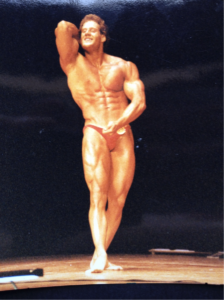
I’m quite certain those accumulated experiences of being bullied had something to do with how much time I spent lifting weights as a teenager. When I was fifteen, Arnold Schwarzenegger’s The Education of a Bodybuilder appeared. I followed the path it opened all the way into amateur bodybuilding competitions. Building my body gave visible form to a promise I had made without realizing it: I would never again be as powerless as the boy watching Kramer destroy his bicycle. Here’s one of the few pictures that survived from that time.
The martial arts school where I trained had an intentionally hard edge, and that suited me. I wanted technique, force, speed, and the confidence of knowing I could answer whatever came at me. During college in North Carolina, I boxed in Golden Gloves competition at the state level.
Later came Toughman contests in local bars and weekend work as a bouncer at a popular dive bar. I confess that I sometimes took personal satisfaction in using my strength and skills against people I regarded as bullies.
What began as protection had become an identity. Fear had found muscle, technique, and permission. I could not yet see how easily my strength might decide what a situation required before the situation had truly spoken.
A bully of bullies is still a bully.
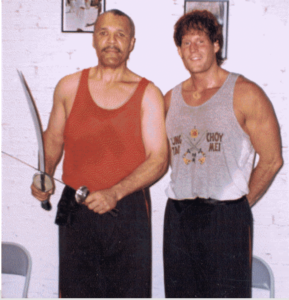
Then I met one of the most important teachers of my life: Sifu Abdur-Rahim Muhammad at the Hung Tao Choy Mei Leadership Institute in Washington, D.C. The Jow Ga Kung Fu academy was built as much around character as combat. Before students learned technique, they learned the academy’s ordering:
Learn kindness, learn justice, and then learn Kung Fu.
Capability followed kindness and justice. The academy occupied a space above an auto shop along the then-changing U Street corridor. We could smell spent oil while we trained. The work was physically demanding, multidimensional, and unlike any training I had previously known. Rahim did more than refine my technique. Something in that experience began polishing the meaning I had assigned to strength.
Sparring carried a related instruction: become stronger, and maintain control. I wrote about that more fully in Chapter 31. I began to understand that the greater our capacity to cause harm, the greater our responsibility not to cause it. Power without that responsibility becomes danger with better technique. Looking back, I recognize in Rahim’s ordering a living relationship between Yang Energy and Yin Energy, long before I had language for what I was experiencing.
Tai Chi continued to reshape my understanding of strength. I have practiced it pretty consistently for about forty years now. Its slowness can disguise what it is cultivating: rootedness that permits movement, sensitivity that detects force before meeting it, and the patience to discover where energy is already going. Giving way does not require disappearing. Sometimes it is how position, timing, and choice are recovered.
That is what I hear in Chapter 69 when it comes to the use of power. Be not the host. Be the guest. Pull back the bow. Advance without display. Find victory by giving way. In the ancient etiquette carried by this image, the host initiates, sets the terms, and directs what happens. The guest enters receptively, listens for the conditions already present, and adapts before acting. The guest remains capable of action. Receptivity lets relationship and reality inform it.
I recognize these postures far beyond martial arts. In negotiation, the host may rush to declare a position; the guest listens first for priorities, pressures, and possible openings. In heated conflict, the host adds force to force; the guest stays grounded while emotion spends some of its momentum, using active listening and validation to help make de-escalation possible. In organizational life, the host imposes a solution before reading the room; the guest studies the living workflow and its pain points, then introduces change where the system has some capacity to receive it.
This is one expression of wu wei: action that works with the movement of a situation rather than forcing movement upon it. “Advance an inch but retreat a foot” carries the same discipline. Yielding protects position, preserves choice, and allows a clearer opening to appear. Its economy comes from proportion—no more force, certainty, or personal display than the moment requires.
I have spent most of my adult life learning to tell those postures apart, mostly by getting them wrong first. There were physical moments, before I had any of this language, when I let size and force stand in for judgment I had not yet earned. I was a guest acting like the host.
Years after physical size had ceased to be the obvious issue, I encountered a subtler version of the same posture. Not long after starting my company, I participated in a branding retreat that included an assessment of personal archetypes. My core archetype was the Magician, oriented toward transformation. Hero and Caregiver appeared as supporting archetypes.
One of the facilitators pulled me aside afterward. In the executive coaching and organizational consulting work I do, she said, that combination carried particular risks when its shadows gathered together. The shadow Magician can become manipulative, using insight to shape an outcome without sufficient consent. The shadow Hero needs someone to save. The shadow Caregiver needs someone to need care.
I did not have much to say back to her. She had just described my first marriage and why it did not survive more precisely than I ever had.
The lessons involving physical force were easier to receive because aggression was visible. This pattern wore the face of devotion, help, and transformation. From the inside, all three could feel generous. Underneath them was the familiar posture of deciding what another person needed, where they should go, and what would help them get there. I was still the host. I had learned to set the terms more gently. The warning remains present in my coaching whenever confidence in a client’s capacity begins turning into confidence that I know the destination.
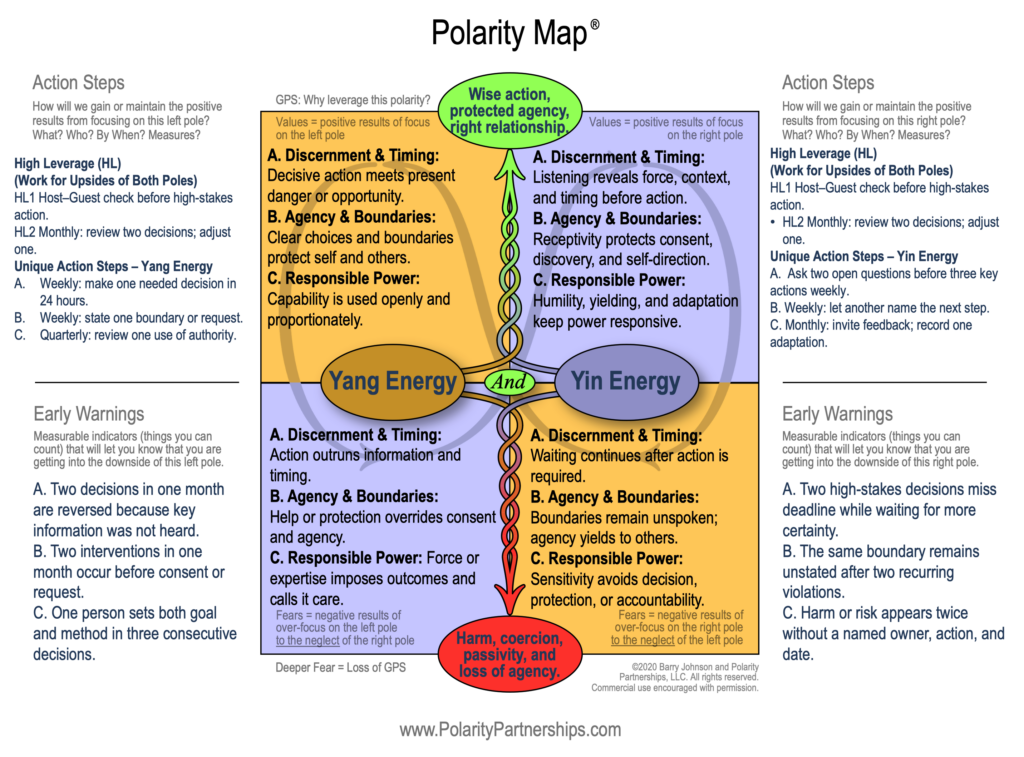
The Polarity I hear in these experiences is Yang Energy AND Yin Energy. I use those names in this chapter for energies available within every person and system; neither belongs to a particular gender. Yang Energy brings action, protection, and expression. Yin Energy brings receptivity, sensitivity, and room for more of the situation to appear. Force loses discernment when it no longer receives. Sensitivity loses protection when it cannot act. Each depends on the other.
Chapter 69 returns me to the question of what strength is listening to. Pulling back the bow gathers energy and changes its timing. Giving way creates room to see. Advancing without display lets the moment shape the action.
These days, presence often means entering a relationship willing to listen long enough for usefulness to take shape. At home and in coaching, I am learning to act after I have heard more. I still arrive as the host more often than I know.
Where in your life might strength enter as a guest?
Here’s a Polarity Map for Yang Energy AND Yin Energy:
 INVITATIONS:
To use an AI-trained “Chat w/Cliff” for Step 1, “Seeing” CLICK HERE.
Ready for the Polarity Advantage? Go deeper into Polarity Thinking, see our online self-directed Credentialing and Introduction to Polarity Practice or in-person training with Barry Johnson and me at Kayser Ridge by CLICKING HERE.