


See the Series Introduction for Just Tao It, Part I: HERE
See the Just Tao It Series Introduction Tao/It on-ramp, PART II: HERE
See Just Tao It, Chapter 1: HERE
From my interpretation of the Tao Te Ching, Chapters 77 (Unpublished):
It is like the bending bow.
As bottom ascends,
The top moves low.
Yet we take
From those with less,
Giving more
To those with excess.
The wise
Are like skilled archers.
Pulling back,
To release.
These
are Its ways.
—
A nonprofit executive director sat across from me last spring, weighing two budget proposals that could not both be funded in full. One would carry the organization into three additional counties — new staff, new reach, new promise. The other would raise wages for the frontline case managers already on staff, several of whom qualified for the same public assistance they helped other families apply for. She kept using the words “either” and “or.” Either we grow, or we shore up. Either we build something new, or we take care of what we already have. She was not wrong about the math. The board had approved one number, and both proposals wanted most of it.
Drawing on Cathy Carroll’s work with family businesses (see the Wiser Decisions piece on Family Business), I watched this same argument happen inside a three-person family business choosing between a new product line and health coverage for the two employees who had been there since the beginning. Then I watched it happen inside a mid-sized manufacturer choosing between an acquisition and a pension shortfall. Now, the same pattern is unfolding at a scale none of us can quite hold in our heads, inside a country of over three hundred million people. Different rooms, different numbers, the same argument. Do we build the ceiling higher, or do we strengthen the floor? (See Strong Floor, No Ceiling: PART I and PART II.)
The image is a bow being drawn. When the bottom of the bow rises, the top comes down to meet it — that is simply how a bow works, how tension becomes useful instead of dangerous. Left alone, the poem says, we tend to do the opposite: take from those who have less, and give more to those who already have excess.
Barry Johnson — my partner, friend, and mentor for over twenty years at Polarity Partnerships — traced this pattern back further than economics. Underneath “give more to those with excess,” he found four ordinary, decent desires stacked on top of each other: to solve problems, to protect our own, to provide for our own, and to belong. None of these is a flaw. Pursued without their interdependent partners — without also leveraging polarities, protecting others, providing for others, and belonging wider than our own group — those same decent desires can compound into what Johnson called a hyper-vicious cycle. Enough people making enough locally reasonable choices, at enough scale, produces gross inequality without anyone needing to intend it. No villain required. Just an accumulation of Or where And was needed.
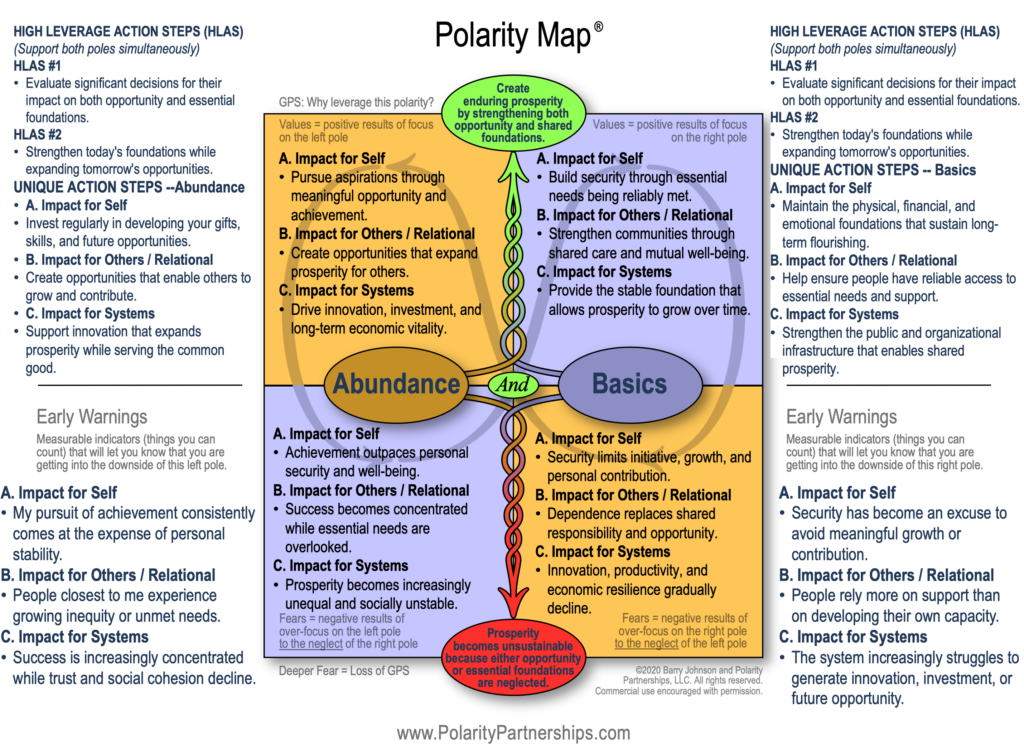
Oliver Libby names the same pattern from a different direction. The American Dream, as he reframes it, was never meant to be a choice between a floor and a ceiling. It was meant to be both at once — a Strong Floor beneath everyone, and No Ceiling above anyone. Somewhere between idea and daily practice, the floor and the ceiling got argued about as though a nation had to pick one. Shared Prosperity became one camp’s word. Individual Achievement became the other’s. The Polarity Map underneath both ideas points toward something deeper: a floor without a ceiling starves ambition. A ceiling without a floor abandons people. Wiser decisions require holding both, over time.
One reason the conversation so often becomes polarized is that we’ve inherited a story about the bow itself. Historian Heather Cox Richardson traces that story back well before the Cold War or even the Russian Revolution. Throughout much of American history, proposals to strengthen public education, public health, infrastructure, workplace safety, or other shared investments have repeatedly been framed as “redistribution of wealth” or the first step toward socialism. The language changes from one generation to the next. The underlying pattern remains remarkably consistent: strengthening the floor is portrayed as threatening the ceiling.
Richardson’s work also points toward something deeper. These debates are rarely only about economics. They are conversations about what government is for, what freedom requires, and how a society understands shared responsibility. When those questions are reduced to an Either/Or choice, the bow begins to lose its shape. We end up arguing about Strong Floor or No Ceiling when reality keeps asking for both.
Whether one agrees with Richardson’s conclusions or not, her historical observation is difficult to ignore. Across Reconstruction, the Progressive Era, the New Deal, and the civil rights movement, remarkably similar arguments reappear whenever Americans debate how broadly the benefits of prosperity should be shared. Different generations. Different policies. A familiar pattern.
The numbers, when you look at them, are simply the bow’s tension made visible — Strong Floor and No Ceiling, drawn out to the scale of a nation. Since 1980, income for the top tier of American households has grown at several times the rate of income for households in the middle and toward the bottom. The share of the nation’s income going to the top has drifted back toward levels last seen roughly a century ago, before the mid-twentieth-century reforms narrowed the gap for two generations. The gap runs along more lines than income alone — race and geography both show up inside it, compounding rather than existing separately. Researchers point to several forces working together: automation changing which jobs exist, global trade changing where they are located, and a decline in the share of workers represented by unions. None of these forces required malicious intent. Each was, on its own terms, somebody solving a real problem. Together, unaccompanied by their interdependent And, they draw the bow tighter.
As bottom ascends,
The top moves low.
The metaphor is deceptively simple. It was already present in the nonprofit director’s spreadsheet, in the family business’s health plan, in the manufacturer’s pension shortfall. Seeing the bow bend at that small, personal scale is what makes it possible to recognize the same shape at the scale of a nation, without needing a villain to explain it.
The wise, the poem says, are like skilled archers, pulling back in order to release. Pulling back is what makes the aim possible; a Strong Floor drawn taut enough to hold everyone is what gives a No Ceiling anywhere to reach toward. What would it take — in your own budget, your own organization, your own community, your own country — to stop choosing between the Strong Floor and the No Ceiling, and begin drawing the bow the way the Tao describes?
Here’s a Polarity Map for Basics AND Abundance:
For more on Abundance Chapter 29 of And, Volume 1, Foundations by Barry Johnson:
And_V1_PEEK_C29_Poverty_Racism_Sexism
INVITATIONS:
To use an AI-trained “Chat w/Cliff” for Step 1, “Seeing” CLICK HERE.
Ready for the Polarity Advantage? Go deeper into Polarity Thinking, see our online self-directed Credentialing and Introduction to Polarity Practice or in-person training with Barry Johnson and me at Kayser Ridge by CLICKING HERE.