


See the Series Introduction for Just Tao It, Part I: HERE
See the Just Tao It Series Introduction Tao/It on-ramp, PART II: HERE
See Just Tao It, Chapter 1: HERE
From my interpretation of the Tao Te Ching, Chapter 79 (Unpublished):
In reconciliation,
An ache
May remain.
What is settled,
Leaves something unsettled.
What is resolved,
Leaves something unresolved.
The one who holds
Does not press.
The one who yields
Does not forget.
What remains,
Remains.
—
This morning I stood on the upper deck at Kayser Ridge after finishing my Tai Chi practice, watching the sun come up. Looking down at the rocks beyond the deck, I wondered whether any of them had once been part of the firepit I built there more than twenty years ago.
Back then, the deck was a small platform I had fashioned from leftover subfloor material. Beside it, a firepit grew rock by rock over the course of a year, part of a therapeutic process I barely understood. I was reeling from the second of two back surgeries, a separation and divorce, and the loss of my relationship with my stepson, Kyle. Kayser Ridge still felt like a construction site with little hope of completion. Carrying rocks and piling them until they became the “mother of all firepits”—probably visible from space—gave my grief somewhere to go. The pit held fires fed by construction scraps. Far from city light, I spent countless evenings beneath stars that looked close enough to touch.
Late one evening, in front of a beautiful fire, an almost uncontrollable urge to scream rose through me. So, I did.
It came from someplace primal, and I kept going. The sound felt strange enough that I wondered whether I was losing my grip. Then something inside gave way and tears entered the screaming. I stopped when the energy was gone, my chest ached, and my throat burned. The fire kept burning. The stars remained in place. My voice was gone, and I had a leadership session to deliver at The Washington Post on Monday.
Standing on the new deck this morning, I wanted to walk back through time and put a hand on that younger man’s shoulder. I wanted to tell him he would get through it and that life would become beautiful again. I doubt those words could have reached him. The pain was the pain. Even a precise description of what would eventually stand on that spot could not have changed what he was living through.
A few months ago, from a hospital bed during another wave of back pain, I had several long conversations with one of the wonderful people caring for me. He shared some of the pain he carries from South Africa’s recent history: devastation that remains part of his present even as the country around him has become genuinely different from the one that produced it. His history and mine differed in every meaningful measure. We recognized something in each other through the persistence of what remains after conditions change. The mind may register the change. The body and the memory can continue carrying what happened.
The text we call the Tao Te Ching took shape in the late Zhou world, amid declining authority, rival states, recurring warfare, political ambition, and ordinary people living with the consequences. Scholars continue to debate whether Lao Tzu was one historical person, a legendary figure, or a name attached to wisdom accumulated over time. Whatever its authorship, this quiet text was formed under tremendous pressure. The old man—or the tradition gathered under his name—was dealing with some major shit. Chapter 79 carries the clarity of someone who understood that signing an agreement never guarantees the end of grievance.
The chapter uses an old image: two parties settle an account by splitting a tally. One half records the obligation; the other establishes the right to collect. The sage holds the evidence without pressing every claim it permits. The debt is acknowledged. The injury remains visible. Restraint changes what gets done in their name.
That restraint expresses wu wei: action free of forcing. Many translations close with the Tao showing no favoritism, remaining available to those who live in alignment with it. The Tao does not intervene to make anyone apologize, forgive, trust, or become ready. Pressure can produce an apology-shaped sentence. Reconciliation requires conditions that force cannot create.
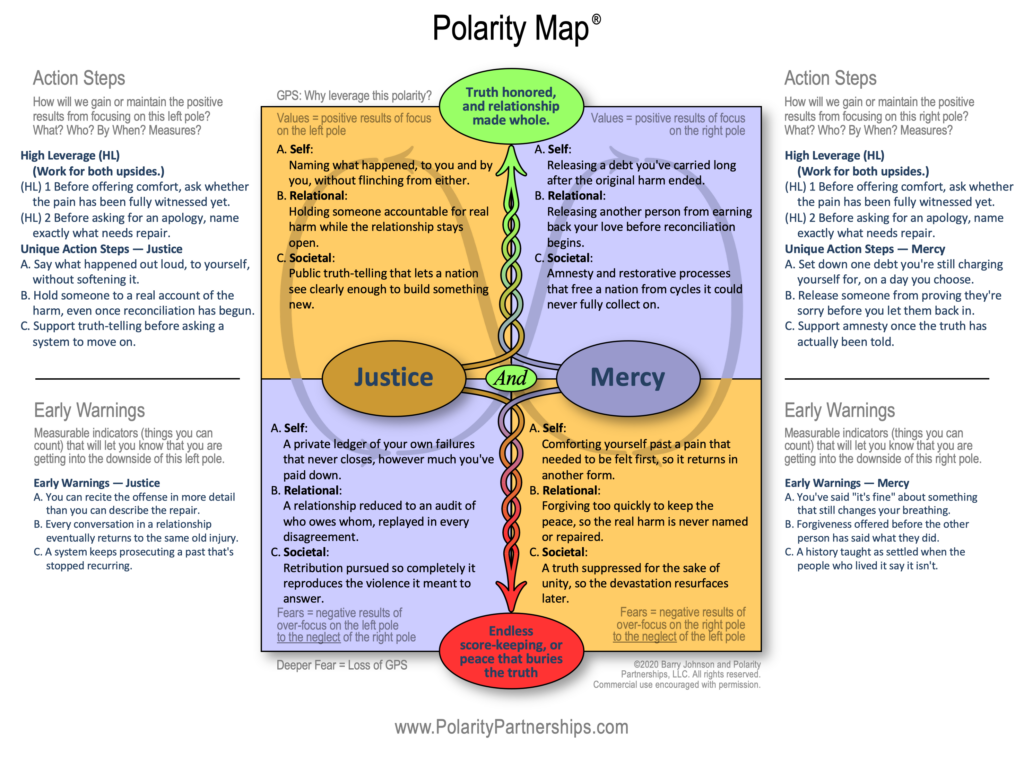
Barry Johnson’s work helped me name the polarity I see beneath the tally: Justice AND Mercy. At the individual level, it appears when we hold someone accountable for what they did while leaving room for the possibility that neither person nor relationship must remain forever frozen at the moment of injury. That possibility is never owed. Renewed access is never guaranteed. Barry traces a related pattern in organizations through Conditional Respect AND Unconditional Respect: respect earned through contribution and conduct, together with the respect due to someone through their humanity.
Mercy can coexist with distance. A person may release the desire for revenge while keeping a boundary firmly in place. Forgiveness, reconciliation, accountability, and renewed trust remain related and distinct. Reconciliation becomes possible where truth has been spoken, responsibility faced, conduct changed, and enough safety exists to support an honest relationship.
South Africa’s Truth and Reconciliation Commission attempted this work at national scale. People who had committed politically motivated crimes could seek amnesty through full public disclosure. Amnesty was conditional; admission alone did not secure it. Barry’s chapter on the Commission first helped me see the pattern operating across a country.
The case of Amy Biehl continues to carry the tension for me. Amy was a twenty-six-year-old American Fulbright scholar killed outside Cape Town in 1993. Four young men were convicted of her murder and later granted amnesty after the Commission found that the crime was politically motivated and that they had made full disclosure. Amy’s parents attended the hearings and supported the decision. Two of the men later worked with the foundation established in Amy’s name. Their daughter remained dead. The men remained responsible. Transformation entered the story without revising either fact. Justice refuses to see less than what happened. Mercy remains willing to see more than the worst act a person committed.
South Africa’s history opens a harder question beneath the personal one: what do we do with a debt we did not personally incur or an injury we did not personally suffer? Families inherit grievances. Nations do. Religious traditions and political movements do. History becomes part of the ground on which later generations stand.
Barry Johnson gives this collective question another pair of names. In his 2021 essay “Proud AND Critical,” written amid the national argument over critical race theory, he asks whether love of country and honest examination of its failures can support each other. Pride in a country’s ideals gives citizens reason to care when the country’s conduct falls short. Critical vigilance keeps those ideals from becoming ceremonial language. A democracy loses something vital when either capacity is treated as disloyal to the other.
Barry contrasts what he calls the Résumé Approach with the Witness Approach. A résumé puts a country’s best foot forward: courage, invention, sacrifice, expanding freedom, and the ideals we hope children will cherish. A witness swears to tell the whole truth: the achievements, the exclusions, the people who paid costs hidden by the triumphant account, and the distance still separating national words from national deeds. Children deserve access to both. So do adults. A national résumé without witness becomes promotion. Witness without any living connection to aspiration can leave people with an indictment and nowhere to belong.
“We do not have to hide any part of our country’s past or present in order to love our country,” Barry writes. Proud AND Critical does not map mechanically onto Mercy AND Justice. The two polarities enter the same field. Pride can carry enough belonging to remain in relationship with a flawed inheritance. Critical inquiry can carry enough truth to face what belonging alone may prefer to avoid. Pride can also protect mythology. Criticism can become a permanent accusation. The question is whether our love is sturdy enough to see the country whole.
Here in the United States, that ground is being contested in real time. As I write in July 2026, federal power is being used to direct how the Smithsonian and other national institutions tell the American story. A new executive order calls for signs warning visitors that the National Museum of American History has been ideologically captured and directs corrective interventions around its exhibits. The language of celebration is being placed in tension with accounts of racism, exclusion, dispossession, and unfinished struggle—as though love of country and an honest reckoning with its history cannot occupy the same ground.
A nation needs access to its courage, creativity, sacrifice, and progress. It also needs access to enslavement, Indigenous dispossession, segregation, exclusion, exploitation, and the ways those histories remain present in systems and lives. Justice without Mercy can turn history into hereditary prosecution. Mercy without Justice can turn history into public relations.
Historical memory does not assign personal guilt to people for acts they did not commit. It does ask what we have inherited, what continues to shape the present, and what responsibility belongs to us now. Mercy toward ourselves cannot be purchased with amnesia about others. Justice worthy of the name cannot require descendants to live forever inside an ancestral crime. A mature nation can love itself enough to tell the whole truth and remain in relationship with itself while doing so.
The relationship between Justice AND Mercy is demanding. Justice holds what happened without flinching and refuses to pretend no debt was incurred. Mercy releases another person—or ourselves—from having to pay every part of that debt before life is allowed to continue. Justice overfocused to the neglect of Mercy becomes the collector’s ledger: every injury preserved for prosecution, every conversation another hearing, every descendant born into an unpaid account. Mercy overfocused to the neglect of Justice becomes premature reassurance and coerced closure. It tells the grieving to move on, the harmed to forgive, and the nation to celebrate before the ache has been heard.
“Forgive and forget” is common advice. Chapter 79 leaves the words in tension. The one who yields does not forget. Justice requires memory so repair and prevention remain possible. Mercy asks what the memory will be used for. We may remember for protection, witness, learning, and the interruption of repeating harm. Memory may also become a sentence handed to someone else, a permanent prosecution that outlives every possibility of repair. The history remains. Our relationship with it continues to shape what comes next.
I still do not know whether any rocks below the new deck belonged to that old firepit. The platform changed completely. What stands there now bears little resemblance to what stood there twenty years ago. The ground remained.
Whatever lies beneath the deck is holding what came after it, whether I can identify the individual stones or not. Reconciliation asks no one to pretend the old material disappeared. It asks whether we can build with it honestly: remembering what happened, protecting what must be protected, releasing what can be released, and refusing to make yesterday the sole author of tomorrow.
What remains, remains. Justice helps us remember. Mercy helps us decide what the remembering is for.
Here is the related Polarity Map for Justice AND Mercy:
INVITATIONS:
To use an AI-trained “Chat w/Cliff” for Step 1, “Seeing” CLICK HERE.
Ready for the Polarity Advantage? Go deeper into Polarity Thinking, see our online self-directed Credentialing and Introduction to Polarity Practice or in-person training with Barry Johnson and me at Kayser Ridge by CLICKING HERE.