

A colleague from the Polarity Thinking community recently sent me a Fox News opinion piece with a simple note attached: “Thought you’d find this interesting.”
I did. I’ve had this conversation before. Many times.
The article could have come just as easily from several of my fraternity brothers from my undergraduate years at Lenoir-Rhyne University in Hickory, North Carolina. Some proudly describe themselves as Ultra-MAGA. I describe them differently.
I love them unconditionally. That’s the gentle, grace-filled side of love — the kind that doesn’t ask them to earn it, prove it, or vote a certain way to keep it.
They’re friends.
We’ve celebrated weddings together. We’ve buried parents together. We’ve watched one another raise children or step-children in my case, and become grandparents in their case. We know one another well enough to remember who we were before politics became our favorite way of introducing ourselves.
What’s grown harder is the other side of love — the tougher, justice-filled side that asks us to hold each other accountable and tell each other the truth. Barry Johnson names the polarity underneath that difficulty: All Are Loved AND All Are Accountable. Loving them unconditionally has always come naturally. What’s taken more work is the conditional side together — the collaborating, the conversing, the plain communicating that accountability requires.
Some of that is simply us. Especially over the last decade, we’ve discovered that we come at almost everything from different pole preferences — the same underlying values, approached from opposite starting points. Some of it isn’t us at all. Social media profits from a specific move on the Polarity Map: the diagonal jump from what I value most straight to what you fear most about the side you trust least, skipping past your best intentions and my own blind spots entirely. It’s a faster, more shareable comparison than the slower work of seeing the whole picture — exactly the posture the algorithms reward. Humans leaned toward Either/Or long before social media arrived. None of this is easy.
Sometimes one of them sends an article with a challenge attached: “Tell me I’m wrong.” Or, “Prove me wrong.”
If you’ve spent much time on social media, you already know how that conversation usually ends. Someone “wins.” Nobody learns.
More than once, I’ve ended the exchange with, “I think we simply share different values.” It was honest. It also left me dissatisfied. We had walked past something worth discovering together.
This latest article reminded me of those conversations. It also reminded me how differently I might respond today.
If my friend asked, “Tell me I’m wrong,” I think I’d begin somewhere neither of us expected.
I’d say, “I won’t do that. Because I think you’re right. At least, you’re right about something important.”
The article, “Biden Administration Forced a False Choice on Americans About Immigration,” was written by Joe Abraham for Fox News. It opens with an idea from economist Thomas Sowell: “There are no solutions. There are only trade-offs.” It argues that political leaders have presented Americans with a false choice between compassion and enforcing immigration law, and it reminds readers that every public policy creates benefits, costs, and risks. It also tells a personal story. Abraham’s daughter, Katie, was killed in January 2025 by a man who had been deported once already and had reentered the country unlawfully. From that loss, he concludes that leadership requires acknowledging the trade-offs that accompany immigration policy rather than pretending they don’t exist.
I think he’s right. Trade-offs are real. Consequences are real. Good intentions don’t erase them. Every meaningful public policy carries benefits, costs, and risks.
I’d simply add one more dimension.
Polarity Thinking begins with a simple question: is this really a trade-off? Or are we looking at two enduring values that have to succeed together over time?
Those are very different questions. Trade-offs ask, “Which option should we choose?” Polarities ask, “How do we leverage both?”
The immigration debate often sounds like a contest between compassion and enforcement. Others describe it as open borders versus secure borders. Still others frame it as humanitarian responsibility versus the rule of law. I wonder whether all of those conversations are pointing toward something even deeper.
None of those framings is wrong. Immigration isn’t one polarity. It’s a multarity — a stack of related tensions, each one a different altitude on the same mountain. Compassion AND Rule of Law names the values in play, though it’s incomplete on its own. Welcoming AND Protecting gets closer, naming what a healthy immigration system is actually trying to accomplish. Inclusion AND Order gets closer still. Overfocus on Inclusion alone tends toward chaotic processes, eroded public trust, and political backlash, until the system produces less inclusion, not more. Overfocus on Order alone tends toward fear and rigidity, until reduced opportunity and inhumane outcomes cost the system its legitimacy. A healthy immigration system needs both, with a purpose something like this: sustain a lawful, welcoming system that earns long-term public trust.
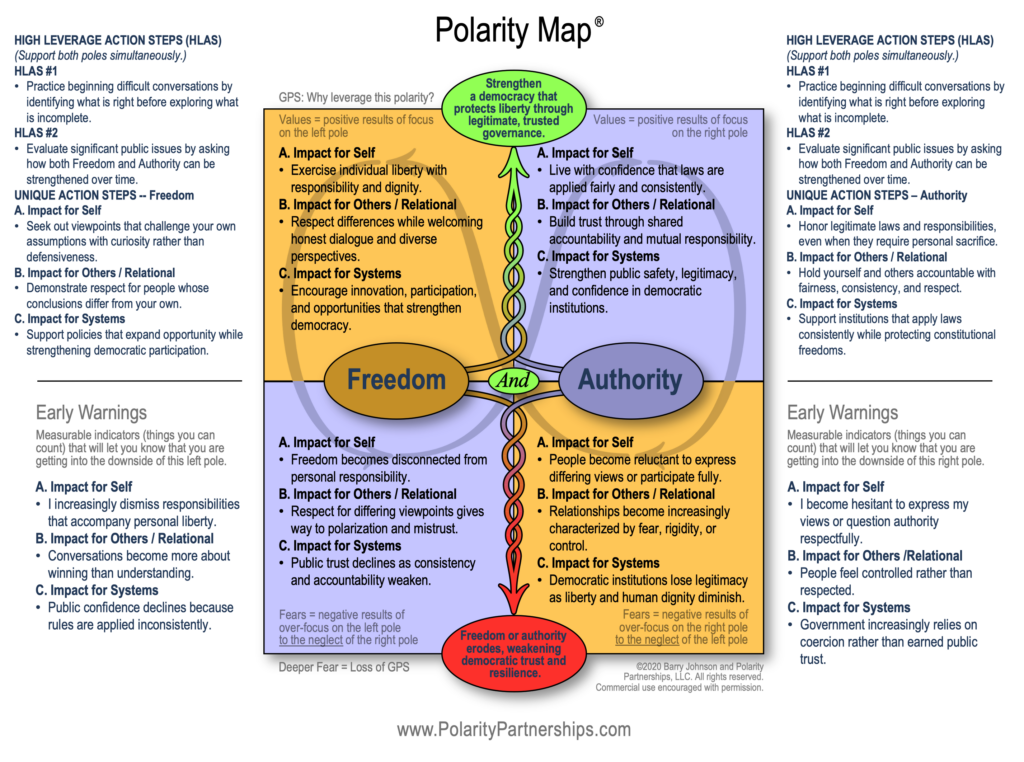
For me, the underlying polarity is one we’ve studied for decades at the Polarities of Democracy Institute: Freedom AND Authority. Every healthy democracy depends on both. Freedom without legitimate authority eventually produces disorder, uncertainty, and declining public confidence. Authority without freedom eventually produces fear, rigidity, and diminished human dignity. Neither pole is the enemy. Each becomes dangerous when pursued to the neglect of the other.
That’s true in families. It’s true in organizations. It’s true in democracies. And I think it’s true here.
Freedom AND Authority isn’t the only Polarity of Democracy this debate touches. Human Rights AND Communal Obligations sits right alongside it — every migrant’s claim to safety and dignity, held together with a community’s claim to decide who joins it and how. Justice AND Due Process shows up too, in how deportation and asylum actually get carried out. Different polarities, same underlying pattern: a healthy democracy holds several of these at once, not just one.
One of the things I appreciate about my fraternity brothers is that they care deeply about preserving something. They care about the rule of law. They care about safe communities. They care about fairness. They care about sovereignty.
I don’t dismiss those concerns. I share them. I’d happily stand beside them in strengthening those realities.
I hope they’d know I’d also stand beside them in protecting the freedoms that legitimate authority exists to preserve.
I also hope they’d recognize that I care deeply about something too. Human dignity. Compassion. Opportunity. The contributions immigrants have made, and continue to make, to this country. The possibility that America can remain both welcoming and lawful.
Neither of us is defending a political party. Each of us is protecting one side of a polarity that democracy itself depends on.
If that’s true, the conversation changes. I no longer need to prove my friend wrong. He no longer needs to prove me wrong. Instead, we might ask a different question: “What would it look like to strengthen both Freedom and Authority over time?”
That question invites a different kind of leadership. We might agree that immigration laws should be enforced consistently, because public trust depends on it. We might also agree that legal immigration should remain accessible, humane, and worthy of the people who seek to build a life here. We might support secure borders and efficient asylum processes while strengthening pathways for legal immigration and reducing incentives for unlawful entry. We might insist that compassion and accountability are partners, not competitors.
Democracy was built to hold enduring tensions like this one, and to help us live inside them wisely.
One of the greatest gifts my fraternity brothers have given me over the years is the reminder that disagreement doesn’t erase relationship. We’ve shared too much life together to reduce one another to a voting record. That history matters. So does the future we’re trying to leave behind.
If one of them sends me that article tomorrow and writes, “Tell me I’m wrong,” I hope I’ll answer differently.
“You’re right.”
“There’s another dimension I’d love to explore with you.”
“Would you be willing to see if we can strengthen both Freedom and Authority together?”
Because that’s the conversation America has been trying to have all along.
Every enduring democracy eventually discovers the same truth. Political arguments often sound like disagreements over policy. Over time, they reveal enduring values asking to be leveraged together.
Here’s a Polarity Map for Freedom AND Authority:
INVITATIONS:
For more on the Polarities of Democracy, see Dr. Bill Benet’s framework, CLICK HERE .
Want to learn more about Polarity Thinking and explore options for self-paced learning and Credentialing?
CLICK HERE
Want to use an AI-trained “Chat w/Cliff” to support you in Step 1 Seeing?
CLICK HERE