

- Advocating for “Both/And” thinking as a replacement for “Either/Or” thinking.
Example: “We need to get away from ‘Either/Or’ thinking and use ‘Both/And’. “
- Using “verses” as a conjunction for the two poles instead of “and”.
Example: “We’ve got a polarity of Structure versus Flexibility.” - Describing the two poles of a polarity in a negative-to-positive, with versus as the conjunction.
Example: “We’ve got a polarity of Rigidity vs Flexibility” or “Chaos vs Structure.”
- Describing the two poles of the polarity as “something” and “not something”.
Example: “I think we have a polarity of Structure” and Not Structure”. - Describing each pole as a polarity, instead of the two poles as a polarity.
Example: “I think we have a Structure polarity and Flexibility polarity.”
- Using “balance” to describe the optimal result or goal for addressing polarity tensions.
Example: “We need to do a better job of balancing the structure and flexibility polarity.”
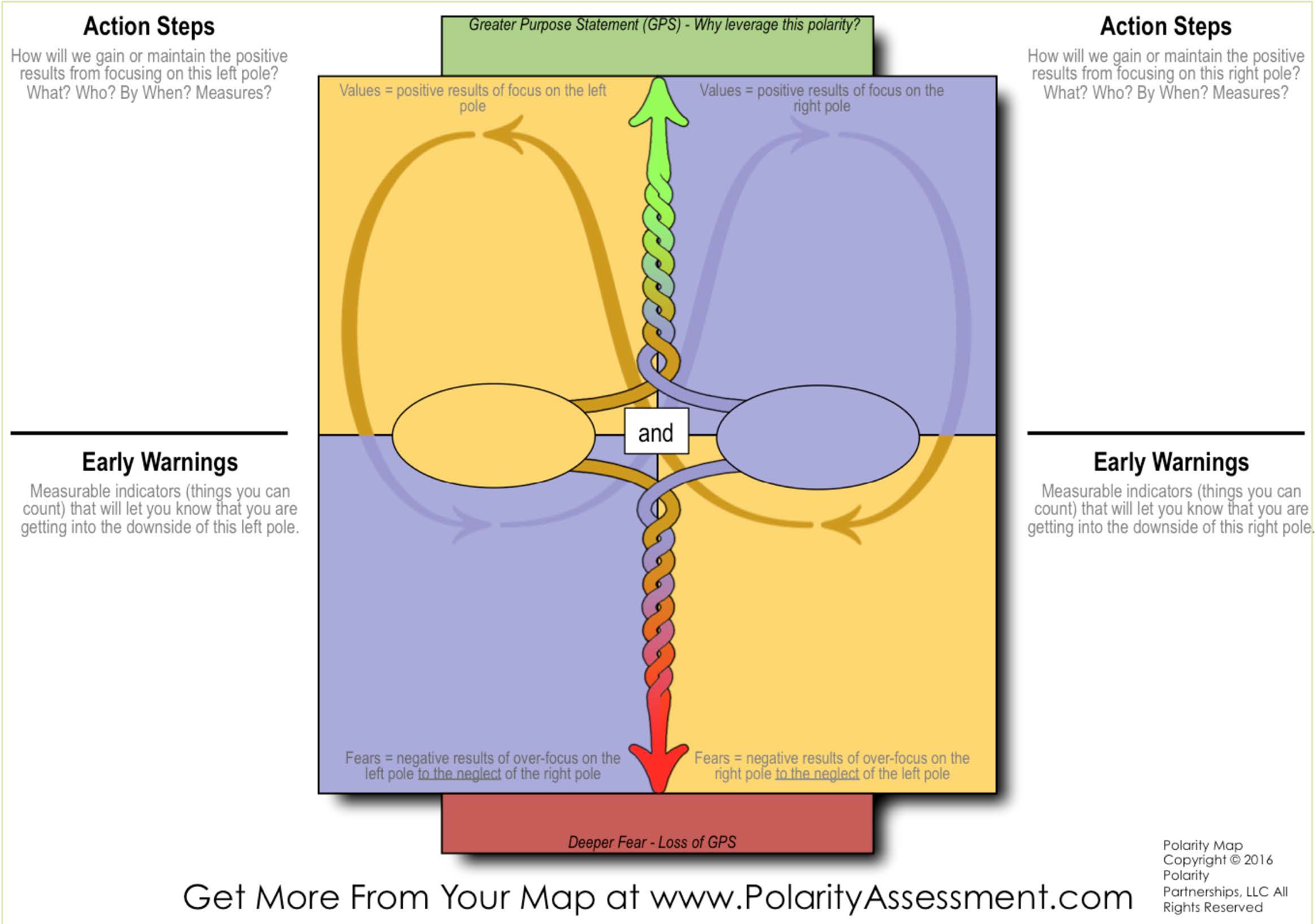
(The optimal state to maximize the upside benefits of both poles and minimize the downside limitations. The Polarity Map® depicts “leverage” as the optimal state with the infinity loop visual showing maximum upside benefit and minimal downside limitation. See Below) - Describing any choice or decision between alternatives as a polarity.
Example: “Look, Cookies versus Fruit — it’s a polarity! - Putting “and” between any two alternatives that may be solvable problems that are not interdependent with each other, and calling it a polarity.
Example: “I think I’ll have Red Wine and White Wine — it’s a polarity!” - Identifying poles names that are not differentiated from one another.
Examples: “I think we have a Structure and Organize polarity or “Flexibility and Emergence polarity.”
- Suggesting that “merging the poles” will eliminate the tension.
Example: “If we ‘structureflex’ that’ll solve the polarity.” (“Structureflex” could be a Greater Purpose.)