


Family businesses are a defining force in the economy. They span everything from corner stores to multi-billion-dollar enterprises, woven into the fabric of communities, regions, and industries. Scale alone doesn’t capture what makes them matter, though. They carry something most organizations don’t: memory that extends backward through generations and forward into futures that haven’t been named yet.
And they’re complex.
Nothing is wrong with that. Everything that matters is simply happening at once—economic performance, family relationships, identity, legacy, and future possibility—all inside the same system. Which makes understanding what these businesses actually are, and what makes them work, essential.
There are moments in this work when everything you’ve been trying to say shows up in a person. October of last year was one of those moments.
Meet my long-time friend and colleague, Cathy Carroll.

Barry and I were at Kayser Ridge hosting a PACT Certification cohort. I like to say I’m a pig in mud when I’m with Barry in that setting—surrounded by leaders who are hungry to learn, to practice, and to take Polarity Thinking into the world in their own way. This gathering was especially meaningful. It happened to be the 50-year anniversary of the Polarity Map, and we pulled off a surprise celebration that landed exactly the way you’d hope.

In the middle of all that, Cathy Carroll did what Cathy does. She made Polarity Thinking feel obvious.
Not simplified. Not reduced. Just accessible in a way that lands with people who don’t need the theory to know it’s true. You don’t feel like you’re being taught something new. You feel like you’re being reminded of something you already know but haven’t had language for.
And she wasn’t just speaking conceptually. Cathy had already been using the Polarity Assessment in her work—slightly ahead of the PACT pack—and she brought that lived application into the room. She walked the group through a real example from her own practice, demonstrating what applied polarity work looks like in action and giving the cohort a grounded introduction to the Applied Learning Project each participant would soon take on as part of their practicum.
That combination—clarity, practicality, and lived experience—is rare. And family business needs polarity thinking and practice. Because family business isn’t one polarity. It’s a multarity. (See Chapter 42 of And, Volume 2, Applications — .pdf at the end)
Family AND Business is the doorway, but it doesn’t stay there. It expands into a living system of interdependencies: Tradition AND Innovation, Family First AND Business First, Transparency AND Privacy, Support AND Challenge, Reveal AND Conceal, Cooperate AND Confront, Exclude AND Include (“Exclude” is considered a neutral or positive, FYI).
These aren’t separate tensions to manage one at a time. They are interwoven, each influencing the others and contributing to something larger than any single pair can explain.
Cathy also offered to share the polarities from her book in our Polarity Map Public Library, giving licensed practitioners worldwide access to them. That is mission work, personified. As her speaking and client work have evolved, she has kept adding to that set, drawn directly from lived experience. The library doesn’t just grow. It becomes more real.
That’s what we call multarities—interdependencies of more than two poles that together support a Greater Purpose that is more than the sum of the parts.
If Cathy’s book had come out a few years earlier, the Family Business multarity would have been part of my chapter in And: Volume Two. Because this is exactly what it looks like in practice.
Each polarity doesn’t just need to be leveraged on its own. Each sits inside a wider web. Shift one, and others move. And the cascade is predictable.
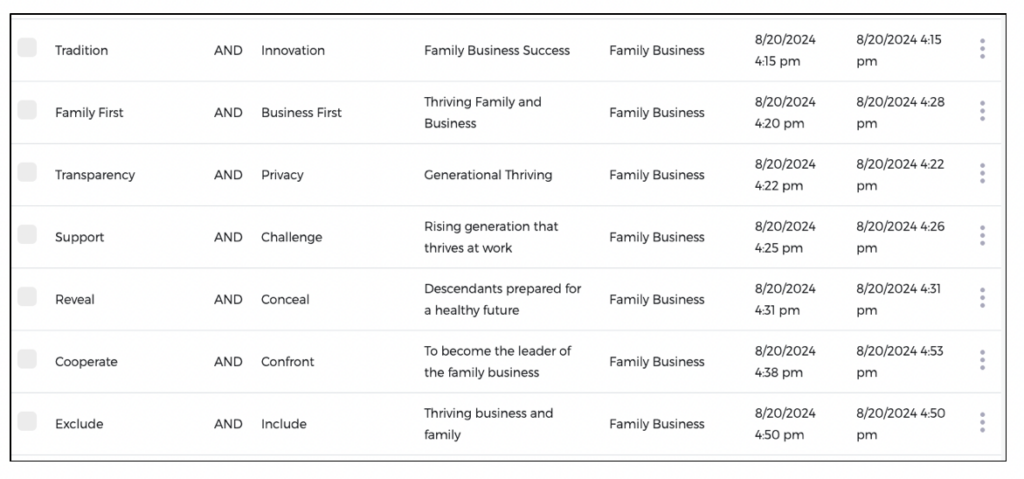
Overfocus on Family First to the neglect of Business First, and performance drops, which strains Business First further. To compensate, you start making exceptions—Inclusion to the neglect of Standards. Exceptions require you to hide information—Privacy to the neglect of Transparency. Hidden information erodes trust. Without honest challenge, poor performance remains—Cooperate to the neglect of Confront.
One shift cascades through the entire system. This is simply how the multarity begins to produce dysfunction.
In most organizations, Part AND Whole shows up as individual needs versus organizational goals. In family business, it shows up inside the same person—at the same moment—in the same decision. Am I a daughter or a CFO? Am I a brother or a board member? Am I protecting my parent or protecting the business they built? Am I honoring legacy or ensuring survival? You’re both if you’ve chosen to be in or stay in the Family Business. And the decision you make affects both the Individual AND System in ways that compound over time.
A daughter who is also CFO sits across from her father—the founder—and has to recommend closing a division he built. She knows it’s the right business decision. She also knows what it will cost him to hear it. She doesn’t get to be only the CFO in that moment. She is both. And whichever voice she leads with, the other one is still in the room.
That’s what makes family business different. In most organizations, tensions show up across roles. In family business, they show up inside people.
The same individual is a sibling, an owner, a leader, a parent, and a legacy holder. Every decision carries economic, relational, and identity consequences at the same time. So what looks like a disagreement about strategy is often something else entirely. These are not edge cases. They are the work. And underneath all of this is trust.
Trust in yourself—the capacity to hold Family Loyalty AND Business Accountability without reducing to one. Trust in others—that your sibling-partner, parent-founder, and child-successor can navigate these tensions without choosing sides that fracture the whole. Trust in the system—that it can sustain Family Values AND Market Realities, Legacy AND Innovation, What You Inherited AND What You Must Become. (For more on the Trust Multarity, GO HERE.)
When trust erodes at any of these levels, the multarity destabilizes. And in family business, trust doesn’t just erode from poor decisions. It erodes from unspoken expectations, unnamed tensions, and the accumulation of small fractures that never got addressed because “we don’t talk about that at Thanksgiving.”
This is why succession is one of the hardest challenges in organizational life. Families care intensely — about too many things at once, and those things pull in different directions.
You care about your kids AND you care about the business surviving. You care about fairness AND you care about competence. You care about tradition AND you care about adapting to market realities. You care about keeping the family together AND you care about telling the truth.
When these are treated as either/or choices, somebody loses. And in family business, the person who loses doesn’t just leave the company. They often still show up at Thanksgiving—with a story.
That’s the real cost.
And that’s what Cathy brings to life in Hug of War: How to Lead a Family Business With both Love and Logic. A grounded, human look at what happens when the expectations of family and the demands of business meet without a simple way to reconcile them.
As John A. Warnick put it, it’s “a groundbreaking guide for family business.” And as I shared when I first encountered her work, it’s “an essential resource…to foster harmonious and sustainable growth.”
What Cathy makes clear—through stories that take you into the lived experience of real leaders—is that these tensions are interdependencies to live inside. When the competing impulses of family and business are embraced as connected, leaders move beyond Either/Or-thinking into solutions that draw strength from both. Multiple Ands are active at once, whether we see them or not—improving one relationship strengthens the whole system, and neglecting one weakens several others. The work is seeing more: recognizing the web we are already inside, and choosing better because of it.
Family businesses require thinking in “Ands” — and the ones that can will always outperform those that can’t, or don’t. Because when these tensions are treated as problems to solve, the system responds. Relationships stiffen. Conversations get harder. What people say and what they mean begin to drift apart. The effort to fix it usually pushes harder in the same direction, which deepens the pattern.
Over time, the system produces the downside of multiple poles at once. That’s the part most frameworks miss. They assume you can choose.
Family business doesn’t give you that option. You don’t get to choose Family OR Business. You don’t get to choose Love OR Accountability. You don’t get to choose Inclusion OR Standards. You live inside all of them. All the time. In a system that remembers. And a future that extends beyond you.
That’s why Cathy’s contribution matters. She doesn’t just name these tensions. She reveals the system they live in. She gives families language for what they’re already experiencing—and a way to work with it without turning it into a win/lose conversation. By contributing these polarities to the Public Library, she’s made them usable for others doing the same work in their own systems.
Because here’s what happens when you can finally see the system you’re in:
What feels personal becomes structural. What feels isolated becomes interconnected. What feels stuck becomes something you can move within.
Because in family business, decisions don’t just land in the moment. They land across generations. Patterns compound. And the cost of getting it wrong isn’t just a missed quarter. It’s a fracture that carries forward through the system.
Which is why this is ultimately about more than managing tension. It’s about learning to live inside interdependence in a way that holds. Not perfectly. Not permanently. Consistently enough that relationships strengthen, performance sustains, and the next generation inherits something worth building on.
Leaders who can do that develop something a balance sheet can’t measure, though it determines whether that balance sheet holds. They develop the capacity to make wiser decisions over time.
I’m grateful to be connected with Cathy and to be doing this work alongside people who care enough to stay with what doesn’t resolve. AI may increasingly provide answers. Family business still requires people who can see the system they are in—and stay with it long enough for something wiser to emerge.
There are moments in this work when everything you’ve been trying to say shows up in a person. Cathy Carroll is one of those people.
And family businesses are one of those systems—where the work of seeing more clearly isn’t just helpful. It’s what allows the next generation to inherit something worth building on.
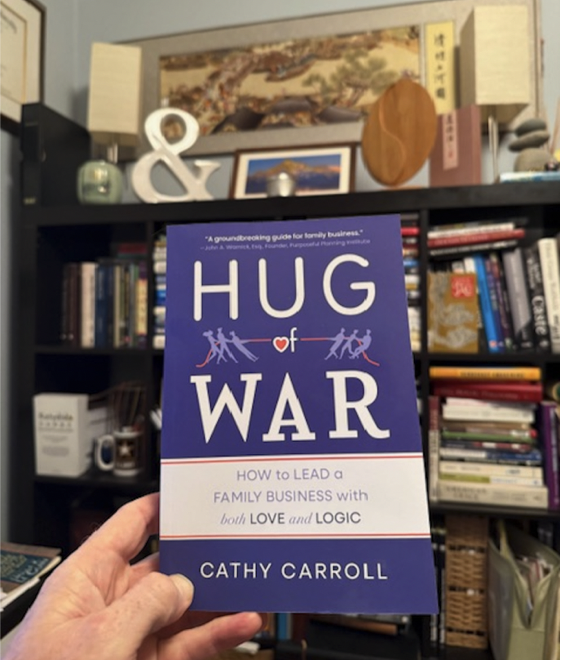
Get the book, here:
https://www.amazon.com/Hug-War-Family-Business-Logic/dp/B0D3GVL78V
Want to learn more about Polarity Thinking and explore options for self-paced learning and Credentialing?
CLICK HERE
Want to use an AI-trained Chat w/”Cliff” to support you in Step 1 Seeing?
CLICK HERE