
There’s a tendency—especially in leadership circles—to treat trust as a cultural layer that sits downstream from the “real work” of organizations. Strategy first. Execution first. Results first. Trust becomes something discussed afterward, usually once strain, disengagement, fragmentation, or burnout begin surfacing.
That framing has never held up particularly well once you start paying attention to how systems actually function.
Jack Gibb saw this long before most of us were looking in that direction. Trust was never merely a relational outcome in his work. It was part of the enabling condition that allowed relationships, coordination, learning, and interdependence to function in the first place. And it wasn’t static. It developed over time. It either expanded what a system was capable of, or quietly constrained it long before anyone fully recognized the consequences.
Barry Johnson credits Gibb, his mentor, directly in the Polarity Realities, especially the insight that “Seeing is loving.” I’ve increasingly come to think of that less as poetic language and more as operational reality. If we cannot see the larger system we are participating in, our responses narrow. We begin managing parts as though they are independent from the larger wholes they both shape and depend upon.
That’s where fragmentation begins accelerating.
Gibb described trust as developmental progression. Trust creates the conditions for Openness. Openness allows Alignment. Alignment strengthens coordinated action. Over time, systems become capable of deeper Interdependence—the very thing most organizations claim to want while struggling to cultivate the conditions that sustain it.
Over the years, while teaching leadership and coaching programs at American University and George Mason, I kept encountering something I couldn’t fully ignore. Different frameworks, different language, different entry points—and underneath them, increasingly familiar structural patterns.
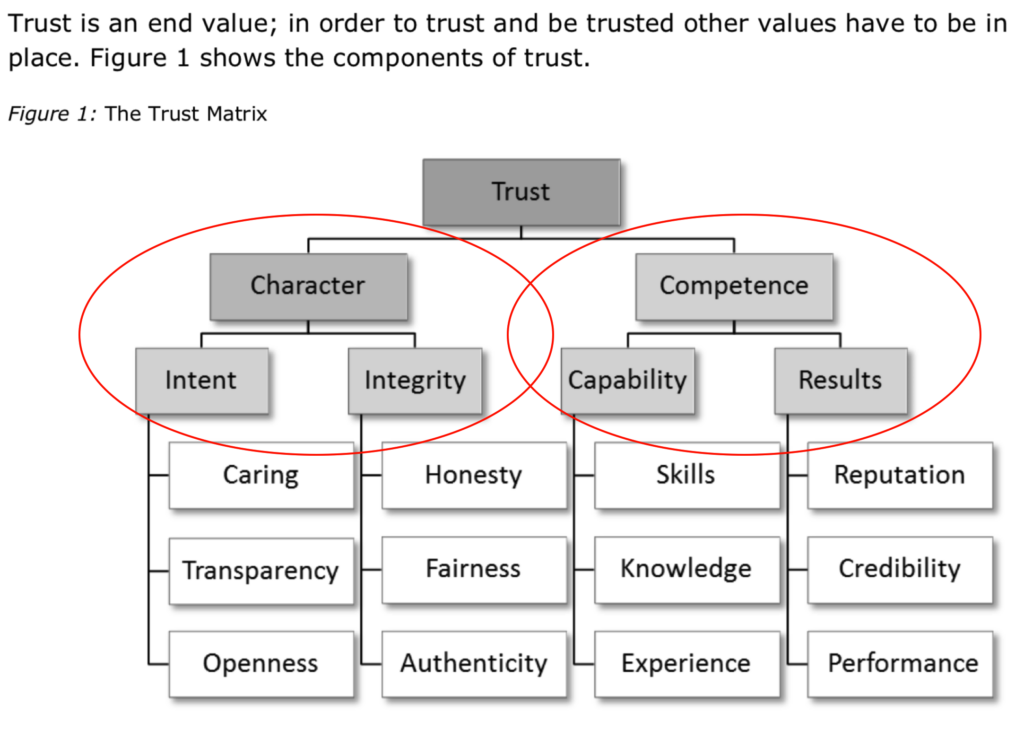
Covey explores Character AND Competence across Self, Relationship, Organizational, Market, and Societal trust.
Charles Feltman frames trust through Sincerity AND Care, Competence AND Reliability.
Richard Barrett connects trust to values alignment and levels of consciousness development.
The Center for Creative Leadership emphasizes Structural AND Relational dimensions across multiple leadership tensions and paradoxes.
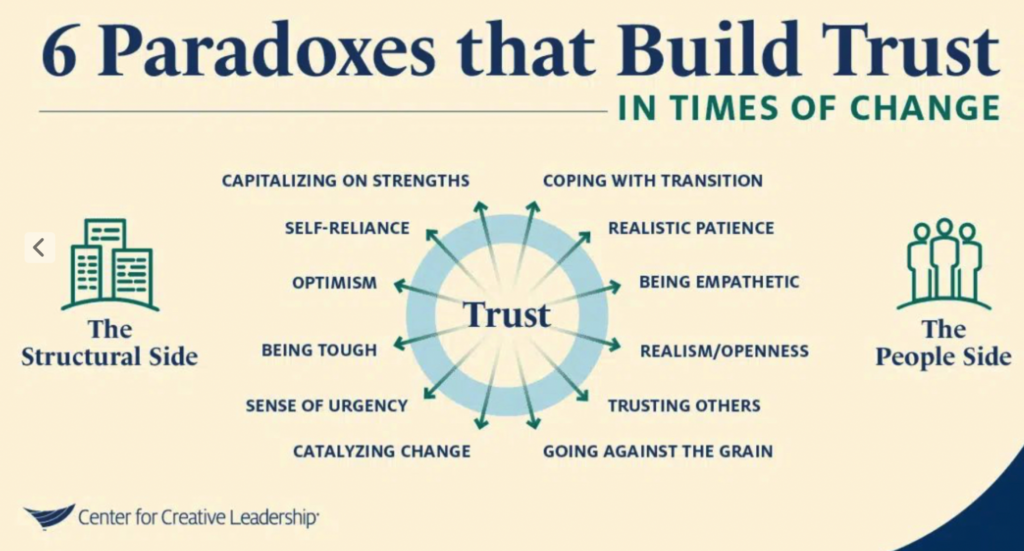
Individually, these models are useful. Seen together over time, something deeper starts becoming visible. The distinctions between them matter less than the recurring architecture underneath them.
What Covey describes through Character AND Competence resembles the same energetic tension Feltman approaches through Care AND Reliability. Barrett’s focus on values alignment echoes the ongoing relationship between Intention AND Behavior. CCL’s emphasis on feedback and accountability repeatedly surfaces tensions resembling Support AND Challenge.
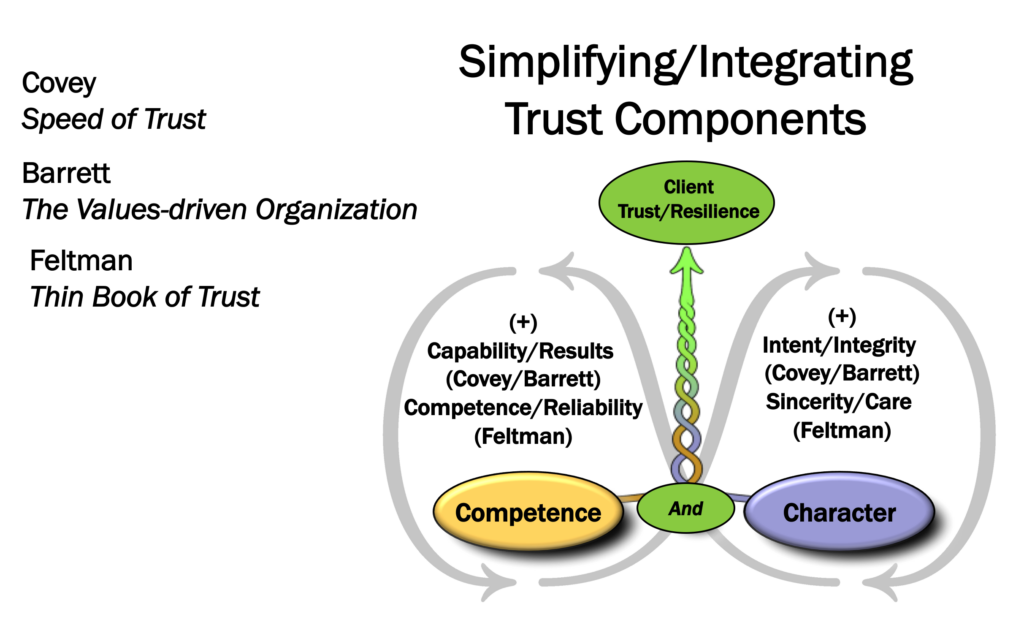
Different maps eventually start revealing overlapping terrain.
This is part of what makes Gibb so important in retrospect. He wasn’t simply adding another trust model into the field. He was helping illuminate the developmental conditions underneath the models themselves.
Trust rarely deteriorates in only one place.
It weakens systemically when interdependent tensions stop being leveraged well over time.
When Character outruns Competence, intentions remain strong while outcomes weaken.
When Competence outruns Character, performance may continue for a while as relationships slowly erode underneath it.
When Care expands without Accountability, standards drift.
When Accountability expands without Care, people disengage.
Behavioral correction alone rarely resolves those conditions for very long because the underlying interdependencies continue operating whether they are acknowledged or not.
That shift feels increasingly important to me now.
The movement from model selection toward structural understanding changes the conversation entirely.
Trust starts looking less like a variable and more like a Multarity—a field of interdependent polarities interacting simultaneously across levels:
Self Trust AND Relationship Trust AND Organizational Trust AND Societal Trust.
Character AND Competence.
Care AND Accountability.
Support AND Challenge.
Continuity AND Change.
The work is never about optimizing one side permanently.
The work is learning how to leverage the tensions well enough that the larger system remains capable of coherence, adaptability, discernment, and coordination over time.
That pattern becomes increasingly visible once you start looking for it.
Organizations where performance pressure expands faster than relational capacity.
Institutions where authority distances itself from accountability.
Social systems where competing narratives about truth, identity, and belonging lose the capacity to remain in meaningful relationship with one another.
This reaches far beyond leadership development.
It affects whether complex systems can continue functioning at all.
Yuval Noah Harari has been approaching similar concerns from another direction. His concern extends beyond misinformation itself into the erosion of shared trust in the structures that allow large-scale coordination to function. As trust weakens, coordination weakens with it. In highly networked and AI-amplified environments, those consequences scale quickly.
AI did not create those fractures, though it certainly accelerates them.
Information moves faster. Influence scales faster. Distortion scales faster. Human discernment struggles to keep pace with systems increasingly optimized for speed, stimulation, prediction, and amplification.
Whatever level of trust exists inside a system—strong or weak—tends to become amplified under those conditions.
Strong trust expands capability.
Fragile trust accelerates fragmentation.
The deeper tension increasingly appears developmental and systemic rather than merely technological.
Human Consciousness AND Artificial Intelligence.
If one accelerates far beyond the other, decision quality, coordination, and legitimacy begin straining under the imbalance.
Which eventually returns us to the larger polarity sitting underneath much of this work:
Part AND Whole.
Inner Development AND Outer Impact.
Sustainable system outcomes require internal capacities capable of navigating tension, uncertainty, difference, complexity, and interdependence over time. At the same time, development that never extends beyond the individual struggles to produce meaningful collective impact.
Trust lives inside that relationship.
Self Trust without System Trust often drifts toward isolation.
System Trust without Self Trust often produces compliance without ownership.
When both strengthen together, systems gain greater capacity to remain present to tension without immediately converting difference into threat, certainty, or fragmentation. Coordination improves. Discernment improves. Decisions hold together longer under pressure.
That’s part of what increasingly interests me.
Less the pursuit of better leadership techniques, and more the developmental conditions that allow wiser participation inside complex systems over time.
Wiser Decisions that hold—for both Part AND Whole.
Trust helps make that possible.
Not as a value statement or aspirational slogan, but as an interdependent developmental system requiring stewardship, maintenance, discernment, and ongoing leverage across multiple tensions simultaneously.
And if there’s a place to begin, it may simply involve noticing where one side of a tension has gradually expanded beyond relationship with the other.
That’s often where trust is already under strain, whether the system recognizes it yet or not.
Which eventually brings us back toward where Gibb started.
Seeing creates the possibility for systems, relationships, and human beings to begin functioning differently again.
Want to learn more about Polarity Thinking and explore options for self-paced learning and Credentialing?
CLICK HERE
Want to use an AI-trained Cliff to support you in Step 1 Seeing?
CLICK HERE