


See the Series Introduction for Just Tao It, Part I: HERE
See the Just Tao It Series Introduction Tao/It on-ramp, PART II: HERE
See Just Tao It, Chapter 1: HERE
From my interpretation of the Tao Te Ching, Chapter 13 (Unpublished):
At the far edge
of great success or suffering,
ground and balance
grow precarious.
In great suffering,
ground is near—
yet balance
does not appear.
In great success,
balance grows thin—
and ground
is hard to stand within.
At either edge,
attachment grows.
With ground and balance,
attention holds.
At the edge of desire or fear,
aspiration begins to veer.
With desire,
it reaches too far.
With fear,
it stays where you are.
From all or none,
effort is done—
yet spirit fades
before it’s won.
A steady source
comes from neither
desire nor fear.
It rests between
what pulls away
and what holds here.
Content to move
without excess—
aspiration alive,
and balance at rest.
—
We are watching leaders whose aspiration has separated from contentment.
They move with certainty but without grounding. They act with conviction but without reflection. They pursue outcomes without examining what those outcomes cost—or who pays.
For now, let’s focus on the pattern itself.
When aspiration operates without contentment, power begins to organize around its own momentum. Intent remains clear. But impact shifts. And the gap between what leaders mean and what people experience begins to widen.
Lao Tzu wrote the Tao Te Ching during the collapse of the Zhou dynasty—a time when factions were consolidating power, rulers were weaponizing law, and certainty was replacing wisdom. The parallels to our moment are not subtle.
The pattern is ancient. The technology amplifying it is new. And the stakes have never been higher.
At the far edge of aspiration, something subtle begins to shift. What begins as direction can become fixation. What begins as purpose can become insistence. The movement outward continues, but it loses its reference point.
This is where intent and impact begin to separate.
Intent remains clear—often even strengthened. The story holds. The purpose feels justified. But impact starts to land differently. What is meant to guide begins to press. What is meant to serve begins to narrow. The response from others changes, not always loudly, but noticeably. And rather than adjusting, intent often doubles down.
It’s easier to defend intent than to sit with impact.
We humans have a tendency to judge ourselves by our intent, and others by their impact.
I’ve caught myself doing this in my own consulting work—staying committed to a strategic direction long after clients had started experiencing it as pressure rather than partnership, because the intent behind it still felt right to me. Naming that out loud, even just to myself, has usually been the first step back toward Contentment.
This plays out at every scale. In individuals—how we grow without losing what grounds us. In systems—whether movement sustains or burns itself out.
You can’t have progress that holds without the capacity to pursue what’s next and remain connected to what already is.
Power has always carried this risk. It is rarely experienced as misuse from the inside. It is experienced as necessity, as clarity, as staying the course.
From the outside, it often feels different. It feels like something is no longer being heard. Something is no longer being seen.
This pattern plays out anywhere power concentrates. An executive convinced their vision is too important to slow down for the people questioning it. A founder who defends a strategy so vigorously that the team stops bringing him the data that contradicts it. A leader whose aspiration has become so untethered from grounding that opposition feels like betrayal and accountability feels like obstruction.
Aspiration, when it loses grounding, does not disappear. It intensifies. It organizes around its own momentum.
Fear plays its role as well. Where desire pushes forward, fear constrains. It protects what has been established, resists what might disrupt it, and narrows the field of what is considered possible. Between them, aspiration is no longer guided. It is pulled.
What is striking is how often this appears to work. Outcomes hold. Movement continues. The deviation is not immediately visible because it is reinforced by short-term success. Over time, what was once a departure becomes accepted. What is accepted no longer feels like a deviation at all. It becomes the way things are done.
By then, impact has already shifted.
Trust does not disappear in a single moment. It changes gradually.
Trust reorganizes around what is consistently experienced rather than what is intended.
When intent is used to explain away impact, the gap widens. And when that gap widens under the presence of power, it becomes difficult to close.
And when trust erodes, it erodes at every level.
Trust in yourself—that you can pursue ambitious goals without losing sight of what grounds you, that you can aspire AND remain connected to what already matters. Trust in others—that leaders with power will examine their impact, not just defend their intent. Trust in systems—that institutions can pursue progress without abandoning the people inside them.
When leaders operate with Aspiration to the neglect of Contentment, trust doesn’t just thin—it reorganizes around self-protection. People comply, but they stop believing. They perform, but they stop contributing. And systems built on that kind of trust don’t hold.
Democracy depends on this polarity.
It requires Aspiration—the belief that systems can improve, that injustice can be addressed, that the future can be different from the past. Without Aspiration, democracy atrophies into passive acceptance of what is.
But democracy also requires Contentment—the capacity to honor what currently exists, to work within established process even when it feels slow, to engage with opponents as fellow citizens rather than enemies to be defeated.
When Aspiration operates without Contentment, democratic norms become obstacles to be overcome. Checks and balances become barriers to be dismantled. Opposition becomes betrayal. The end justifies any means.
When Contentment operates without Aspiration, injustice persists. Systems settle around those they already serve.
We are seeing what happens when Aspiration separates from Contentment under conditions of concentrated power. Intent remains clear. Impact becomes damage. And trust—the invisible infrastructure democracy depends on—begins to erode.
And now artificial intelligence is accelerating Aspiration without generating Contentment.
AI can optimize for outcomes at unprecedented scale. It can pursue goals with relentless efficiency. It can execute on vision faster than any human system ever could.
What AI cannot do is hold Contentment. It cannot sense when optimization is causing harm. It cannot recognize when pursuit has become insistence. It cannot feel the cost of relentless forward motion on the people experiencing it.
We are generating Aspiration at AI speed while developing Contentment at human speed.
Leaders without Contentment are using AI-powered Aspiration to pursue vision without examining impact.
That combination—ungrounded aspiration, amplified by technology that has no capacity for reflection—is what makes this moment different.
The pattern is ancient. The scale is unprecedented. And the gap between intent and impact is widening faster than our capacity to close it.
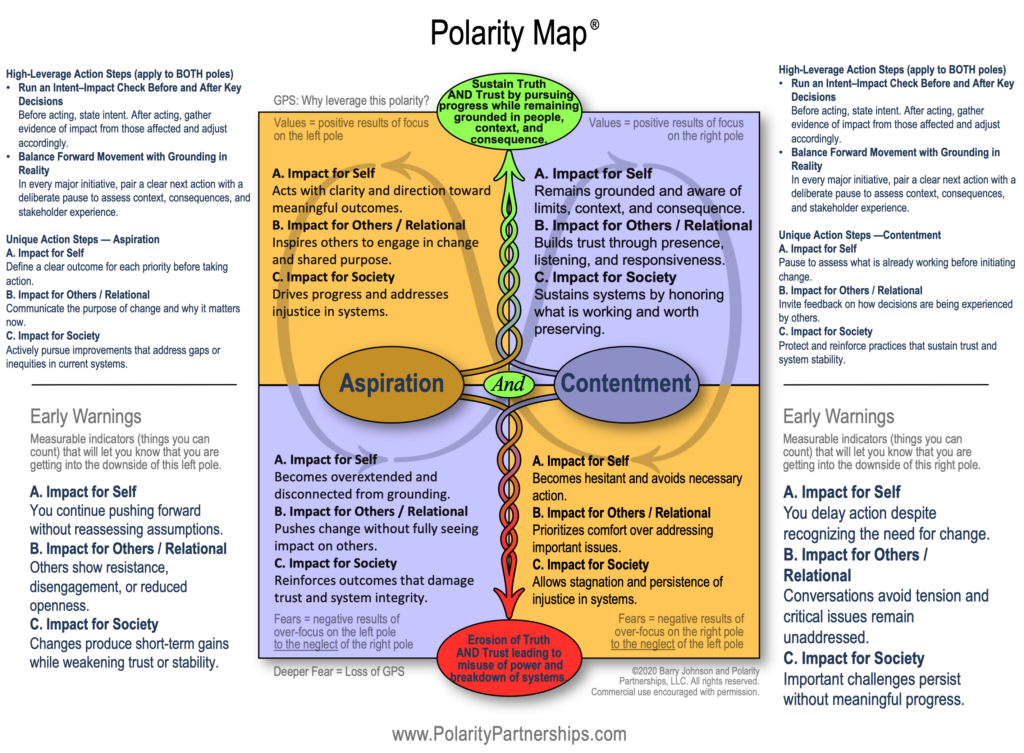
Aspiration AND Contentment hold this tension differently. Aspiration continues to move, to reach, to act. Contentment keeps that movement connected—to people, to context, to consequence. It allows intent to be examined through impact without losing direction.
Without that grounding, aspiration does not fail because it lacks energy. It fails because it loses relationship.
And what loses relationship cannot hold over time.
Leaders who can hold Aspiration AND Contentment together develop something rare and necessary: the capacity to make wiser decisions over time.
Decisions that pursue Progress AND honor what Sustains. Decisions that serve Immediate Need AND Long-Term Trust. Decisions that move forward AND remain grounded in Relationship. Decisions that don’t just achieve outcomes—but deepen the capacity to keep achieving them without burning out the people inside the system.
Lao Tzu knew this during the collapse of the Zhou dynasty. We are relearning it now.
The question is whether we will use it in time.
Here’s a Polarity Map for Aspiration And Contentment:
INVITATIONS:
Take a customized Polarity Assessment based on the Polarity Aspiration AND Contentment for this Chapter HERE.
To use an AI-trained “Chat w/Cliff” for Step 1, Seeing” CLICK HERE.
Ready for the Polarity Advantage? Go deeper into Polarity Thinking, see our online self-directed Credentialing and Introduction to Polarity Practice or in-person training with Barry Johnson and me at Kayser Ridge by CLICKING HERE.