

See the Series Introduction for Just Tao It, Part I: HERE
See the Just Tao It Series Introduction Tao/It on-ramp, PART II: HERE
See Just Tao It, Chapter 1: HERE
From my interpretation of the Tao Te Ching, Chapter 16 (Unpublished):
Watch, listen, and be
Empty space.
Stillness returns
Serenity.
Without the wellspring,
Life narrows.
Reckless movement growing,
Danger follows.
Remain near It.
From cracks, smallest,
Light appears.
Forever free,
There in It,
Serenity.
—
I’m pretty certain that for a long time I misunderstood what stillness meant in the context of this chapter.
I treated it as something adjacent to real life. Useful, certainly. Healthy, probably. I meditated regularly for years and took it seriously enough that most people around me would likely have described me as disciplined about it. But if I’m honest, much of that relationship still existed primarily from the neck up.
Stillness was something I practiced. It had not yet fully become something embodied.
Then a mountain biking accident rearranged the conversation.
The injuries were substantial: a traumatic brain injury, fractured C2 vertebrae, and an arterial dissection. Recovery was measured less by achievement than by restraint, and that changed far more than my physical condition.
There are seasons when effort helps, and there are seasons when effort itself becomes part of the problem.
That distinction became painfully real.
My nervous system no longer negotiated with life the way it once had. Cognitive overload arrived faster. Fatigue behaved differently. The relationship between stimulation and recovery changed. Even healing itself resisted force. Pushing harder often extended the problem instead of solving it.
That was deeply disorienting for someone accustomed to effort, productivity, usefulness, responsibility, and movement.
Especially movement.
Somewhere inside that long recovery, stillness stopped being conceptual. It became biological, and eventually existential.
During that period, I revisited my interpretation of the Tao Te Ching—a work shaped through decades of returning, revising, and seeing differently over time. Some chapters landed differently after the accident.
This was one of them:
Without the wellspring,
Life narrows.
Reckless movement growing,
Danger follows.
I no longer heard that merely as poetic wisdom.
I recognized it physically.
Movement disconnected from awareness had already nearly killed me once. During recovery, I could feel how modern life continuously rewards similar conditions: reactivity without reflection, certainty without grounding, acceleration without discernment.
The body keeps score (Dr. Bessel van der Kolk) — it knows things the ego often resists admitting. Perpetual activation extracts a price.
That feels especially relevant right now. This decade in the United States is proving extraordinarily difficult and destabilizing. Fear moves quickly through systems now. Outrage travels with it, often followed by a kind of tribal certainty that leaves little room for discernment. Entire institutions can drift below the line into reactivity while rewarding emotional escalation as virtue.
You can feel the pull constantly.
And if I’m being honest, I don’t stand outside that pull observing it from enlightened distance. Some days I navigate it reasonably well. Other days I can feel myself getting narrowed by frustration, fatigue, defensiveness, doomscrolling, over-identification, or the desire to force clarity where reality itself remains unsettled. (“World’s Worst Taoist” was originally the title of this series, which I was talked out of.)
That narrowing matters because once awareness narrows, movement tends to become reckless.
Which is why I’ve increasingly come to believe that the most important decision a leader makes in any moment may be: move or be still?
Most leaders no longer have enough interior space to make that choice consciously. The systems surrounding them reward speed over discernment, reaction over reflection, certainty over presence. Constant movement gradually becomes normalized, even when movement itself is amplifying the problem.
Chapter 16 feels connected to something much larger than serenity in the modern self-help sense. It feels connected to presence under pressure.
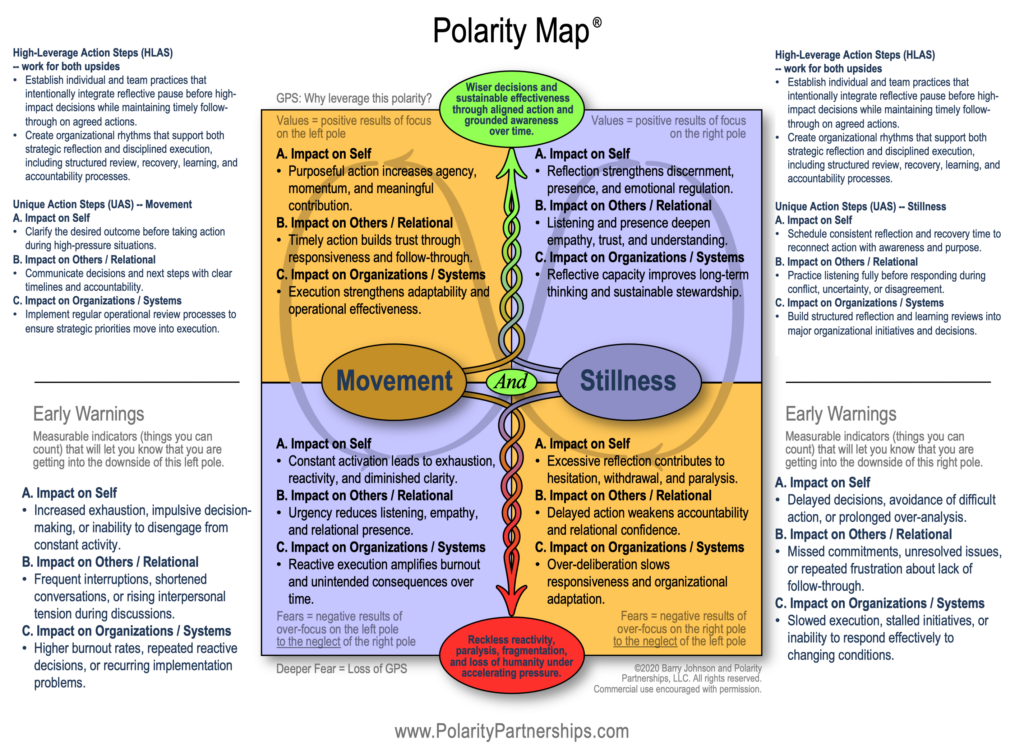
Movement AND Stillness exists in service of wiser action over time. Action emerges from awareness instead of compulsion. Responsiveness stays connected to reflection instead of pure reaction.
Movement disconnected from stillness tends toward reactivity—fast, certain, disconnected from deeper knowing. Stillness disconnected from participation gradually drifts toward paralysis. Awareness remains present, but action struggles to emerge when needed.
The Greater Purpose is developing the capacity to draw from both Movement and Stillness in service of what each moment actually requires. That capacity—knowing when to move and when to be still—may be one of the most critical leadership capacities in an accelerating world.
This is also a Part AND Whole question.
When individuals optimize for constant movement to the neglect of stillness, they serve the Part—immediate productivity, visible accomplishment, performance metrics—while weakening the Whole: relationships, long-term capacity, sustainable effectiveness.
When organizations optimize for execution speed to the neglect of reflective capacity, they often create cultures where exhaustion replaces discernment and urgency overrides learning.
At the same time, systems can drift too far toward Stillness. Reflection becomes delay. Discernment becomes over-processing. Awareness never fully converts into participation. Individuals hesitate to act. Organizations lose responsiveness. Necessary movement slows while conditions continue changing.
Civilizations require both movement and stillness over time. Growth without reflection destabilizes the future. Reflection without movement struggles to protect or sustain anything meaningful.
Every separation of Movement from Stillness eventually becomes a failure to honor interdependence—the recognition that sustainable effectiveness requires both action and awareness, both participation and reflection, both doing and being.
In my own work, I’ve often referred to a kind of grounded stillness as And Presence: remaining sufficiently grounded to stay connected to both poles without becoming captured by either.
That distinction feels increasingly important to me.
“Wu Wei” in Taoism, “effortless action” that aligns with the natural flow of life rather than fighting it), at least as I’ve slowly come to understand it, lives far away from passivity or disengagement. It feels closer to aligned participation. Action emerging from relationship with the wellspring instead of compulsive reaction.
And that is far harder than it sounds, especially in systems rewarding immediate certainty, perpetual performance, emotional activation, and endless invitations into DDT (Dreaded Drama Triangle): Victim, Persecutor, Rescuer.
TED (The Empowerment Dynamic) reframes that movement differently. Creator energy remains connected to both current reality and desired outcome without surrendering agency to fear. (See And V2, Chapter 39)
That feels deeply Taoist to me now. (Where am I right now? TED? DDT?)
The same imbalance appears again and again once you learn to recognize it.
Democracy requires both the movement of decisive action and the stillness of deliberative wisdom. Democratic systems worldwide are weakening as societies lose capacity for the stillness required for collective discernment.
AI accelerates this imbalance. Algorithmic systems optimize for movement—speed, decisiveness, execution, measurable action—while steadily compressing the pause between stimulus and response where wisdom emerges.
The environmental crisis reflects the same fracture. Relentless economic movement—growth, extraction, acceleration—separated from the stillness required to sense consequences, relationship, and sufficiency.
Trust weakens under similar conditions. Organizations execute faster while people feel increasingly disconnected from meaning. Leaders make decisions at speeds that diminish the relational presence required for accountability.
Movement disconnected from its source becomes reckless. Stillness disconnected from participation loses relevance.
Both are required. Neither is sufficient alone.
The Tao does not remove tension from life. It changes our relationship with tension.
Stillness, at least as I’ve come to experience it, feels less connected to becoming calm and more connected to remaining sufficiently grounded that action stays informed rather than compulsive.
Without stillness, action deteriorates into reaction. Without action, stillness deteriorates into withdrawal.
And perhaps that’s part of what I’m trying to learn in this period of life: how to remain useful without becoming consumed, engaged without becoming performative, responsive without becoming reactive, aware without drifting into paralysis.
Some days I do that better than others. And the difficulty seems to only be increasing.
AI removes the pause. Algorithmic acceleration optimizes for movement while systematically compressing the stillness where wisdom emerges.
The space between stimulus and response—the space Chapter 6 pointed toward as the well that never runs dry—is steadily shrinking.
This makes the cultivation of stillness not merely personally beneficial, but civilizationally essential.
Because if human beings lose the capacity for the stillness that allows discernment, decision-making increasingly shifts toward systems optimizing for speed without wisdom, execution without meaning, movement without awareness.
Whether we’ll use AI has already been decided. What remains open is whether we’ll maintain enough stillness to remain present to what AI is optimizing for—and whether those optimizations actually serve human flourishing or merely accelerate existing imbalance.
Still:
“From cracks, smallest,
Light appears.”
That’s truer for me now, than ever. Recovery stripped away some illusions about control, effort, certainty, and invulnerability that organized far more of my life than I understood at the time. Somewhere inside that stripping away, stillness stopped being merely something I visited.
It became something I needed to survive, and thrive.
Forever free,
There in It,
Serenity.
Here’s a Polarity Map for Movement AND Stillness:
INVITATIONS:
And_V2_PEEK_C39_TED
Self-assess by taking a custom Polarity Assessment for this chapter, HERE.
To use an “AI-trained Chat w/Cliff for Step 1, Seeing” CLICK HERE.
Ready for the Polarity Advantage? Go deeper into Polarity Thinking, see our online self-directed Credentialing and Introduction to Polarity Practice or in-person training with Barry Johnson and me at Kayser Ridge by CLICKING HERE.