

See the Series Introduction for Just Tao It, Part I: HERE
See the Just Tao It Series Introduction Tao/It on-ramp, PART II: HERE
See Just Tao It, Chapter 1: HERE
From my interpretation of the Tao Te Ching, Chapter 15 (Unpublished):
In ancient times
those who followed It
had simple presence.
They were watchful—
like one stepping
across an iced-over stream.
They were alert—
as if moving
through enemy terrain.
They were courteous,
like a well-mannered guest.
As melting ice,
they were fluid.
As uncarved wood,
they were solid.
As a valley,
they were open.
As clear water,
they were plain.
Quiet in form,
steady in being,
they did not rush
to be known.
—
I’ve been sitting with this chapter longer than most. Part of the reason is that it would be easy to misuse it. A person could read something like this and immediately start drifting toward nostalgia: a simpler world, a better past, stronger values, fewer complications, clearer lines. We’re already surrounded by enough of that impulse, and much of it is fear searching for certainty while wearing the clothing of wisdom.
It asks how a human being remains grounded while moving through conditions that reward speed, reaction, certainty, visibility, and emotional escalation. That’s a far more difficult practice than romanticizing the past.
The descriptions themselves are almost understated. Watchful. Careful. Courteous. Fluid. Solid. Open. Plain. None of it sounds especially dramatic, which may be part of why modern systems tend to overlook these qualities entirely. We’ve become conditioned to associate impact with force, immediacy, confidence, dominance, and performance. If something doesn’t arrive loudly, people often fail to recognize its depth.
Yet the people described here are not passive. They’re disciplined in ways that don’t require constant announcement. They see clearly and they remain composed enough not to be pulled into every current surrounding them. The image of crossing an iced-over stream feels especially important to me now. The person crossing the ice is not frozen or timid. They are attentive. They understand consequences. They understand that careless movement creates unnecessary danger.
We’ve built environments extraordinarily effective at generating response. Response drives engagement. Engagement drives amplification. Outrage spreads quickly. Fear spreads quickly. Certainty spreads quickly. Systems optimized around reaction reward people for moving before understanding fully forms.
Over time, the pace itself starts shaping perception.
People form conclusions before examining conditions carefully. They adopt positions before understanding the ground beneath them. Immediate reaction starts resembling competence. Emotional certainty starts resembling clarity. And because systems reward these behaviors with visibility and reinforcement, many people gradually stop recognizing the difference between responsiveness and reactivity.
Eventually the system’s pace becomes internalized.
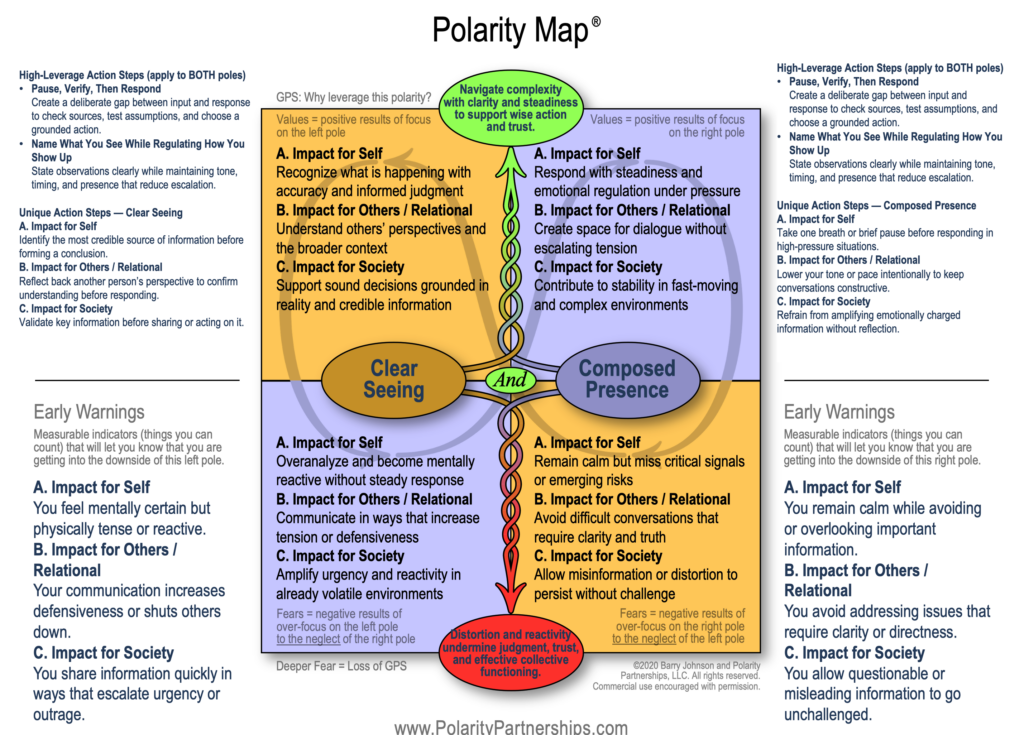
Clear Seeing AND Composed Presence.
Clear Seeing helps us recognize what is happening. Composed Presence helps prevent us from adding distortion to it. Lose either one and the system gradually starts governing us from the inside.
A few years ago, after my accident, I experienced a period where I could no longer orient myself using many of the frameworks and patterns that had guided me for decades. The familiar movement between poles no longer felt accessible. I wasn’t experiencing obvious preference, momentum, certainty, or directional pull. Everything felt strangely neutral. The familiar internal pull toward one pole or another had gone still.
It slowly occurred to me that I was experiencing something closer to the center of the polarity itself—not detached from the map, but located inside the place that holds all quadrants simultaneously without fully identifying with any single one.
There wasn’t much certainty available there. Very little control either.
There was presence.
Breathe. Be. Then do the next thing.
That experience permanently changed my relationship with the poem. Composed Presence became the capacity to remain grounded while reaction never fully took control of perception.
Clear Seeing to the neglect of Composed Presence easily turns into intelligent reactivity. A person recognizes patterns accurately while still being emotionally captured by them. Awareness accelerates while discernment weakens.
Composed Presence to the neglect of Clear Seeing creates different risks. A person maintains steadiness while gradually losing relationship with changing reality around them. The nervous system remains calm while perception becomes outdated.
Together, though, they create something far more durable: the ability to move through complexity without becoming entirely shaped by the surrounding system.
The image of uncarved wood has held my attention for years because it carries something deeply relevant to modern life. Uncarved wood is whole. Full of possibility. Once carved into a particular instrument or identity, usefulness increases in one direction while possibility narrows in others.
Systems carve people constantly.
Organizations shape identity. Political systems shape identity. Algorithms shape identity. Social media rewards particular forms of presentation, reaction, and visibility. Over time, people can become optimized for response itself—quick positioning, emotional signaling, certainty performance—while slowly losing access to wider dimensions of themselves.
Clear Seeing AND Composed Presence helps preserve enough wholeness that we remain capable of choosing how we participate rather than becoming unconsciously shaped by every surrounding force.
One line has shaped my thinking for years:
they did not rush
to be known
Everything in modern culture rewards visibility. People are expected to respond immediately, position themselves publicly, signal identity rapidly, and maintain continuous participation in the attention economy. Silence often gets interpreted as weakness, irrelevance, ignorance, or lack of conviction.
And yet many of the wisest people I’ve encountered move differently. Their impact comes from the quality of presence they bring once they do respond, not the speed of the response itself. Over time, people learn they can trust how those individuals engage because the engagement emerges from discernment instead of compulsion.
That kind of trust develops slowly. People learn you are capable of remaining present without being swept away by every current surrounding you. They learn your responses emerge from groundedness rather than emotional contagion or social pressure.
The system still pulls, of course. It always will. The deeper question has never been whether the current exists. The question is whether we notice when it begins setting the pace of our own perception.
Systems optimize for engagement, response, stimulation, speed, and amplification. These dynamics are powerful. Their consequences depend on how we participate in them.
Which leaves the deeper question sitting with us personally:
Can we recognize when we are being pulled? Can we remain grounded enough to choose our participation consciously instead of reacting automatically?
Clear Seeing AND Composed Presence.
Both, over time. In ways that allow movement without surrendering ourselves entirely to the movement surrounding us.
The ancient ones moved with intentionality. Intentionality may be one of the most necessary human capacities remaining in an age organized around acceleration.
Here’s a Polarity Map for Clear Seeing And Composed Presence:
INVITATIONS:
Take a custom Polarity self-assessment based on this polarity HERE.
To use an AI-trained “Chat w/Cliff” for Step 1, Seeing” CLICK HERE.
Ready for the Polarity Advantage? Go deeper into Polarity Thinking, see our online self-directed Credentialing and Introduction to Polarity Practice or in-person training with Barry Johnson and me at Kayser Ridge by CLICKING HERE.