

See the Series Introduction for Just Tao It, Part I: HERE
See the Just Tao It Series Introduction Tao/It on-ramp, PART II: HERE
See Just Tao It, Chapter 1: HERE
From my interpretation of the Tao Te Ching, Chapter 58 (Unpublished):
When the country is governed well,
People thrive.
When the country is unjust and unmerciful,
People become reactive and unaware.
Happiness is found,
And circled around.
In losing the ability
To be honest and truthful,
Truth is the lie,
Honesty the deceitful.
And so, the wise
Are jagged,
And do not cut.
Are pointed,
And do not hurt.
Are forthright,
Without bad intent.
They offer insight
Without forcing,
One way as right.
—
In 2026, the United States turns 250 years old. That feels worth paying attention to. Two hundred and fifty years is long enough for ideals to become institutions, institutions to become traditions, and traditions to become assumptions that few people stop to examine. It is also long enough for every generation to discover, in its own way, that self-government is harder than it looks.
Happy 250th Birthday, America.
Around 2,500 years ago, Lao Tzu was watching a different society wrestle with many of the same human tendencies. Kingdoms competed for power. Leaders sought greater control. People were drawn toward certainty during uncertain times. Chapter 58 reads less like philosophy and more like the notes of someone paying careful attention to what happens when human beings become disconnected from reality while remaining convinced they possess it.
The line that captures the chapter’s warning sits right in the middle: Truth is the lie. Honesty the deceitful. Those words have always struck me as strange. Then again, so has human behavior.
Most of us have witnessed some version of this dynamic. A leader becomes successful and gradually stops receiving candid feedback. A management team becomes convinced it has found the answer and grows less interested in contrary evidence. A movement begins with legitimate concerns and eventually treats disagreement as betrayal. A family develops rules about what can and cannot be discussed. A church, company, nation, or political party starts confusing loyalty with truth.
People rarely set out to deceive themselves. The process is usually more subtle. We become attached to a particular explanation, a particular leader, a particular identity, a particular story about the world. Information that supports the story receives a warm welcome. Information that complicates the story receives a cooler reception. Eventually the flow of information changes. Questions become less frequent. Challenges become less comfortable. Reality begins arriving through increasingly narrow channels.
The language often remains unchanged throughout the process. Truth is still discussed. Honesty is still praised. Transparency still appears in mission statements and speeches. Yet something important begins shifting beneath the surface. The words stay put while their meaning slowly migrates elsewhere.
The pattern becomes predictable once you have watched it enough times. A leader becomes successful. The success creates confidence. The confidence attracts followers. The followers begin trusting the leader’s judgment. The trust gradually becomes deference. The deference reduces challenge. The reduction in challenge weakens correction. Before long, information starts arriving pre-filtered. Bad news develops a habit of arriving late. Nobody intends for this to happen. Most participants remain convinced they are helping. That may be the most fascinating part of the entire process.
Lao Tzu appears to be describing a system that has lost its capacity for self-correction.
That observation feels especially relevant in a year when Americans are celebrating a quarter of a millennium of constitutional democracy. The founders understood that human beings are vulnerable to certainty, especially when it arrives wrapped in confidence, simplicity, and promises of security. Madison wrote about it explicitly. Hamilton wrote about it. Much of the architecture they designed — the distribution of power, the insistence on independent oversight, the mechanisms for correction and accountability — can be understood as an attempt to preserve Discernment alongside Certainty, to keep reality welcome at the table even when authority would prefer otherwise.
Chapter 58 points toward a polarity the founders understood without having a name for it:
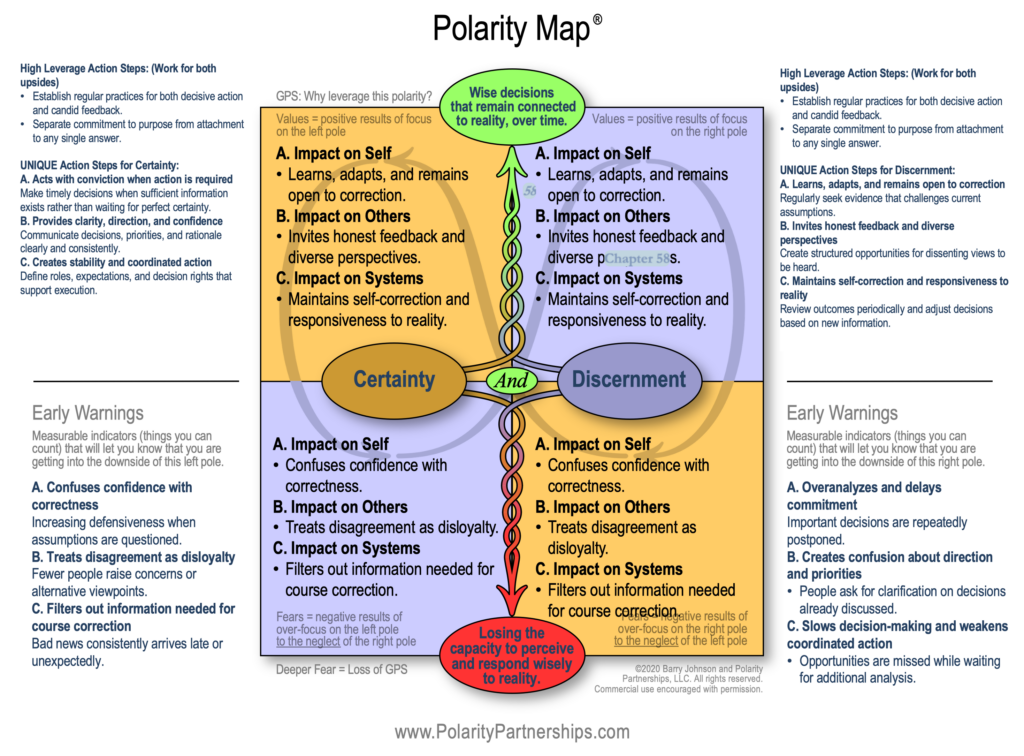
Certainty And Discernment.
Certainty contributes direction — it helps people act, allows leaders to make decisions, organizations to move forward, and societies to pursue common purposes. Discernment contributes something equally necessary: room for questions, feedback, learning, and adjustment. It helps reality find its way into the conversation. Neither contribution remains sufficient for very long without the other, and the ability to leverage both together — continuously, imperfectly, over time — is what distinguishes genuinely great leaders from those who simply held the title.
When Certainty is pursued to the neglect of Discernment, a governing system gradually loses the capacity to know it is making poor decisions. When Discernment is pursued to the neglect of Certainty, the capacity for action can drift into endless deliberation. Both patterns appear regularly in leaders, organizations, movements, and governments of every kind. The challenge becomes especially visible during periods of genuine uncertainty, when the desire for a clear answer — for someone willing to declare exactly what is happening and exactly what should be done about it — can become stronger than the desire for accuracy.
That is where Chapter 58 begins feeling remarkably contemporary, sadly. And for some of us, depressingly so.
The chapter concludes with a description of the wise that has always felt refreshingly practical. The wise are jagged and pointed and forthright — possessing perspective, clarity, and judgment. These are qualities of real authority. And none of those qualities become weapons. Their jaggedness does not cut. Their pointedness does not hurt. Their forthrightness carries no bad intent. Their insight is offered without forcing one way as right.
The leader who can hold this combination — conviction without requiring submission to it, clarity without sealing off the channel for honest information — is the one to which this chapter points.
I find myself thinking about that image whenever discussions about leadership become dominated by confidence and strength. Lao Tzu doesn’t seem concerned with whether leaders possess conviction and more concerned with what happens to their relationship with reality after they acquire it. That is a useful question for leaders. It is a useful question for organizations and democracies. And it may be the most useful question available to those of us participating in the American experiment as it enters its 250th year.
Chapter 58 does not offer a final answer. The relationship between Certainty And Discernment remains active in every generation. The invitation is ongoing. Each era inherits the same challenge:
to leverage both — enough Certainty to act and enough Discernment to learn.
The future depends upon our ability to do both.
Here’s a Polarity Map for Certainty AND Discernment:
INVITATIONS:
To use an AI-trained “Chat w/Cliff” for Step 1, Seeing” CLICK HERE.
Ready for the Polarity Advantage? Go deeper into Polarity Thinking, see our online self-directed Credentialing and Introduction to Polarity Practice or in-person training with Barry Johnson and me at Kayser Ridge by CLICKING HERE.