

See the Series Introduction for Just Tao It, Part I: HERE
See the Just Tao It Series Introduction Tao/It on-ramp, PART II: HERE
See Just Tao It, Chapter 1: HERE
From my interpretation of the Tao Te Ching, Chapter 30 (Unpublished):
Using It with skill
Avoids violence
From weakness of will
Or a loss of purpose.
Power skill knows violent action,
Holds the similar reaction.
Even sincere intention
Cannot forsake
Grief from everyone
In the violent wake.
Using It power skillfully
Holds fast to purpose
Acting willfully
Retreating to advance
Succeeding through absence.
—
One of the reasons I find the Tao Te Ching so remarkable is that Lao Tzu keeps describing patterns that remain recognizable twenty-five centuries later. The technologies change. The borders change. The flags change. Human beings remain remarkably consistent.
Chapter 30 is often read as a warning about war. It certainly includes that warning. Yet the deeper lesson seems broader. The chapter is concerned with what happens when force becomes a preferred tool for solving problems. Armies are one expression. Governments are another. Organizations, movements, institutions, and even families can find themselves wrestling with the same temptation.
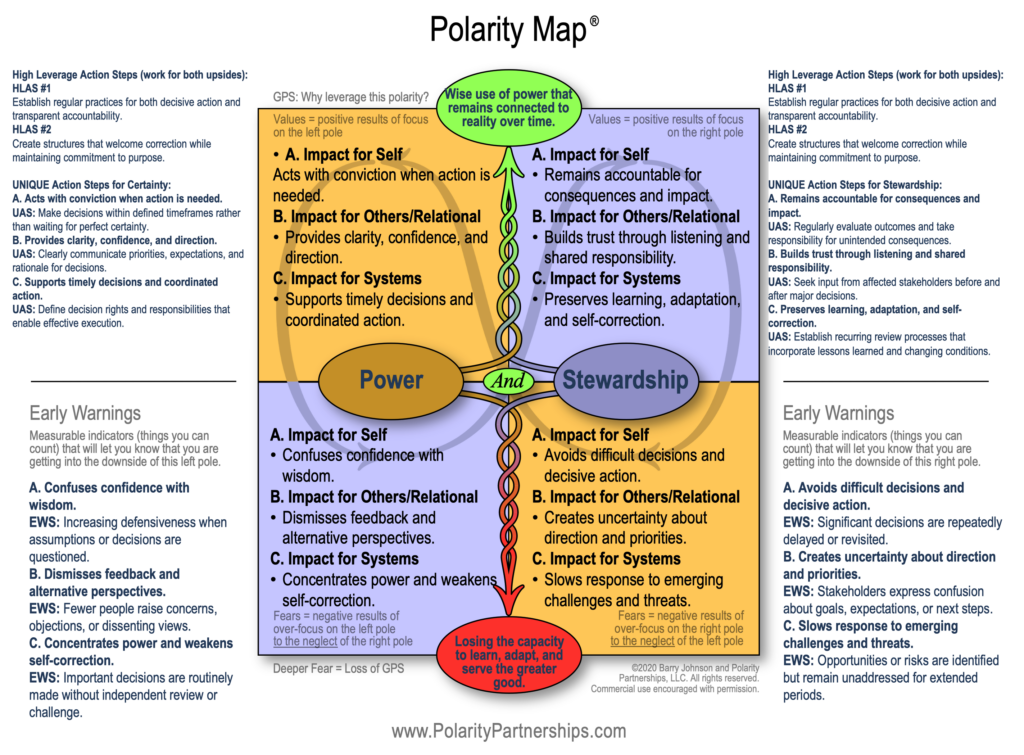
The temptation is understandable. Force creates movement. It produces visible results. It projects confidence. It offers the reassuring appearance that somebody is in control. During uncertain times, that appearance can become extremely attractive. From a polarity perspective, the deeper challenge is Power And Stewardship. Human systems need enough Power to act and enough Stewardship to remain connected to reality. Remove Power and meaningful action becomes difficult. Remove Stewardship and power gradually begins serving itself.
History contains no shortage of examples.
In his work on the history of human civilization, Yuval Noah Harari describes the twentieth century as a contest between three great stories about how societies should organize themselves: Fascism, Communism, and Liberal Democracy. Each promised a different path toward human flourishing. Each developed a different answer to the question of how information should move through a society.
Fascism sought unity through centralized authority, national identity, and the concentration of power. Communism sought equality through centralized planning and state control. Democracy distributed authority across institutions, elections, courts, journalism, markets, civic organizations, and citizens themselves.
The outcomes tell an interesting story.
Both Fascism and Communism struggled with self-correction. Information flowed upward through increasingly narrow channels. Leaders became insulated from reality. Loyalty became more valuable than dissent. Questions became less welcome than certainty. By the time significant mistakes became visible, the systems often lacked the ability to adjust course.
Harari’s explanation is practical. Democracies frequently outperformed their authoritarian rivals because distributed systems process information more effectively than centralized ones. More voices create more correction. More correction creates better decisions over time. The defining strength of a healthy democracy may not be that it avoids mistakes. Its defining strength may be that it retains the capacity to recognize and correct them.
Lao Tzu approaches the same territory from a different direction.
Chapter 30 repeatedly warns against forcing outcomes. It cautions against intimidation, domination, boasting, and the pursuit of strength for its own sake. The chapter recognizes that power detached from stewardship eventually loses touch with reality. Once that happens, leaders begin reacting to the world they imagine rather than the world that actually exists.
The pattern extends far beyond politics. Organizations experience it when executives become insulated from difficult truths. Religious institutions experience it when leaders become increasingly immune from challenge. Families experience it when authority becomes disconnected from listening. Individuals experience it whenever certainty becomes more attractive than curiosity. The scale changes. The pattern remains recognizable.
Whenever authority becomes disconnected from feedback, correction becomes difficult. Whenever certainty becomes disconnected from curiosity, learning becomes difficult. Whenever power becomes disconnected from stewardship, unintended consequences begin accumulating.
This is where democracy becomes especially interesting from a polarity perspective.
Democracy is not built on the assumption that people will always be wise. It is built on the assumption that people will often be wrong. The genius of the system lies less in preventing mistakes than in creating mechanisms that help society discover and correct them. Elections, an independent judiciary, free expression, competing viewpoints, and a free press all serve a similar purpose. They help reality remain welcome in the conversation.
That contribution feels increasingly important in an age shaped by artificial intelligence, algorithmic influence, and unprecedented concentrations of information. Harari warns that modern technologies may allow centralized systems to process information at scales previously unimaginable. Artificial intelligence introduces a fascinating twist. For most of human history, authoritarian systems struggled because no central authority could gather and process enough information to govern effectively. AI may change that equation. The question is whether greater computational power will increase human wisdom or simply increase the efficiency with which human beings make the same mistakes.
With great sadness, I find this concern both remarkably contemporary and remarkably ancient.
Chapter 30 suggests that enduring power requires something different from domination. It requires Stewardship. Stewardship recognizes that power exists in service of a larger purpose. Stewardship remains interested in consequences. Stewardship understands that force may occasionally be necessary while also recognizing that every use of force leaves a wake.
The chapter’s wisdom becomes easier to appreciate when viewed through that lens.
Power contributes direction, protection, action, and decisive leadership. Stewardship contributes restraint, accountability, correction, and care for the larger system. Both remain essential. The challenge has never been choosing one over the other. The challenge is leveraging them together.
Twenty-five centuries after Lao Tzu wrote Chapter 30, humanity still appears to be wrestling with the same question: How do we exercise power without becoming captive to it?
The technologies have changed.
The stakes have grown.
The question remains.
Here’s a Polarity Map for Power AND Stewardship:
INVITATIONS:
To use an AI-trained “Chat w/Cliff” for Step 1, Seeing” CLICK HERE.
Ready for the Polarity Advantage? Go deeper into Polarity Thinking, see our online self-directed Credentialing and Introduction to Polarity Practice or in-person training with Barry Johnson and me at Kayser Ridge by CLICKING HERE.