

See the Series Introduction for Just Tao It, Part I: HERE
See the Just Tao It Series Introduction Tao/It on-ramp, PART II: HERE
See Just Tao It, Chapter 1: HERE
From my interpretation of the Tao Te Ching, Chapter 17 (Unpublished):
The best leaders,
Dependence disappears.
The next best leaders,
Are praised.
The next,
Are feared.
The worst,
Are despised.
Leaders who respect the people
Earn respect in return.
By giving trust,
They receive trust.
They do not impose the way forward,
Yet the way appears.
And when the work is done,
The people say,
“We did this ourselves.”
—
When I sit with this chapter and then look at leadership in American politics today, I don’t reach first for analysis. I find myself holding my head in my hands. There’s disgust in there. Some anger. And something deeper that feels closer to grief. Grief for what is happening, certainly, though also grief for what we are gradually starting to accept as normal.
What troubles me most extends beyond poor leadership. It reflects a drift in how power is held, exercised, concentrated, justified, and normalized over time.
Underneath all of it sits one simple test: healthy leadership increases the capacity of the people. Unhealthy leadership increases dependence on the leader.
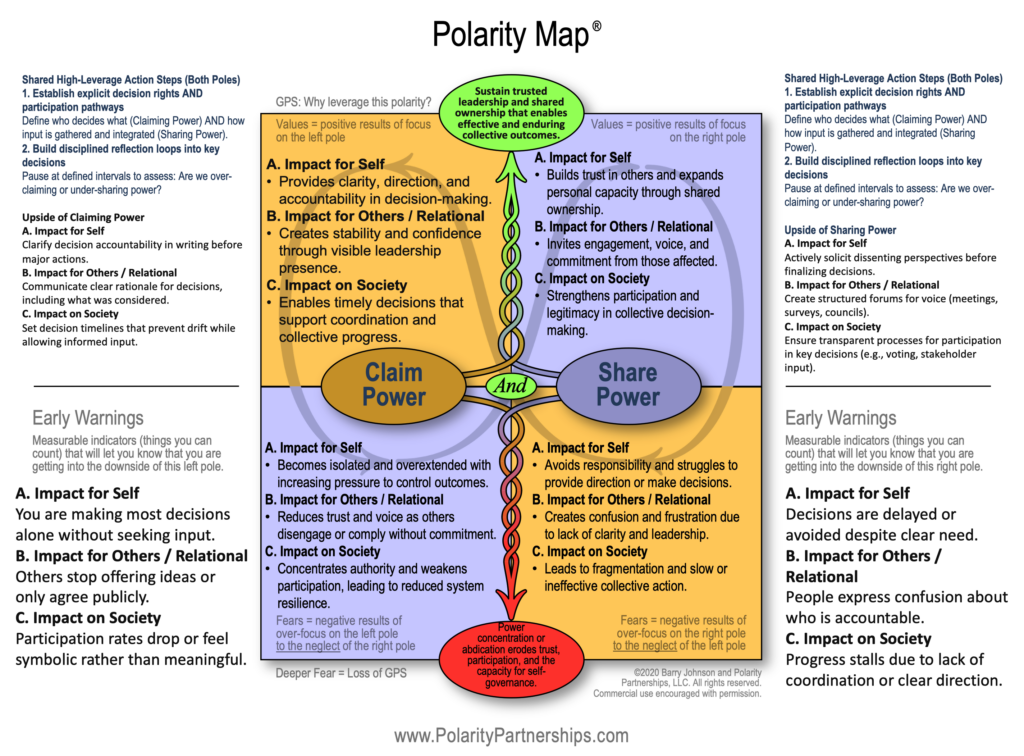
This chapter lives inside a polarity that shows up everywhere from individuals to entire nations: Claim Power AND Share Power (see Chapter 22 of And, Volume 1, Foundations).
Every leader claims power. That’s unavoidable. Decisions need to be made, direction needs to be established, responsibility eventually lands somewhere. The leaders this chapter points toward, though, do not stop there. They share power as part of how leadership itself operates. And when that polarity is leveraged well, something important begins happening inside the larger system. People do not become dependent. They become engaged. Ownership no longer needs to be assigned artificially because participation itself starts generating commitment. The work gradually shifts from belonging primarily to the leader toward belonging increasingly to the people themselves.
That dynamic is woven deeply into democracy.
In the language of Polarities of Democracy, Claim Power AND Share Power lives inside Participation AND Representation. Representation requires leaders willing to claim power on behalf of others. Participation requires that power remain sufficiently shared so people continue shaping the conditions affecting their lives. When those tensions remain connected, democracy functions more coherently. Once they drift apart, strain begins accumulating across the system.
Claim Power to the neglect of Share Power follows a remarkably predictable pattern. It rarely announces itself dramatically at first. It normalizes gradually. Control begins feeling efficient. Certainty starts resembling strength. Speed feels necessary. And because nothing immediately breaks, the boundaries stretch a little further each time. Over time, what once felt concerning starts feeling familiar.
Normalization of deviance rarely arrives through spectacular failure. More often it arrives through gradual adaptation. Human beings adjust to what they repeatedly experience. Eventually the drips and dribbles stop registering altogether.
And that process shapes culture.
Culture is the lived reality of how power moves through a system, not a secondary or abstract organizational feature. When Claim Power AND Share Power are leveraged well, culture holds tension, invites participation, and remains adaptive under pressure. When they are not, culture turns brittle, performative, extractive, or fearful.
And those effects do not remain isolated. They ripple outward through every level of human organization—individuals, relationships, families, teams, communities, nations, and the shared reality all of us depend on. Our collective ability to leverage this polarity counts at every level.
It affects individual well-being. It affects whether teams and communities can hold conflict without fracturing. It affects whether democratic societies remain capable of self-governance without eroding the very conditions that make self-governance possible.
You can hear the drift whenever leadership language starts moving from shared responsibility toward singular authority.
“I alone can fix it.”
That kind of statement carries a certain emotional clarity, even reassurance, especially during periods of instability, fear, or fragmentation. At the same time, it signals a predictable movement toward Claim Power to the neglect of Share Power.
History offers no shortage of examples showing where that drift eventually leads.
It can all feel coherent for a while.
Until it no longer does.
Similar dynamics appear inside the structures originally designed to balance power itself. When separation of powers weakens—when one branch gradually stops checking another—the system rarely fails all at once. It adjusts. Rationalizes. Absorbs the shift incrementally.
The same pattern emerges when the relationship between Church AND State begins losing healthy distinction. Church AND State serve different yet necessary functions within a larger whole: thriving democratic societies and thriving spiritual communities. When those distinctions remain respected, both contribute without one dominating the other. Once those boundaries weaken, even with sincere intentions, power starts concentrating. Participation narrows. Shared authority gradually becomes held authority.
And when concentrated power joins itself to moral or divine certainty, drift accelerates quickly. Conviction hardens into position. Relationship gives way to defense.
Even inside systems under strain, though, something important remains available: the capacity to claim power.
Not symbolically. Concretely.
Inside democracy, that often appears through one of the simplest and most powerful acts available to ordinary people: voting.
Senator Raphael Warnock described democracy as “the political enactment of a spiritual idea: the sacred worth of all human beings.” If that’s true, voting becomes more than procedural participation. It becomes an expression of shared dignity and shared responsibility. A way of claiming power that simultaneously reinforces the shared nature of it.
So if you find yourself holding your head in your hands right now, my encouragement remains simple:
VOTE.
Recent history has shown moments where democratic systems bent dangerously toward concentrated power. Hungary offers one visible example. And still, people showed up. In overwhelming numbers. Conditions were imperfect. Questions about fairness remained real. People participated anyway, because participation itself became part of resisting disengagement.
The act carried meaning beyond outcome alone. A reminder that the system still belongs to the people participating inside it.
Because the health of democratic systems is never measured solely by how power operates at the top. It is also measured by whether people continue claiming power throughout the system itself.
This is where discipline enters, as practice rather than theory.
The ability to notice early warning signs before they normalize into accepted conditions.
Fewer voices included. Greater risk attached to disagreement. Decisions accelerating while participation narrows.
These are not minor inconveniences. They are indicators revealing increasing systemic risk. Ignored long enough, systems rarely self-correct automatically. The patterns compound.
And honestly, when I consider what could compound once these conditions harden further, it becomes fairly easy for my mind to wander toward dark territory.
Fortunately, we are not there.
Yet.
This is also where I’ve had to wrestle with myself personally. Once I lose trust entirely in people’s capacity to recognize drift and interrupt it, I stop leveraging the polarity myself. I begin reacting from one side of it.
I recognize the pull most clearly in my own work. There have been sessions where a client’s system felt so stuck that I stopped trusting the group to find its own way through, and I started supplying the answer instead of the conditions for finding one. It worked, in the narrow sense that the meeting ended with a decision. It also taught the room that clarity comes from me rather than from them. I’ve caught myself doing the opposite too—staying so committed to shared process that a team drifted without direction long after they needed someone to simply decide. Both moments cost something. The tension doesn’t resolve once. It has to be re-entered every time.
Claim Power without Share Power hardens into control. Share Power without Claim Power drifts toward abdication. The cycle compounds.
Remaining inside the tension is uncomfortable. It may still be necessary if anything meaningful is going to change.
And there are signs—uneven, imperfect, incomplete—that something healthier remains alive underneath the strain. People continue showing up. Speaking up. Participating. Refusing complete withdrawal.
Protests around the world, some among the largest in modern history, suggest many people still understand something important instinctively:
democracy survives through participation.
By giving trust, they receive trust.
That line may be among the most recognized passages in the Tao Te Ching. Leadership literature has repeated it for decades because people recognize its truth immediately, even while experiencing it far less frequently than they would like.
And trust itself is never merely sentimental. It involves relationship to power.
Trust without truth becomes manipulation. Truth without trust becomes rejection.
When both remain connected, power can be shared without dissolving into chaos or domination.
Leadership worthy of trust creates conditions where participation grows, ownership remains genuinely shared, and people continue recognizing themselves in the work they are helping create.
So that someday the work can still belong to the people. And they can say, without performance or hesitation:
“We did this ourselves.”
Here’s a Polarity Map for Claim Power And Share Power:
INVITATIONS:
And_V1_PEEK_C22, “Claiming Power And Sharing Power” from And, Volume 1, Foundations.
To use an “AI-trained Chat w/Cliff for Step 1, Seeing” CLICK HERE.
Ready for the Polarity Advantage? Go deeper into Polarity Thinking, see our online self-directed Credentialing and Introduction to Polarity Practice or in-person training with Barry Johnson and me at Kayser Ridge by CLICKING HERE.