

See the Series Introduction for Just Tao It, Part I: HERE
See the Just Tao It Series Introduction Tao/It on-ramp, PART II: HERE
See Just Tao It, Chapter 1: HERE
From my interpretation of the Tao Te Ching, Chapter 18 (Unpublished):
When seeing It
Fails to be clear,
Justice and piety
Come by decree.
When rationality
And forced piety endure,
Hypocrisy
Becomes sure.
When family associations
Are absent of conscience,
There come collusions,
Pretense and appearance.
When the shared vision
Is lost by the nation,
Patriotic exploitation
Shows up as division.
—
It’s tempting to believe history repeats because human beings fail to learn. The deeper pattern appears more troubling than that. Genocide, systemic oppression, cruelty, and dehumanization continue emerging because the conditions capable of producing them continue being recreated.
Barry Johnson, despite his remarkably sophisticated understanding of polarity dynamics, often begins teaching with the simplest examples imaginable: Inhale AND Exhale. Activity AND Rest. Human beings rarely argue with these tensions because we experience them directly. We feel them. We move through them naturally. He frequently has people physically walk the infinity loop because the body recognizes something before cognition fully organizes around it. The movement itself reveals the pattern. Once people experience interdependence directly, their orientation can begin to shift.
As the same tensions move into larger human systems, they become harder to see clearly. Distortion enters when people begin treating one necessary value as a complete solution.
Culture functions as an operating system, shaping what remains visible, what receives reinforcement, and what gradually disappears from awareness. Culture reinforces preferences. Repeated preferences become identities. Identities then organize around clusters of values that feel complete from inside the group.
Political parties, nations, religions, economic systems, and ideologies all organize around combinations of preferred values, treating those combinations as complete solutions. The neglected poles never disappear. They become projected onto others.
Either/Or Thinking to the neglect of Both/And Thinking converts interdependent tensions into competing sides. Once that simplification hardens into identity, the world divides into Us and Them. Evidence is selected, assumptions fill the gaps, and partial truth becomes convincing enough to feel complete.
And from inside the system, people rarely experience themselves as distorted.
The capacity to see the humanity of the other gradually weakens from there.
The system begins feeding itself. Stories reinforce identity. Evidence gets selected in service of defending existing conclusions. The feared downsides of the opposing pole slowly become the defining description of the opposing group itself. Over time, the other side is experienced as dangerous, irrational, immoral, or inhuman.
History reveals where that movement can eventually lead. Genocidal violence is often preceded by sustained failures in seeing: classification, projection, dehumanization, exclusion, and the concentration of power.
Poverty can be intensified when resource questions are framed as Abundance for Some OR Basics for All, especially where concentrated power protects accumulation and assigns scarcity downward. Claim Power to the neglect of Share Power gradually normalizes inequality until exploitation starts appearing inevitable or deserved.
Racism has distinct historical forms, while also drawing strength from this broader pattern of projection, institutionalized exclusion, and concentrated power. Once belonging organizes itself around Us OR Them, projection becomes institutionalized. The dominant group defines normalcy, safety, morality, competence, and legitimacy while assigning feared or rejected qualities onto those marked as other. The stronger the projection, the stronger the perceived justification for maintaining power over the projected group.
Sexism also becomes durable through concentrated power, normalized hierarchy, inherited roles, and structures that present constructed inequalities as natural. Power concentrates disproportionately, and leadership becomes identified with one group across generations.
Seeing polarities does not erase differences in power, responsibility, or harm. It helps reveal the larger system while preserving accountability for the choices people and institutions make within it.
These patterns are historical, political, psychological, spiritual, and systemic. They can become more durable and destructive when Either/Or Thinking combines with concentrated power across multiple interacting polarities.
Barry Johnson explored this directly in Chapter 29 of And, Volume 1. A single poorly leveraged polarity creates strain. Multiple poorly leveraged polarities interacting together generate what eventually became described as a hyper-vicious cycle: Problem Solving OR Polarity Leveraging, Claim Power OR Share Power, Abundance for Some OR Basics for All, Belong with Us OR Love All. Each pair is an interdependent polarity. When the system applies Or-thinking to all of them at once, the downsides reinforce one another and create a hyper-vicious cycle.
As Barry wrote:
“An alternative to an ‘evil intent’ or ‘evil source’ as a root cause for chronic issues like poverty, racism, and sexism can be found in a stack of polarities in which Or-thinking is used when And-thinking is required.”
That observation redirects attention from isolated villain narratives toward the conditions that reproduce chronic harm. Systemic conditions help explain recurrence, while individuals and institutions remain accountable for the choices they make within those conditions.
AI now enters this system. AI did not invent these dynamics. It amplifies them.
AI can scale inherited distortions. Models trained on historical decisions may reproduce patterns already embedded in hiring, policing, facial recognition, lending, and access. The speed and reach are new; the underlying human preferences and power arrangements are older. It can extend decisions farther and faster while making the path from data to conclusion harder to see.
The interaction among Either/Or Thinking, concentrated power, and AI is deeply consequential. Human beings are no longer dealing only with individual prejudice or isolated institutional failures. We are building systems capable of reproducing distorted patterns at a scale and speed that existing forms of oversight may struggle to match.
Complex systems require the developmental capacity to use Both/And Thinking wherever interdependence is present.
The destructive consequences named in this chapter rarely announce themselves as destruction. Imposed morality. Declared righteousness. Public virtue. Destructive patterns often begin as attempts to restore order, coherence, identity, meaning, or protection during periods where people feel something valuable slipping away.
Those responses can become fused with institutions originally created to preserve compassion, wisdom, or justice.
Faith traditions have generated extraordinary compassion and have also been used to justify exclusion, domination, persecution, and violence when certainty fused with institutional power.
The chapter raises a difficult question: if human beings are so intelligent, why do we repeatedly behave so destructively?
Destructive behavior persists when intelligence develops without an equal capacity for seeing larger wholes.
As systems grow more complex, greater developmental capacity becomes necessary to hold larger wholes simultaneously — Self AND Other, My Group AND Their Group, Nation AND Nation — without converting difference into enemy-making.
Once that capacity weakens, interdependent tensions simplify themselves rapidly into competing absolutes organized around right and wrong, Us and Them, worthy and unworthy. Opposition takes over the field, and polarization begins reinforcing itself structurally.
Truth and reconciliation efforts attempt to restore conditions in which accountability, grief, dignity, and shared humanity can re-enter public life after profound harm. Countries including South Africa, Rwanda, and Canada have undertaken very different truth, justice, reconciliation, and repair processes after apartheid, genocide, colonial violence, and systemic abuse. Truth supports accountability. Reconciliation supports the possibility of a shared future. Sustainable repair requires both.
This work demands accountability, grief, restraint, courage, and sustained relationship with complexity. It requires people and societies to face harm, resist denial and revenge, and remain with complexity long enough for deeper forms of seeing to emerge.
Underneath every framework in this chapter is the original discipline of seeing. Seeing means allowing enough of the person, group, history, fear, dignity, harm, and possibility to remain visible that real difference can exist without erasing shared humanity.
Jack Gibb once said:
Seeing is loving.
Seeing does not require agreement. It requires enough contact with another person’s humanity that disagreement does not erase their dignity.
I’ve spent nearly two decades bringing Polarity Thinking and the Tao together because both illuminate different dimensions of this same challenge.
The Tao preserves relationship with Mystery. It reminds us that reality resists forced simplification and that many of the deepest truths of human life cannot be reduced fully into categories, ideology, certainty, or control.
Polarity Thinking reveals Patterns. It helps human beings recognize how tensions behave over time, what happens when one pole expands beyond relationship with the other, and how interdependence shapes consequences across systems.
Together, they create a wider field of understanding: Patterns AND Mystery.
Enough structure to recognize recurring dynamics. Enough humility to remember reality always exceeds our maps of it.
Either/Or Thinking to the neglect of Both/And Thinking does far more than create intellectual error. It creates the conditions where human beings gradually lose relationship with one another’s humanity.
Polarity Thinking offers a way to recognize recurring dynamics. The Tao cultivates humility before the Mystery that exceeds every framework. Both can support fuller seeing and wiser participation.
Wiser participation begins with seeing more completely.
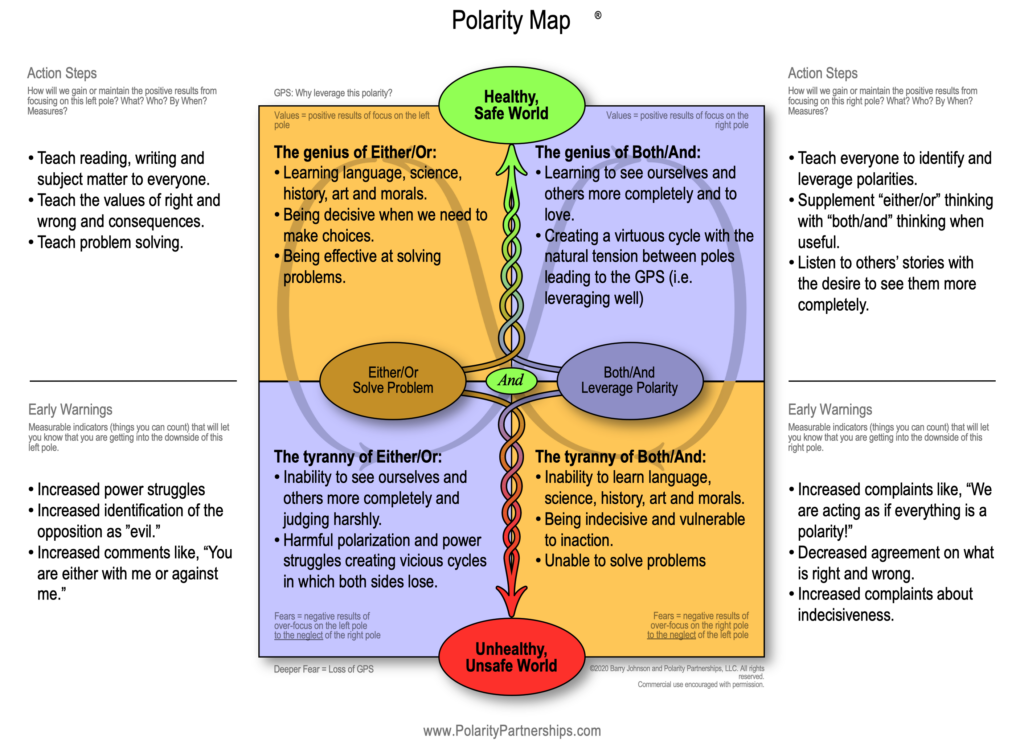
Here’s a Polarity Map for Either/Or-thinking AND Both/And-thinking from And, Volume, 1 Foundations:
INVITATIONS:
To use an AI-trained “Chat w/Cliff” for Step 1, Seeing” CLICK HERE.
Ready for the Polarity Advantage? Go deeper into Polarity Thinking, see our online self-directed Credentialing and Introduction to Polarity Practice or in-person training with Barry Johnson and me at Kayser Ridge by CLICKING HERE.