


See the Series Introduction for Just Tao It, Part I: HERE
See the Just Tao It Series Introduction Tao/It on-ramp, PART II: HERE
See Just Tao It, Chapter 1: HERE
From my interpretation of the Tao Te Ching, Chapter 19 (Unpublished):
Reduce emphasis on piety,
Ease returns.
Reduce emphasis on rationality,
What is natural appears.
Reduce emphasis on grasping,
Sufficiency is found.
When the spirit stirs,
Let go.
Hold It.
—
Somewhere along the way, most of us picked up the idea that every strength eventually becomes a weakness. It sounds right. It even feels right when you’ve lived through it.
But I don’t think it’s entirely true.
What I’ve come to see—sometimes the hard way—is that strengths rarely fail because they are strengths. They begin creating trouble when they get separated from the other strengths they depend on.
The shift is subtle at first. Clarity gradually stops traveling with curiosity. Drive loses contact with rest. Care drifts away from boundaries. Structure separates from flexibility. None of those strengths disappear. In many cases they become even stronger, which is precisely why the pattern is so difficult to recognize.
The problem isn’t usually overuse in the way people often describe it. It’s the gradual assumption that one strength can carry the whole load by itself.
Gradually, the system begins tightening.
What once created movement starts narrowing it. What once supported life in the system starts exhausting it. The strength keeps doing exactly what it was designed to do, but without the balancing influence of its complement, it slowly loses range.
Same strength. Different relationship.
Barry Johnson’s early work pointed toward something deceptively simple: some challenges aren’t problems to solve. They are ongoing relationships to work over time. When we forget that, we tend to do what human beings have always done under pressure—we pick the side that appears strongest, clearest, safest, or most familiar and lean harder into it.
For a while, that often works. Long enough, sometimes, to convince us we’ve found the answer.
Until the system starts pushing back.
Bob Anderson describes leaders reaching a point where the very capabilities that once made them effective begin limiting their effectiveness. He calls it the “Canceling Effect.” From the inside, it rarely feels dramatic. It feels more like effort producing diminishing return. More force. Less movement.
Separation changes the relationship.
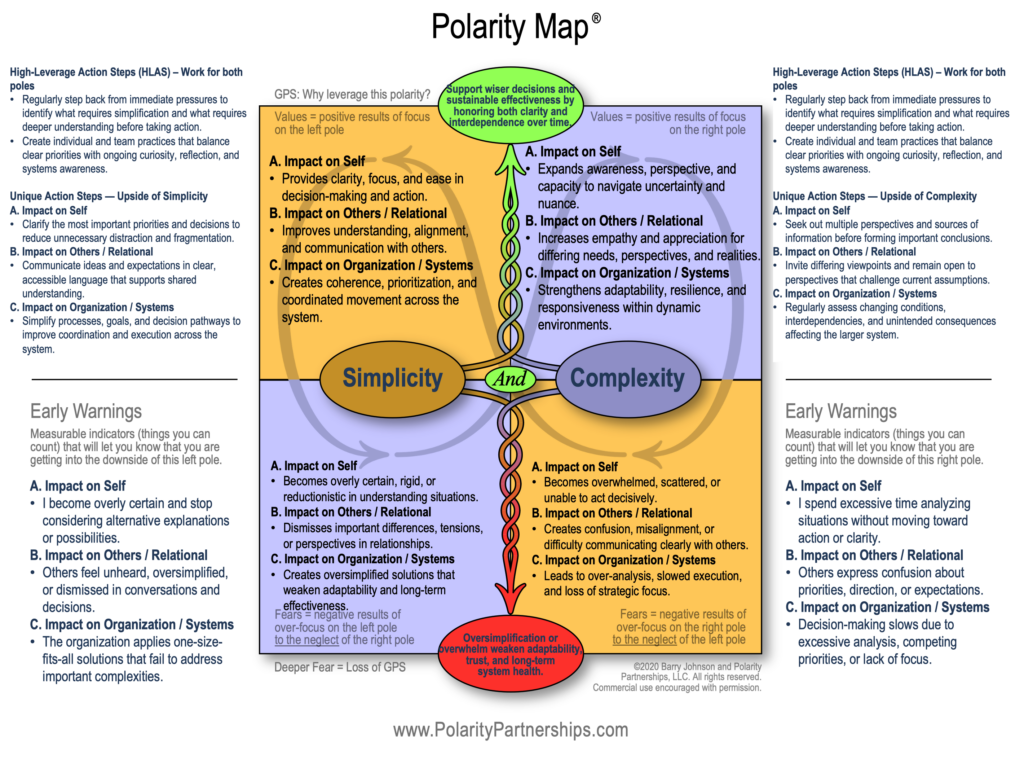
Simple without Complex becomes reductionistic. Complex without Simple becomes overwhelming.
Activity without Rest becomes relentless. Rest without Activity becomes stagnant.
The Tao approaches this differently than most modern performance systems do. It doesn’t immediately prescribe adding more capability, more optimization, or more control.
It reduces emphasis.
That’s the move to which Chapter 19 points.
Reduce emphasis on piety.
Reduce emphasis on rationality.
Reduce emphasis on grasping.
The teaching isn’t rejecting these capacities. Rationality matters. Structure matters. Effort matters. Conviction matters. The issue emerges when one way of operating expands so fully that everything else begins organizing around it.
That’s when strengths begin separating from the relationships that keep them healthy.
You can usually feel the shift before you can explain it. Conversations lose some of their openness. Systems become less adaptable. People no longer experience the same ease with one another. Trust begins thinning inside organizations, and leadership gradually loses its range. The instinctive response is almost always the same: more effort, more certainty, more control, more speed. Each additional push appears reasonable by itself, even while the larger pattern continues tightening.
Once you’ve seen this pattern in yourself, you begin noticing it elsewhere. Organizations lose adaptability when Structure separates from Flexibility. Democracies weaken when Freedom separates from Responsibility. Technologies amplify harm when Capability separates from Wisdom. The same relationship continues appearing, even as the systems become larger and more complex.
Yuval Noah Harari has been pointing toward another dimension of this same challenge. We are now building systems so complex that no individual—and perhaps no group of individuals—fully understands how they function. At the same time, we increasingly depend on those systems to shape financial decisions, political outcomes, social relationships, information flows, and now even human meaning itself.
Ironically, the deeper complexity becomes, the stronger the demand for simplification grows.
People reach for certainty. Ideology. Reduction. Tribal belonging. Simple explanations for increasingly interdependent realities.
But complexity without simplicity overwhelms human beings, while simplicity without complexity distorts reality.
That tension is becoming one of the defining challenges of our time.
Harari often notes that human beings are gradually shifting from participants within systems to passengers carried by systems they no longer comprehend. That feels deeply connected to what Chapter 19 is warning about. Rationality separated from what is natural eventually loses contact with the human beings it was meant to serve.
The Tao never asks us to fully comprehend everything. It keeps pointing somewhere else.
Rebalance. Reduce emphasis while remaining connected.
At the deepest level, this is usually a Part AND Whole issue. A person optimizes for immediate effectiveness while losing connection to the larger system sustaining them. Organizations optimize for performance while weakening culture. Societies optimize for speed while exhausting meaning, trust, and relationship.
Eventually the separation begins undermining the very thing it was trying to protect.
That’s why Chapter 19 feels surprisingly relevant right now.
We live inside systems constantly rewarding amplification. Louder certainty. Faster reaction. More productivity. More optimization. More ideological purity. More acceleration. More performance.
Very little encourages reconnection.
Very little reminds us that strengths become fully themselves through relationship.
And this is where Polarity Thinking helped make the Tao feel less abstract for me.
Reducing emphasis isn’t withdrawal. It isn’t passivity. It isn’t becoming weaker. It is releasing the extra weight we’ve placed on one side of a relationship that was never designed to stand alone.
As the relationship begins reconnecting, something else changes as well. Clarity softens enough for curiosity to return. Effort eases enough for rest to re-enter the system. Care steadies enough to include boundaries again. Competence remembers its dependence on character, and speed rediscovers wisdom. Nothing new has been added. Something essential has simply returned.
That’s the move.
Reconnecting strength to its complement.
Those moments are more often invitations than failures. We rarely notice this movement while it’s happening. We simply find ourselves working harder, explaining more, defending positions with greater certainty, or adding one more layer of effort to something that no longer seems to respond. They invite us to ask whether the strength we’ve trusted has become separated from the relationship that once allowed it to serve life so well.
Reduce emphasis.
Let go.
Hold It.
Here’s a Polarity Map for Simplicity AND Complexity:
INVITATIONS:
Self-assess by taking a custom Polarity Assessment for this chapter, HERE.
To use an “AI-trained Chat w/Cliff for Step 1, Seeing” CLICK HERE.
Ready for the Polarity Advantage? Go deeper into Polarity Thinking, see our online self-directed Credentialing and Introduction to Polarity Practice or in-person training with Barry Johnson and me at Kayser Ridge by CLICKING HERE.