

See the Series Introduction for Just Tao It, Part I: HERE
See the Just Tao It Series Introduction Tao/It on-ramp, PART II: HERE
See Just Tao It, Chapter 1: HERE
From my interpretation of the Tao Te Ching, Chapter 24 (Unpublished):
Those who stand too high on tiptoe,
find balance undone.
Those who rush with far to go,
arrive forgetting where they’re from.
Those who prove how bright they glow,
cast dim illumination.
Those who delight in potent authority,
grow small beneath dominion.
Those who seek their own necessity,
leave little that remains.
Grow from this.
Be without over-do.
Leave space—
and It moves through.
—
We are living through a crisis of leadership.
We have no shortage of leaders. The deeper crisis concerns the kind of leadership our systems elevate and reward.
Across politics, corporations, media ecosystems, institutions, and movements, we reward people who are loud, certain, image-driven, allergic to criticism, and convinced that strength means never admitting error. Somewhere along the way, domination started getting mistaken for competence.
Human history has seen versions of this before. What feels different now is the scale and amplification of it all. Algorithms reward outrage. Performance outruns reflection. Certainty travels faster than wisdom. And now artificial intelligence can manufacture the appearance of brilliance faster than most human beings can finish a cup of coffee.
I’ve spent more decades in the applied behavioral science field than I care to admit. Long enough to watch leadership theories rise and fall. Long enough to sit with organizations trying to recover from the damage caused by leaders who confused dominance with strength and performance with wisdom. Long enough to watch intelligent human beings become trapped inside systems organized more around fear, image management, and ego protection than learning, trust, accountability, or reality.
And honestly, the last decade has shaken me.
This goes deeper than partisan identity. What we are witnessing reveals something profoundly human about fear, power, and the collective shadow.
The patterns are no longer subtle.
The addiction to attention. The humiliation of opponents. The inability to admit error. The demand for loyalty over truth. The treatment of expertise and institutional knowledge as threats rather than resources.
I could go on, but I won’t. And beneath much of it sits an old human seduction: the belief that cruelty signals strength.
Behavioral science has warned about this for decades. Jung warned too. What he called the Shadow does not disappear because people become successful, powerful, admired, or intelligent.
Unexamined power often feeds it.
When insecurity remains outside awareness, it frequently compensates through overconfidence. The ego expands to protect itself from weakness, uncertainty, or inadequacy. A persona forms around certainty, superiority, and control. The louder the performance becomes, the more fragile something underneath may be.
Research on overconfidence shows the same distortions appearing again and again: people believe themselves more capable, more moral, and more accurate than evidence supports. Feedback starts feeling dangerous. Contradiction becomes threat.
And once enough power gathers around that dynamic, reality itself becomes difficult to hear.
The loudest voice in the room is not always the strongest.
Sometimes it is the most frightened.
This is where the Tao feels almost painfully relevant.
Those who prove how bright they glow, cast dim illumination.
Years ago, I wrote a chapter in And: Volume 2, Applications with two colleagues, exploring Drama and Empowerment through the lens of Polarity Thinking, drawing from Stephen Karpman’s Drama Triangle and David Emerald’s Empowerment Dynamic to examine what happens when fear starts organizing human relationships.
Karpman identified three reactive roles people rotate through under threat: Persecutor, Rescuer, and Victim.
The Persecutor blames, humiliates, controls. The Rescuer over-functions and creates dependence while calling it help. The Victim surrenders responsibility while insisting powerlessness is unavoidable.
None of this is leadership. This is reality-show-like theater.
And entire organizations, political systems, and cultures can begin organizing themselves around these roles.
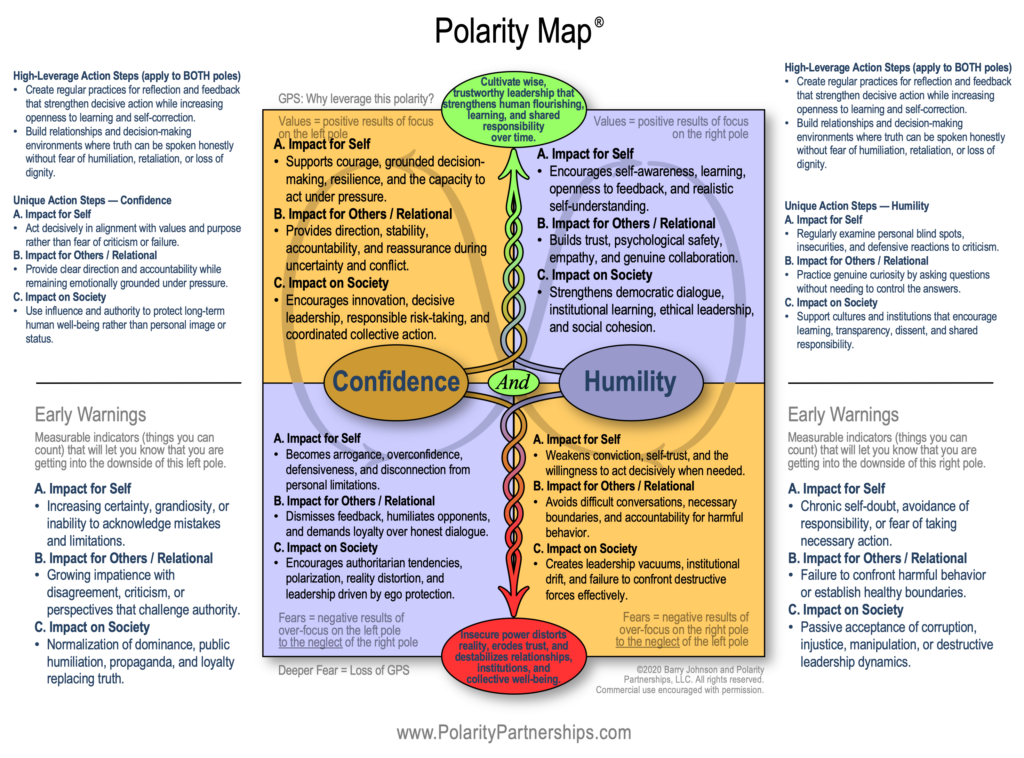
What struck me revisiting that work is how deeply this connects to Confidence AND Humility.
Confidence to the neglect of Humility easily slips toward persecution disguised as strength. Humility to the neglect of Confidence can become helplessness disguised as virtue. And rescuing others without boundaries often becomes ego attachment wearing compassionate clothing.
We need something more developed than all three.
Jim Collins found something similar in Good to Great. The strongest leaders in his research rarely resembled the heroic executive culture celebrates—many were modest, grounded, almost unremarkable in presentation.
Collins called this Level 5 Leadership: fierce professional will paired with deep personal humility.
Because confidence is not the same thing as self-importance.
Healthy confidence allows leaders to act decisively, tolerate pressure, hold boundaries, and move toward meaningful goals without losing themselves in uncertainty or criticism.
But Confidence to the neglect of Humility eventually distorts perception itself.
Leaders stop listening. Feedback becomes threat. Opponents become enemies.
Reality gets filtered through ego protection.
Edgar Schein reached similar conclusions: leadership weakens when leaders believe they must appear all-knowing, emotionally invulnerable, and perpetually certain. He argued instead for what he called “here-and-now humility”—the recognition that other people may understand important realities better than we do.
That requires something difficult: the willingness to not always be the smartest person in the room.
Which brings us back to AI.
We are entering a strange period of human history where almost anyone can generate the performance of intelligence instantly. Arguments that sound convincing. Strategies that appear sophisticated. Confidence that feels earned.
Which means the distance between appearance and substance can become enormous. In a culture already rewarding performance over depth, this is gasoline near open flame.
The person most willing to say “I don’t know” may soon become the most trustworthy person in the room.
At the same time, Humility to the neglect of Confidence creates its own dangers. Harmful behavior goes unchallenged. Necessary boundaries weaken. Important decisions get avoided.
We need both.
The groundedness to act decisively. And the maturity to recognize that no human being sees completely.
I’ll admit something personally.
Over the last decade, there were moments I struggled to hold onto hope myself. Watching cruelty normalized. Watching basic decency weaken. Watching human beings treat one another as abstractions instead of neighbors.
Reality without Hope is a dangerous place to live.
Jim Collins spoke about another tension that resonates deeply here: Reality AND Hope. Real leaders confront difficult truths honestly without surrendering belief in the possibility of meaningful progress.
I need that reminder. Early, and often. Because if I lose faith in humanity completely, then I’m in the wrong field. I can’t spend a lifetime believing human beings can grow, heal, learn, and lead more wisely — only to abandon that conviction when circumstances become difficult. It’s been more difficult, lately.
In those times, I think about my sister Lori. She lives with chronic illness and still somehow creates hope for people facing the reality of suffering of their own. She does not perform strength. She does not pretend pain is beautiful. She does not announce herself as courageous every fifteen minutes on social media like some kind of inspirational gladiator brand ambassador. She simply keeps showing up.
When we talk, she rarely mentions what the illness has taken from her. She asks about my kids, my work, the weather at Kayser Ridge—as if her life were the ordinary one and mine were the one that needed tending.
That. That feels closer to wisdom than much of what passes for leadership now. She reminds me that courage is not denial. Hope is not naïveté. And humility is not weakness.
If I look carefully enough, I can still see islands of coherence everywhere. Teachers protecting children. Nurses comforting strangers. Communities feeding families. Journalists telling difficult truths. Parents teaching kindness in cruel times. Human beings refusing to surrender their humanity to fear and spectacle.
A better future does not belong just to whoever shouts loudest and knows how to use social media and AI for amplification. It belongs to people grounded enough to hold both Confidence AND Humility … and Reality AND Hope — while helping build something worthy of trust.
The Tao keeps returning to a difficult truth modern culture resists: those most desperate to appear powerful may be the least prepared to hold power wisely.
Because people who need constant admiration rarely serve anything larger than themselves for very long.
That may be one of the defining leadership questions of our time:
Can human beings develop enough Confidence to act courageously — and enough Humility to hold power without becoming possessed by it?
Our future may depend on how we answer it.
Here’s a Polarity Map for Confidence AND Humility:
INVITATIONS:
Here is Chapter 39 from And, Volume 2: And_V2_PEEK_C39_TED
Take a custom Polarity Assessment based on this chapter’s polarity and content HERE.
To use an “AI-trained Chat w/Cliff for Step 1, Seeing” CLICK HERE.
Ready for the Polarity Advantage? Go deeper into Polarity Thinking, see our online self-directed Credentialing and Introduction to Polarity Practice or in-person training with Barry Johnson and me at Kayser Ridge by CLICKING HERE.