

See the Series Introduction for Just Tao It, Part I: HERE
See the Just Tao It Series Introduction Tao/It on-ramp, PART II: HERE
See Just Tao It, Chapter 1: HERE
From my interpretation of the Tao Te Ching, Chapter 3 (Unpublished):
Avoid overpraise of the praiseworthy,
And people will not act resentfully.
Avoid overvaluing what can be possessed,
And people will not act covetously nor feel distressed.
Leaders who are steady
Keep hearts open and bodies fed.
They quiet comparison
Before it takes root or spreads.
They lead without claiming the spotlight,
And follow without falling behind.
They loosen the grip of what’s expected,
And leave forced outcomes aside.
By not doing what need not be done,
What is natural can align.
What is done from not doing
Holds order without design—
And accomplishes more than striving can find.
—
We live in a civilization advanced enough to build artificial intelligence, map the human genome, and communicate globally in real time. One of the highest-status identities in that same civilization is now “Influencer.”
The Tao is naming something concrete: what happens to human systems when amplification overtakes awareness, when influence loses relationship with restraint, and when leadership organizes itself around attention, stimulation, certainty, status, and emotional activation.
Painfully contemporary.
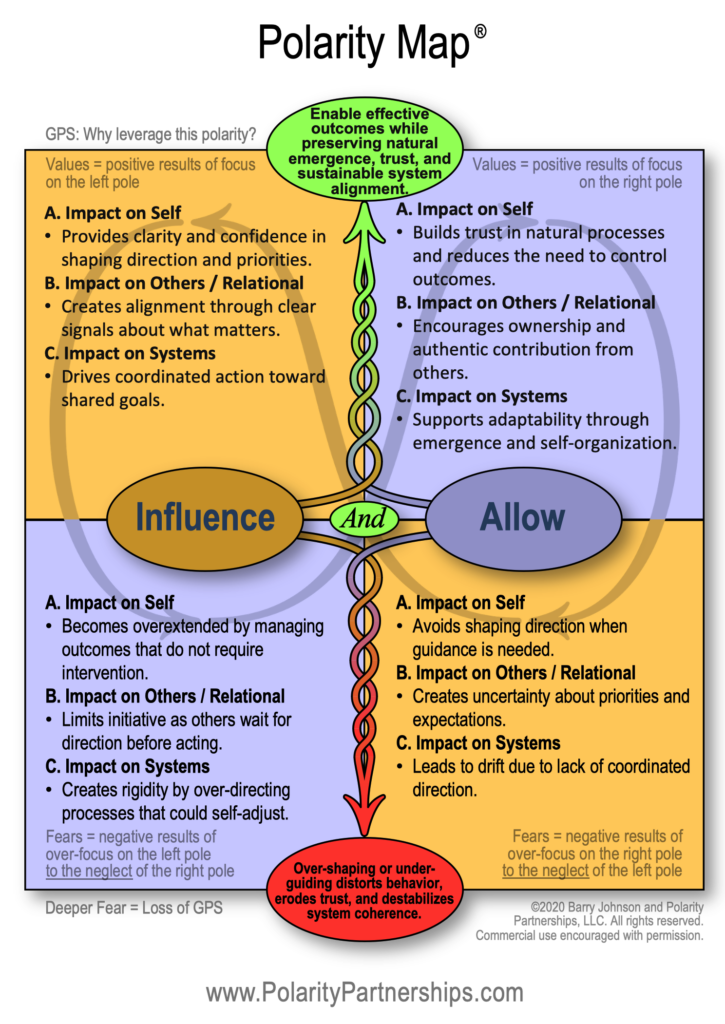
Influence is the pole we understand instinctively: to shape, direct, persuade, move people or systems toward an outcome. Allow is harder to name. It isn’t passivity, and it isn’t stepping back from responsibility. Allow is staying present enough to let a situation, a person, or a system show you what it needs, before deciding what to do about it.
We’re living in a time where praise gets industrialized. Attention gets monetized. Status gets algorithmically amplified. Conflict spreads faster than discernment, and emotional activation outcompetes reflection almost everywhere you look. Systems built to hold democratic tension together now reward outrage, humiliation, performance, tribal identity, and perpetual reaction instead.
The Tao’s warning about overpraise and overvaluing lands differently when entire economies depend on keeping people psychologically activated. AI systems learn what captures attention and feed it back continuously. Influence no longer moves only through human interaction; it moves through recommendation systems, outrage loops, media ecosystems, identity signaling, political branding, and algorithms optimized for engagement rather than maturity.
What gets amplified begins shaping what people desire, fear, resent, imitate, and eventually become. Somewhere inside all that amplification, Allow becomes harder to reach.
That polarity has deepened for me every time I’ve revisited this chapter, especially over the last ten years. We are always influencing something. What we reward shapes behavior. What we elevate shapes aspiration. What we react to shapes what people learn to fear. What we repeatedly place attention on slowly reorganizes the system around it. Leadership can never be neutral, because influence itself shapes conditions whether we intend it or not.
The Tao seems less concerned with influence itself than with what happens when influence loses relationship with wisdom, restraint, humility, and awareness. That’s where things become dangerous.
Because over time, systems reorganize themselves around signal instead of substance. Visibility starts replacing credibility. Dominance starts replacing maturity. Performance starts replacing leadership. Emotional certainty starts replacing discernment. People learn that outrage spreads faster than steadiness, and that humiliation often generates more influence than wisdom.
Eventually entire cultures drift toward developmental gravity downward instead of upward.
Adult ego development theory helps explain why this is so hard to interrupt. Earlier developmental structures aren’t failures; they bring real strengths. Self-centric structures bring courage, decisiveness, and the willingness to challenge stagnation. Group-centric structures bring loyalty, cohesion, and care for others. Under enough fear and amplification, though, those same strengths distort: self-centric distortion shows up as domination, reactive certainty, and image management; group-centric distortion shows up as conformity, tribal fusion, and loyalty tests that override discernment. Modern amplification systems reward both at once, which is part of why so much public leadership feels emotionally exhausting even when it looks successful on the surface.
That dynamic plays out through the Dreaded Drama Triangle Karpman named decades ago — Victim, Persecutor, Rescuer, rotating endlessly through politics, organizations, and media. The system feeds on the energy, and what disappears is the capacity to stay present enough to choose a response instead of reacting.
The same erosion shows up in how we treat disagreement. Political opposition now gets read as existential threat rather than accountability — a shift Chapter 29, Claim AND Share Power, explores more fully. Here, the more useful question is narrower: how did so much intelligence and technological capability end up paired with so little developmental maturity?
The Tao returns attention to the possibility that intelligence without developmental maturity becomes destabilizing over time.
“Leaders who are steady
Keep hearts open and bodies fed.
They quiet comparison
Before it takes root or spreads.”
That feels almost radical now.
Especially because so many systems surrounding us intensify comparison, resentment, envy, fear, outrage, and identity attachment. The Tao’s concern is deeply practical: once comparison takes root and spreads, systems reorganize around emotional scarcity rather than shared participation. And emotionally activated populations become easier to manipulate.
This is where Wu Wei — action without forcing — stops feeling philosophical and starts feeling operationally essential.
Wu Wei gets misread as passivity or disengagement. What this chapter is pointing toward is harder than that: the capacity to influence without compulsively over-shaping, to guide without psychologically possessing outcomes, and to stay aware enough to discern when intervention serves a situation and when it distorts it.
I learned this the slow way, building Kayser Ridge.
When we started shaping the land for what would become our retreat center, my instinct was to shape everything — grade the trails to spec, clear the sightlines I’d already drawn, force the creek crossing to match the plan. The impulse came from something real: I could see the finished place in my head, and I wanted to protect that vision from drift, delay, and compromise.
The cost showed up on a stretch of trail near the ridge line. I had it cut straight, following the drawing instead of the contour. Every hard rain since has argued with that decision, washing out the same stretch, forcing the same repair, refusing to hold the shape I’d insisted on. The land had already told me where the water wanted to go. I hadn’t been willing to listen yet.
Eventually I let a trail builder walk the property without the drawings — watch where the deer moved, where water pooled, where the ridge already wanted a path. What we built instead has held. It needs less repair, feels more natural underfoot, and turned out more beautiful than what I’d originally forced onto the page. Allow didn’t mean doing nothing. It meant staying present long enough to let the land finish teaching me what it already knew.
That discernment is the whole practice. Many modern systems reward perpetual intervention — constant commentary, immediate certainty, rapid escalation, endless emotional positioning. Leaders operate inside environments where stillness itself can feel threatening, because visibility and movement get rewarded continuously.
The result is that intervention starts feeling synonymous with leadership itself. Over time, the capacity to refrain, observe, allow, or stay present without immediately shaping outcomes starts looking weak, passive, naive, or irrelevant.
The Tao points somewhere very different.
“What is done from not doing
Holds order without design—
And accomplishes more than striving can find.”
That line is hard to hear inside modern systems built around amplification.
Yet much of what exhausts our institutions, organizations, democracies, and relationships traces back to leadership cultures that can’t distinguish necessary influence from compulsive over-shaping.
This chapter leaves me with a deeper question: can we remain human enough to participate in powerful systems without becoming psychologically captured by them?
That question feels central to the moment we’re living through. We became extraordinarily powerful, and somewhere along the way, many of our systems lost relationship with the wisdom required to hold that power responsibly.
I still walk that trail near the ridge line, the one that finally held once I stopped forcing it. It reminds me that Influence AND Allow were never opposites. Shaping the land and letting it teach me were both forms of care. The difference was timing, and how long I was willing to wait before deciding I already knew.
Here’s an interior Polarity Map for Influence And Allow:
INVITATIONS:
And_V1_PEEK_C22, “Claiming Power And Sharing Power” from And, Volume 1, Foundations.
To use an AI-trained “Chat w/Cliff for Step 1, Seeing” CLICK HERE.
Ready for the Polarity Advantage? Go deeper into Polarity Thinking, see our online self-directed Credentialing and Introduction to Polarity Practice or in-person training with Barry Johnson and me at Kayser Ridge by CLICKING HERE.