

See the Series Introduction for Just Tao It, Part I: HERE
See the Just Tao It Series Introduction Tao/It on-ramp, PART II: HERE
See Just Tao It, Chapter 1: HERE
From my interpretation of the Tao Te Ching, Chapter 33 (Unpublished):
To know others
adds intelligence.
To know yourself
deepens it with wisdom.
Power over others
appears strong.
Power with others
endures long.
Those who know others
can influence.
Those who know themselves
do not need to prove it.
When self and other
are both seen clearly,
power no longer
needs to rise above.
It moves with.
What moves with
sustains.
—
The polarity here is simple to name and not easy to live: Know Self AND Know Others. Most leaders develop one side. Fewer sustain both. And when that happens, power begins to drift.
Power is not the problem. It never was. How it relates is.
I remember sitting across from an executive years ago who could read every person in the room within minutes—what they needed, what they feared, how to move them. He was remarkable at it. What he couldn’t see was how his own certainty had started organizing the room around him, until people stopped disagreeing with him long before he stopped being wrong. He knew everyone at that table except himself.
Power without awareness gradually reorganizes reality around itself.
Power is simply the ability to act, to influence, to shape what happens next. The question is whether it is grounded in awareness or separated from it. When power loses connection to knowing self, it moves with certainty but without reflection. When it loses connection to knowing others, it acts without fully seeing what it affects. In both cases, something critical begins to thin. Not immediately. Not dramatically. But steadily.
Trust.
Trust is not an abstract ideal. It is the condition that allows anything requiring cooperation to hold. Trust begins personally and gradually becomes the invisible infrastructure of every healthy relationship and every healthy system.
When trust is strong, complexity can be carried.
When trust weakens, even simple things begin to break.
At the individual level, this shows up in how leaders hold themselves. Can I act with conviction and remain aware of my blind spots? Can I influence others and stay accountable for how I do it?
At the systemic level, it determines whether institutions hold. Democratic systems, economic systems, and social systems all depend on leaders who can deliver results and remain grounded in self-awareness. You cannot have systems that hold over time without leaders who can hold themselves. And you cannot develop those leaders inside systems that reward power without accountability.
Truth lives inside this same dynamic. It is not immune to power. What gets called truth is shaped by what is seen, what is reinforced, and what is allowed to stand without challenge. When power is grounded in awareness, truth is something we continue to examine. When power separates from awareness, truth becomes something we protect.
This is where the real danger enters, and it rarely announces itself. It begins with small departures—adjustments made for speed, alignment, certainty, control. Nothing breaks. The decision works. The outcome holds. The deviation is rewarded. Over time, what was once a departure becomes familiar. What was familiar becomes accepted. What is accepted no longer feels like a deviation at all. It becomes the way things are done. Power begins to reinforce itself through repetition rather than correct itself through awareness.
At that point, truth is no longer something we are working to understand. It becomes something we are working to maintain. Trust begins to reorganize around those patterns—confidence in what is consistently reinforced, rather than confidence in what is real.
This is how systems drift. Not through a single failure, but through a series of decisions that appear to work.
You can see this pattern wherever power is misused. In leaders who rely on force rather than relationship. In teams where speaking honestly carries risk. In organizations that reward outcomes without examining how those outcomes were achieved. And at the societal level, where systems that depend on trust begin to lose their capacity to hold.
Democracies weaken this way. It happens gradually before it becomes obvious.
These systems do not function because people agree. They function because people remain in relationship while holding differences that cannot be resolved. They depend on truth being examined, not controlled, and on trust being extended beyond immediate alignment. When power separates from those conditions, the system does not fail all at once. It weakens in the same way trust weakens—gradually, then visibly.
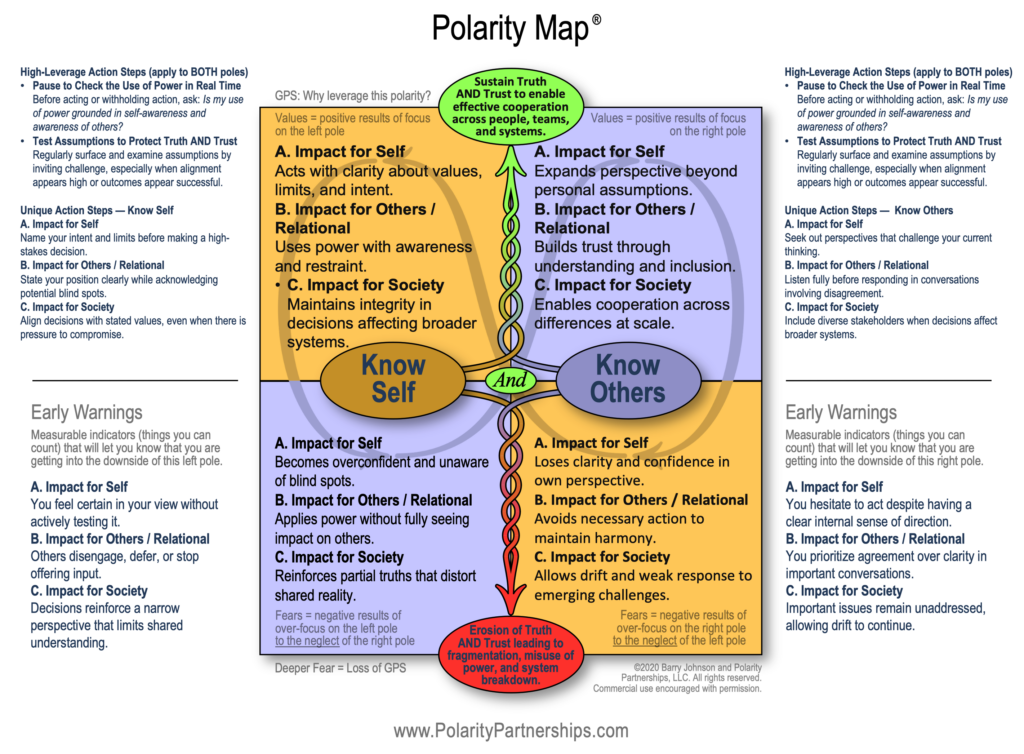
When leaders Know Others but not Self, they use power to influence, control, and manipulate without recognizing how their actions erode the system. When leaders Know Self but not Others, they hesitate, defer, and avoid necessary decisions. Neither sustains systems that depend on trust.
And now artificial intelligence is accelerating power without corresponding growth in awareness.
AI systems can know others at unprecedented scale—analyze behavior, predict preferences, target messaging, optimize influence. They extend the reach of influence faster than any human ever could.
What they cannot do is know themselves. They cannot reflect on their own biases. They cannot sense when they are wrong. They cannot hold themselves accountable for the consequences of what they optimize.
We are scaling the capacity to influence faster than we are scaling the capacity to understand its impact.
That gap is widening. When you combine amplified influence with diminished awareness, the result is predictable: distorted truth, thinning trust, and systems that struggle to hold.
This is not a future risk. It is already here.
And yet, the path forward is not new. It has been here all along.
If we are serious about addressing challenges that require cooperation at scale, the constraint is no longer knowledge, data, or tools. It is leadership capability: the capacity to hold tensions that do not resolve, to act without disconnecting, and to stay in relationship while making decisions that matter.
That is where Competence AND Character come together. Competence without Character can deliver results that undermine the system that produced them. Character without Competence can preserve intention without producing impact. Trust requires both. It is built when people experience that those with power can deliver and can be relied upon in how they deliver.
This shows up in behavior. Speaking directly when it matters. Listening before responding. Following through on commitments. Addressing reality instead of avoiding it. Extending trust in ways that invite it to be returned. These are not soft skills. They are the operating system of trust.
The tension is real. Acting and relating. Shaping and adapting. Deciding and including. These are not choices to be solved. They are tensions to be lived.
Knowing others gives you influence. Knowing yourself changes how you use it. When both are present, power no longer needs to stand above what it affects. It moves with it. And what moves with sustains.
Leaders who can hold Know Self AND Know Others together develop the capacity to make decisions that hold. They remain grounded while acting, rather than merely avoiding conflict. Decisions that meet what is needed now and sustain what will be needed later.
We have known this for centuries. We are watching what happens when we ignore it.
The question is not whether this wisdom is true.
The question is whether we are willing to use it now—while there is still time.
Here’s a Polarity Map for Know Self And Know Others:
INVITATIONS:
Take a custom Polarity self-assessment based on the Know Self AND Know Others polarity HERE.
To use an AI-trained “Chat w/Cliff” for Step 1, Seeing” CLICK HERE.
Ready for the Polarity Advantage? Go deeper into Polarity Thinking, see our online self-directed Credentialing and Introduction to Polarity Practice or in-person training with Barry Johnson and me at Kayser Ridge by CLICKING HERE.