

See the Series Introduction for Just Tao It, Part I: HERE
See the Just Tao It Series Introduction Tao/It on-ramp, PART II: HERE
See Just Tao It, Chapter 1: HERE
From my interpretation of the Tao Te Ching, Chapter 38 (Unpublished):
With high virtue,
doing is heartful,
effortless.
With low virtue,
doing without heart
is restless.
In heartful doing,
nothing is left undone.
In heartless doing,
all comes apart,
one by one.
When virtue is lost,
people reach for good.
Without good,
they turn to what they should.
Without should,
they settle into duty.
Duty is what remains
when heart leaves the doing.
Doing with virtue
is fruit, not flower—
source, not power.
—
Acting comes first for most of us. It’s what can be seen, measured, defended. It’s what gets rewarded. Movement signals progress. Decisions create momentum. Outcomes give us something to point to and say, “that worked.” It’s easy, almost inevitable, to begin believing that progress is a function of how much we do.
And so we act. We initiate, respond, push, build. When things slow down, we add effort. When resistance shows up, we increase force. When results appear, we take that as confirmation that we’ve found the way.
For a while, it works.
Then something begins to feel different. Not wrong, exactly, but heavier. The same action requires more energy. The same effort produces less return. The distance between what is intended and what is experienced begins to widen in ways that are hard to name but easy to feel. What once felt aligned begins to carry strain.
This is not a failure of Acting. It is Acting that has moved ahead of Being.
When Acting separates from Being, it tries to generate from itself what it cannot sustain. Direction becomes urgency. Urgency becomes pressure. Pressure becomes force. And force, over time, starts to erode the very outcomes it was meant to produce. The motion continues, sometimes even accelerates, but something underneath it is no longer holding.
You can see it in leaders who are constantly in motion but increasingly disconnected from the people experiencing that motion. You can see it in organizations that generate activity without building trust. You can see it in systems that pursue change while weakening what allows change to endure.
We do not lack action. We lack the capacity to sustain action.
I felt this most clearly a few years ago, sitting in a room full of people building strategies to accelerate the Sustainable Development Goals, watching brilliant plans pile up faster than anyone’s capacity to carry them out. Everyone in that room was already doing enough. What was missing wasn’t ambition. It was the inner ground to sustain what ambition demanded.
That realization has been showing up in different ways, including one of the more ambitious global efforts of our time. The Sustainable Development Goals gave the world a shared direction—clear articulation of what needs to be done across systems, nations, and generations.
They represent Acting at scale. Collective aspiration organized into outcomes that matter.
And yet progress has not kept pace with the need.
The goals are clear enough. The effort hasn’t been the shortfall. Something else is required to carry that level of action over time.
That recognition led to the emergence of the Inner Development Goals. The Inner Development Goals complement the SDGs rather than replace them—an acknowledgment that the capacity to pursue those outcomes counts as much as the outcomes themselves.
The IDGs recognize something difficult to ignore: sustainable external change depends on sustained inner development. The framework identifies five interconnected dimensions—Being, Thinking, Relating, Collaborating, and Acting. This chapter focuses on two of them: Being and Acting, recognizing that the relationship between these two shapes all the others. And among the framework’s 25 skills, Polarity Thinking is included in the Thinking dimension—a recognition that the capacity to hold tensions rather than resolve them is essential to navigating the complexity the SDGs require.
The SDGs without the IDGs risk becoming effort without foundation—movement that cannot hold. The IDGs without the SDGs risk becoming insight without consequence—awareness that never quite meets the moment.
The relationship mirrors Part AND Whole at the highest scale. The SDGs are Whole—systemic outcomes. The IDGs are Part—individual capacity. You cannot sustain the Whole without developing the Parts that must carry it.
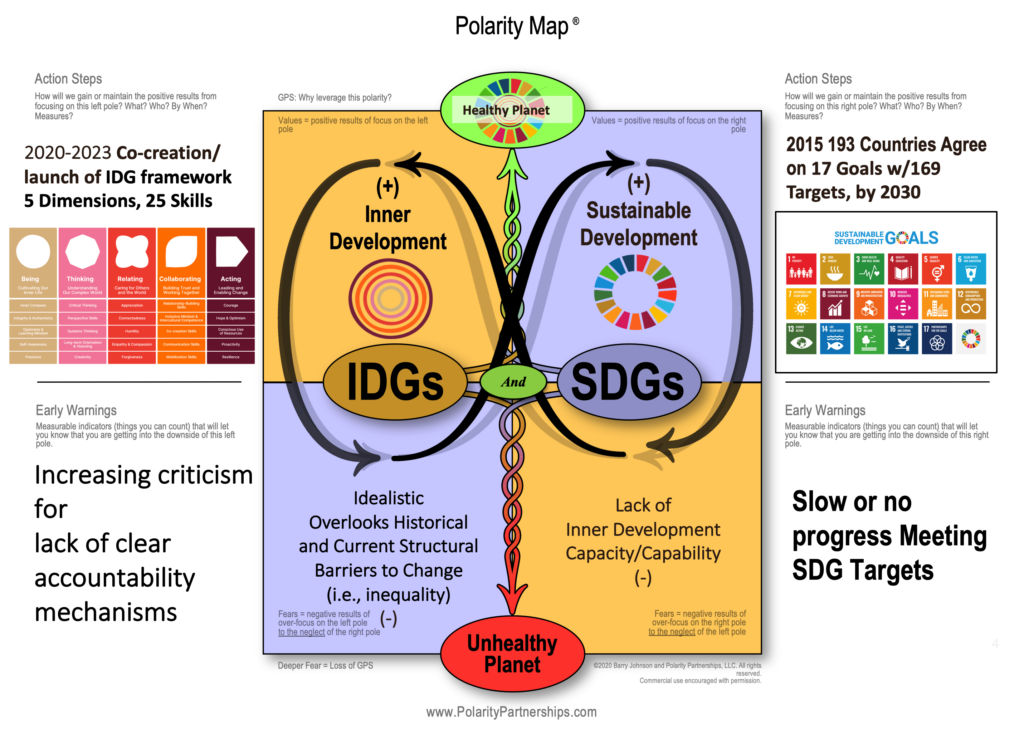
Together, they form something more complete. Acting grounded in Being. Being expressed through Acting.
There’s something else happening now that makes this harder to ignore. We’ve built systems that can act at a scale and speed we’ve never seen before. They process, decide, recommend, and generate with remarkable efficiency.
They extend our ability to do. They do not extend our capacity to be.
They don’t examine intent. They don’t feel impact. They don’t pause to consider what is being reinforced beneath the surface of the action.
They learn from us.
Which means they inherit what we bring to them—our patterns, our assumptions, and our blind spots. What we have learned to normalize, they replicate. What we have not questioned, they accelerate.
When Acting is already ahead of Being, the risk compounds.
Bias that once moved slowly through systems can now move instantly. Decisions that once required reflection can now be made at scale without it. The gap between what is intended and what is experienced can widen before it is even noticed.
It still feels like progress.
That’s what makes it difficult to see.
The question isn’t whether these systems are useful. They are. The question is whether the people using them are grounded enough to recognize what is being amplified through them.
Without Being, Acting scales bias. With Being, Acting has a chance to stay connected—to people, to consequence, to what holds.
This is not theoretical. It shows up in how decisions are made, in how pressure is carried, in how quickly we move and how deeply we stay connected while moving. When Acting runs ahead, we begin to see familiar patterns—more effort, faster cycles, decisions made before they can be fully understood, impact explained away by intent, trust stretched thinner each time we push past what others are experiencing.
And when trust erodes, it erodes at every level. Trust in yourself—that you can act without losing your center. Trust in others—that they experience your action as grounded, not just forceful. Trust in systems—that what is built will hold because it remained connected to what sustains it.
When Being takes over without Acting, the pattern shifts. There is reflection, awareness, even clarity, but not movement. What is seen does not translate into what is done. What is understood does not become what is changed.
Neither holds on its own.
The tension between them is not something to resolve. It is something to live. You can feel it in the moments that ask the most of us—in the pause before acting, when it would be easier to push than to consider impact; in the hesitation before speaking, when it would be easier to remain where you are than to step into what is required. You can see it in teams that swing between overdrive and delay, unable to find a rhythm that allows both movement and grounding.
At scale, this is the difference between effort and progress. Between outcomes that last and outcomes that unravel. Between systems that move forward and systems that wear themselves down in the process.
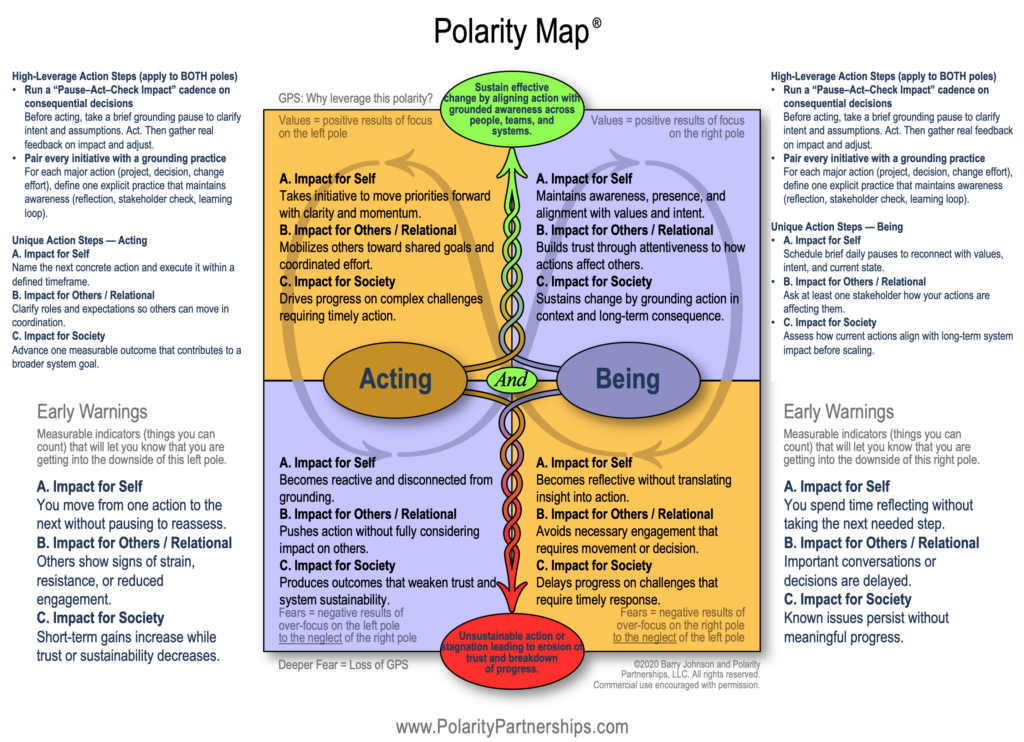
Acting AND Being lives in relationship rather than at a midpoint. Acting expresses Being. Being grounds Acting. One moves. One holds.
When they move together, something changes. Action becomes more precise, not less. Movement becomes more sustainable, not slower. Decisions begin to carry both direction and awareness, both intention and impact. What is built has a greater chance of holding, not because it is perfect, but because it remains connected to the conditions that allow it to endure.
Our challenge is no longer goals, ideas, or effort. It’s the capacity to connect what we do with the source from which it comes while we are doing it.
That connection is what this moment is asking for: Acting and Being, both held in relationship, over time.
Because what we build next will not be determined by how much we do. It will be determined by our capacity to make wiser decisions over time—decisions that remain grounded while they move, decisions that hold both what is needed now and what must endure.
Whether what we do can hold.
Here’s a Polarity Map for Acting And Being:
INVITATIONS:
Take a customized Polarity Assessment based on the Polarity Aspiration AND Contentment for this Chapter HERE.
To use an “AI-trained Chat w/Cliff for Step 1, Seeing” CLICK HERE.
Ready for the Polarity Advantage? Go deeper into Polarity Thinking, see our online self-directed Credentialing and Introduction to Polarity Practice or in-person training with Barry Johnson and me at Kayser Ridge by CLICKING HERE.