

See the Series Introduction for Just Tao It, Part I: HERE
See the Just Tao It Series Introduction Tao/It on-ramp, PART II: HERE
See Just Tao It, Chapter 1: HERE
From my interpretation of the Tao Te Ching, Chapter 44 (Unpublished):
Which is closest,
fame or self-knowing?
Which is dearest,
self-knowing or riches?
Which is torturous,
gains or losses?
Searching outwardly for fulfillment
seeks and never finds It.
Happiness tied to a string
is fragile happiness indeed.
Grasping for It
is why It leaves.
Content inwardly,
avoids disharmony.
Working wholeheartedly,
brings what is deeply joyful.
—
One of the stranger things about getting older is realizing how much of modern life depends on keeping human beings psychologically restless.
A little more recognition. A little more money. A little more certainty. A little more influence. A little more proof that we matter.
Entire systems reinforce the idea that fulfillment exists somewhere just beyond where we currently are, waiting beyond the next accomplishment, promotion, acquisition, breakthrough, optimization strategy, or carefully managed identity.
I don’t say that critically from some imaginary mountaintop of enlightenment. I’ve spent enough decades inside organizations, leadership cultures, achievement systems, and my own ambitions to recognize how seductive external validation can become. Human beings want to matter. We want to contribute. We want our lives to count for something meaningful. There is nothing inherently wrong with ambition, accomplishment, recognition, or material well-being. The Tao is not romanticizing passivity or disengagement from the world.
What it seems deeply suspicious of, however, is the human tendency to search externally for what can never finally be secured externally.
Which is closest, fame or self-knowing?
That question feels especially relevant now because identity itself gets organized around performance. Social media metrics, professional branding, institutional status, political identity, and consumer culture all push people toward constructing lives that can be measured, displayed, admired, and validated outwardly. It becomes surprisingly easy to lose contact with ourselves while becoming highly skilled at managing how we appear to others.
You can watch this happen in organizations constantly. Executives tie identity to quarterly numbers until market shifts feel like personal failure. High performers burn themselves hollow chasing the next promotion, the next recognition, the next proof that they are enough. Organizations pursue growth for growth’s sake without ever seriously asking: growth toward what? And at what cost to the human beings doing the growing?
Artificial intelligence now enters this dynamic as accelerant. Systems measure, rank, compare, score, and monitor human performance continuously. Reflection produces no metric. Presence rarely appears on dashboards. Rest often looks indistinguishable from reduced output. Human beings slowly learn to stay legible to systems that reward performance while remaining blind to depletion.
That is not sustainable.
And it certainly is not wisdom.
Robert Kegan’s work on adult development helps explain part of what unfolds underneath this. Less mature forms of meaning-making tend to organize identity around external systems of approval, belonging, and validation. Success and failure stop being experiences we have and start becoming definitions of who we are. As development continues, people become more capable of examining the systems shaping them instead of remaining unconsciously fused with them.
That movement can feel deeply destabilizing because it raises uncomfortable questions many people spend years avoiding.
Whose definition of success am I living?
What am I organizing my life around? If the applause disappeared, what would remain? What happens when achievement no longer supplies identity the way it once did?
There have been seasons — after my accident, and again in recent health struggles — when my body made it impossible to keep outrunning the question of who I was without my productivity.
I suspect many people eventually discover they spent years climbing ladders without ever questioning who leaned the ladder against the wall in the first place.
Which is dearest, self-knowing or riches?
Human beings need stability, food, shelter, dignity, care, and opportunity. The problem begins when external acquisition replaces inner development as the primary strategy for fulfillment.
Searching outwardly for fulfillment seeks and never finds It.
That line lands hard because so many modern systems depend on keeping people psychologically unsatisfied. The definition of enough continually moves. Satisfaction becomes temporary. Comparison becomes chronic. Every accomplishment quickly normalizes and creates pressure for the next one. More visibility. More accumulation. More certainty. More control.
And beneath much of that striving sits a painful possibility many people rarely say out loud: the fear that without enough achievement, admiration, productivity, or wealth, our lives may not matter very much.
Carl Jung understood that human beings often project unlived worth outwardly. What remains unresolved internally frequently gets pursued symbolically through status, recognition, possession, influence, or control. The tragedy is that external accumulation cannot permanently resolve inner fragmentation.
Happiness tied to a string is fragile happiness indeed.
I think that may be one of the most devastating lines in the chapter. If well-being remains tied to constantly shifting external conditions, stability becomes nearly impossible. Markets shift. Bodies age. Reputations change. Institutions reorganize. Influence fades. Applause disappears. Even success itself becomes unstable because eventually people begin fearing its loss as much as they once desired its arrival.
Most organizational systems intensify this tension. Performance cultures reward endless striving while exhausting the people sustaining the results. Overwork gets reframed as commitment. Boundaries become suspect. Human beings learn to perform capability while privately drifting toward depletion.
The painful irony is that systems organized entirely around external achievement often produce internally fragmented human beings.
Eventually that fragmentation begins showing up everywhere: trust weakens, creativity narrows, relationships thin out, meaning erodes, and exhaustion spreads beneath carefully managed appearances.
Grasping for It is why It leaves.
There is deep paradox there. The tighter human beings grip identity, admiration, certainty, control, or status, the more fragile those things often become. Leaders do this. Organizations do this. Entire nations do this. Cultures can become organized around endless accumulation without ever seriously asking what kind of human beings that accumulation is producing.
This is where adult development becomes profoundly practical rather than merely psychological. More mature human beings develop greater capacity to hold ambition without becoming consumed by it. They become more capable of pursuing meaningful work without organizing identity entirely around outcomes.
They can experience accomplishment without confusing achievement with worth.
Freedom begins there.
Content inwardly, avoids disharmony.
The Tao is not describing withdrawal from life. It is describing a different relationship with ambition, desire, work, and fulfillment. One where inner groundedness reduces the compulsive need to extract identity from external conditions.
And strangely enough, people grounded in that way often become capable of more meaningful contribution, not less.
Working wholeheartedly, brings what is deeply joyful.
That line shifts everything for me because it redirects attention away from performance and back toward participation. The opposite of compulsive striving is not disengagement. It is wholehearted participation untethered from the endless need for external completion.
There is enormous difference between meaningful effort and identity addiction. One expands life and meaningful participation in it. The other consumes both.
I suspect one of the defining developmental questions of adulthood may simply be this: can human beings learn to participate fully in life without needing life to constantly prove their worth back to them?
The Tao seems to suggest that wisdom begins when the answer slowly becomes yes.
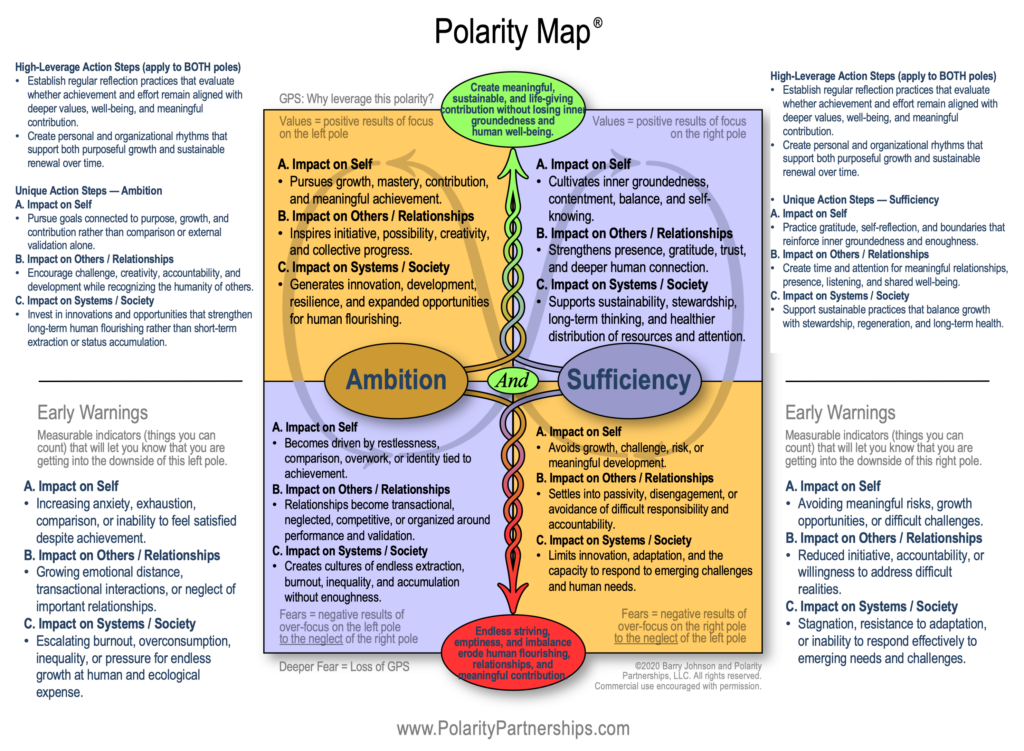
Here’s a Polarity Map for Ambition AND Sufficiency:
INVITATIONS:
Take a custom Polarity Assessment based on this Chapter’s Polarity HERE.
To use an “AI-trained Chat w/Cliff for Step 1, Seeing” CLICK HERE.
Ready for the Polarity Advantage? Go deeper into Polarity Thinking, see our online self-directed Credentialing and Introduction to Polarity Practice or in-person training with Barry Johnson and me at Kayser Ridge by CLICKING HERE.