

See the Series Introduction for Just Tao It, Part I: HERE
See the Just Tao It Series Introduction Tao/It on-ramp, PART II: HERE
See Just Tao It, Chapter 1: HERE
From my interpretation of the Tao Te Ching, Chapter 5 (Unpublished):
Heaven and earth
are impartial,
Straw dogs, making no distinction
at all.
Those who follow It
make no distinction
among all.
Between heaven and earth
is a bellows—
empty,
yet inexhaustible.
Appearing idle,
yet always able.
Used,
it is never spent.
More knowledge
more confusion
More knowing
more illusion
—
This chapter has a way of getting under the skin once the instinct to soften it starts fading. Straw dogs. In ancient China, straw dogs were used in ceremonial rituals. Before the ceremony, they were treated with care—crafted, placed, honored, almost as though nothing mattered more in that moment. Then the ceremony ended and they were discarded without hesitation. No apology. No sentimentality. The ritual completed itself and the system moved on.
That’s the image Lao Tzu gives us. Heaven and earth treat all things like straw dogs—impartially. Which is not exactly the worldview most of us carry comfortably through ordinary life.
I’ve always leaned a bit obsessive-compulsive, so I recognize the pattern in myself easily enough. A project or hobby suddenly becomes everything. Every detail matters. Every outcome feels defining. Attention narrows. Intensity rises. Then eventually it’s over. Filed away. Replaced. Months later the thing that once felt overwhelmingly important barely registers. The intensity was real. The permanence was illusion.
Humans struggle with that transition. The Tao doesn’t seem especially troubled by it. Reality keeps moving. It uses what is there. And then it continues.
That realization can feel deeply unsettling because it strips away the fantasy that the system organizes itself around our preferences, intentions, fairness, or emotional investments. Which eventually brings us to information—truth, fiction, distortion, persuasion, certainty, performance, narrative, identity—all mixed together inside a global system generating more content than any human nervous system was designed to metabolize.
We still like imagining that truth naturally rises to the surface if enough facts accumulate. In practice, reality behaves less cleanly than that. Truth is often complex, slow-moving, inconvenient, and effortful to maintain. It asks more from people than simple emotional confirmation usually does. Fiction travels differently. It cooperates with existing identity structures. It reinforces what people already fear, hope, resent, or want to believe. It arrives emotionally prepared for rapid distribution.
Human beings have always depended on shared stories to cooperate at scale. Religions, nations, markets, institutions, political systems—all rely on narratives capable of coordinating large groups of strangers toward collective action. Those stories matter. Without them, large-scale cooperation weakens quickly. At the same time, stories drifting too far from reality eventually destabilize the systems depending upon them.
Trust begins eroding.
And once trust erodes deeply enough, systems become fragile.
Trust itself has less to do with perfection than with pattern recognition over time. Can people reasonably predict how a system behaves? Does it function with enough integrity that reality and representation remain sufficiently connected? When failures occur, does the system acknowledge them honestly enough to preserve coherence? Those are structural questions as much as emotional ones.
Right now, the structure feels strained in many places because the volume of information overwhelms our ability to verify much of what we encounter. Human beings cannot independently validate everything, so we lean on institutions—science, journalism, law, medicine, education—to help stabilize shared reality. Imperfectly, certainly, though still sufficiently enough that large-scale coordination remains possible.
Once trust weakens inside those systems, coherence weakens with it. Truth itself doesn’t disappear. It loses collective footing. Fiction doesn’t need complete victory to destabilize systems. It only needs enough emotional advantage to outcompete discernment often enough.
And now AI enters this environment.
For the first time in human history, we have systems capable of generating persuasive narrative, synthetic authority, images, emotional tone, social imitation, and informational scale without requiring any relationship to truth itself. AI does not inherently distinguish between reality and distortion. It predicts patterns. It amplifies engagement. It optimizes attention. Which, depending on the day, feels either fascinating or mildly terrifying.
This is where the bellows suddenly lands differently for me than it did decades ago when I first began working with this chapter.
Between heaven and earth is a bellows—empty, yet inexhaustible.
The bellows generates nothing independently. It amplifies whatever moves through it. Truth. Fiction. Meaning. Fear. Wisdom. Noise.
Empty, yet inexhaustible.
Appearing idle, yet always able.
Used, it is never spent.
Human beings have now built a global AI bellows. And the system itself remains fundamentally impartial regarding what gets amplified. Fear spreads. Outrage spreads. Certainty spreads. Confusion spreads. Wisdom can spread too, though wisdom usually moves more slowly because discernment requires more from human beings than emotional reaction does.
Which leaves responsibility sitting precisely where most of us wish it didn’t: with us.
The system is not making distinctions for us. We still have to learn how. Carefully. Imperfectly. Repeatedly.
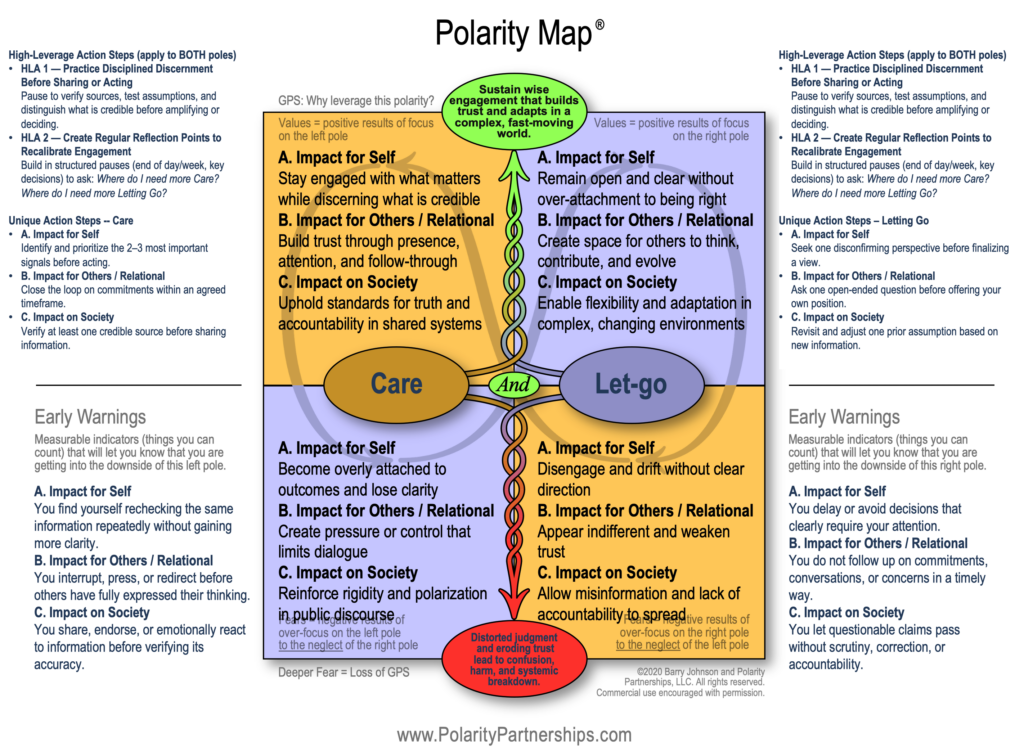
There’s a systems-thinking phrase often attributed to W. Edwards Deming: every system is perfectly designed to get the results it gets. If the results disturb us, eventually attention has to shift toward the structure generating them. Human beings will never navigate that perfectly. That’s part of Let-Go. At the same time, the responsibility to remain sufficiently attentive still matters. That’s the Care.
This chapter increasingly feels connected to several interacting polarities: Care AND Let-Go. Verify Truth AND Make Meaning. Facts AND Story. Trust AND Skepticism.
Story to the neglect of Truth drifts toward manipulation, distortion, and emotional possession. Truth to the neglect of Story often loses relational reach entirely because human beings rarely organize themselves around information alone. Trust given too easily eventually burns people. Trust withheld completely eventually freezes systems into isolation and paralysis.
So once again we arrive back inside tension—not as something to eliminate, but as something to participate in more wisely.
The image of the straw dogs lands differently from there. Less dismissive. More clarifying. Roles change. Systems change. Beliefs change. Identities shift. Entire civilizations reorganize themselves over time whether human beings feel emotionally prepared for it or not. Reality keeps moving. And the tighter people grip what is already changing, the more disoriented they often become.
More knowledge
more confusion
More knowing
more illusion
Which feels strangely relevant inside an age increasingly organized around information abundance and certainty performance.
Perhaps wisdom has less to do with accumulating endless information and more to do with recognizing patterns earlier. Recognizing when confidence starts masquerading as clarity. Recognizing when repetition starts feeling like truth. Recognizing when engagement starts replacing discernment. And learning how to remain present enough to reality that the bellows amplifies something more human than fear alone.
Heaven and earth make no distinction.
We still have to.
Because we are inside the system, not outside it. And the question increasingly feels less like whether we are using the bellows well and more like whether we recognize how deeply the bellows is already shaping us.
Care deeply.
And.
Let go completely.
The bellows is inexhaustible.
Here’s a Polarity Map for Care And Let-go:
INVITATIONS:
To use an AI-trained “Chat w/Cliff” for Step 1, Seeing” CLICK HERE.
Ready for the Polarity Advantage? Go deeper into Polarity Thinking, see our online self-directed Credentialing and Introduction to Polarity Practice or in-person training with Barry Johnson and me at Kayser Ridge by CLICKING HERE.