

See the Series Introduction for Just Tao It, Part I: HERE
See the Just Tao It Series Introduction Tao/It on-ramp, PART II: HERE
See Just Tao It, Chapter 1: HERE
From my interpretation of the Tao Te Ching, Chapter 52 (Unpublished):
From mother, creator.
to inheritor.
And here—
we are.
Leaving innocence,
wants arise.
In wants,
we lose the simple.
In what is small,
hold It—
and see all.
In yielding,
be steady.
Release what covers.
Let what is
remain.
Stand upright.
Know shadow.
See light.
Let what is true
show.
—
I have been noticing how easily my attention can leave without announcing its departure. I begin with one intention and, somewhere along the way, find myself inside another. A headline opens a second door. A message creates a third. By the time I notice, the thing I meant to attend to is still there, waiting.
What interests me is the moment of noticing. Attention has gone somewhere; awareness recognizes that it has gone. Neither experience belongs only to the digital age. Human beings have always been distractible, desirous, obsessive, and capable of losing the larger field inside whatever has become most immediate. The scale and persistence of the invitation have changed. Many of us now carry systems that can compete for attention throughout nearly every waking hour.
Leaving innocence,
wants arise.
In wants,
we lose the simple.
To my ear, these lines leave desire inside the human experience without placing it on trial. Wanting gives direction. It helps us recognize hunger, aspiration, relationship, and possibility. It can also begin organizing the entire field of perception. The wanted thing grows larger. Everything around it recedes. What we attend to starts shaping what we can see.
Gestalt psychology offers a useful image for this movement: figure and ground. Something emerges from a wider field and becomes the figure holding our attention. The ground remains present, although we may lose our felt relationship with it. Attention gives the figure clarity. Awareness helps us remain in relationship with the field from which it emerged.
Chapter 52 leaves that field mysterious. Mother. Creator. Inheritor. The small through which the whole can somehow be seen. Polarity Thinking helps me notice a recurring pattern within that mystery. Their relationship has become reciprocal in my life: the Tao keeps the mystery from being reduced to a model, while the polarity lens gives me language for a movement I can experience before I can fully name it. The map helps me enter the terrain; the terrain continues to correct the map.
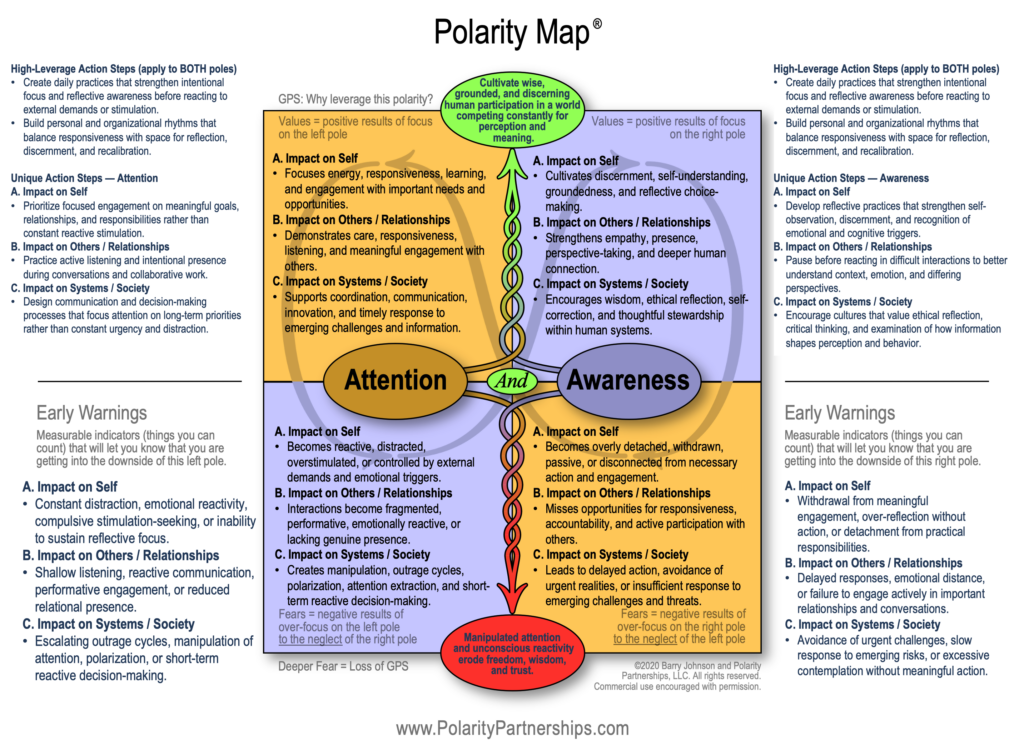
You may see or name the underlying tensions differently. Through a polarity lens, I find myself reading Attention AND Awareness between these lines. Attention brings energy toward a particular person, task, sensation, need, or possibility. Awareness holds a wider field—the relationships, context, patterns, consequences, and parts of ourselves that may be less immediately visible.
Attention allows us to listen closely, learn, choose, build, repair, and respond. It is how we remain with a conversation long enough to hear what another person is trying to say. It is how a craft becomes a practice and how care becomes specific. Awareness brings another gift. It helps us notice what our focus is excluding, how our bodies are responding, which assumptions are shaping perception, and whether the figure before us still deserves the place it occupies.
Each can lose contact with the other. Attention to the neglect of Awareness can narrow into fixation, reactivity, or capture. The urgent figure consumes the field. Awareness to the neglect of Attention can become diffuse or detached—able to observe many things while committing deeply to very little. The field remains wide, yet nothing receives enough energy to be met, made, or changed.
I recognize both movements in myself. There are times when a single demand becomes the whole world. There are also times when reflection creates distance from the particular action or relationship asking something of me. Seeing the pattern does not release me from it. It gives me another chance to participate with a little more choice.
Artificial intelligence intensifies this older human pattern. Systems can now learn which figures most reliably attract us—fear, outrage, novelty, validation, identity, belonging—and place them before us with extraordinary speed. Attention has economic value, and many systems have been designed to hold it. I remain part of those systems. I use them, benefit from them, become absorbed by them, and sometimes recognize their shaping only afterward.
That recognition matters to me more than imagining I can stand outside the system and diagnose everyone else inside it. The same technologies that fragment attention can extend learning, reveal relationships, and help us encounter perspectives beyond our own. The question becomes relational: what kind of attention are these systems strengthening, and what quality of awareness are we bringing to our participation with them?
In what is small,
hold It—
and see all.
I love the movement in those lines. Holding what is small asks for Attention. Seeing all asks for Awareness. The small thing does not disappear into the whole, and the whole does not make the small thing insignificant. A breath, a face, a sentence, a number, a grief, a tree—each can become a doorway into a larger field when focus and spaciousness remain available to one another.
In yielding,
be steady.
I have often associated steadiness with holding firm. Chapter 52 places it beside yielding. That pairing changes how I experience attention. Steadiness can include the capacity to release one figure when the wider field asks to be seen. Yielding can include redirecting attention without treating every interruption as a command.
There are ordinary ways this relationship returns: pausing before following the next link, feeling the body during a difficult conversation, looking up from the screen, staying with a person after the mind has begun preparing its response. None removes us from the competition for attention. Each creates a small opening in which Attention and Awareness can find one another again.
Release what covers.
Let what is
remain.
The coverings are not all outside us. Our fears, ambitions, loyalties, loneliness, and unexamined wants also shape the figures that command attention. Technology can amplify those patterns, yet it did not create the human shadow from which they emerge. I am implicated in the field I am trying to understand.
Stand upright.
Know shadow.
See light.
Let what is true
show.
There is restraint in that final movement. Truth is allowed to show. Attention helps me stay with what is appearing. Awareness helps me notice the field through which I am interpreting it. The Tao leaves something beyond both—the source that cannot be forced into focus or fully held by awareness.
I am still learning when to narrow the field and when to widen it, when to remain with the figure before me and when to notice what has disappeared into the ground. What might become visible when Attention and Awareness are allowed to support one another—and neither claims the whole?
Here’s a Polarity Map for Attention AND Awareness:
INVITATIONS:
Take a custom Polarity Assessment based on this Chapter’s Polarity HERE.
To use an “AI-trained Chat w/Cliff for Step 1, Seeing” CLICK HERE.
Ready for the Polarity Advantage? Go deeper into Polarity Thinking, see our online self-directed Credentialing and Introduction to Polarity Practice or in-person training with Barry Johnson and me at Kayser Ridge by CLICKING HERE.