


See the Series Introduction for Just Tao It, Part I: HERE
See the Just Tao It Series Introduction Tao/It on-ramp, PART II: HERE
See Just Tao It, Chapter 1: HERE
From my interpretation of the Tao Te Ching, Chapter 54 (Unpublished):
There’s no uprooting a rooted center.
What’s held truly
endures.
Allow It to enter—
benefit.
All held
in spirit.
In reaching for the center,
you begin to hold Its spirit.
Seeing yourself in the other,
It grows.
Cultivate It in the family,
the family finds its way.
Cultivate It in the community,
something steadier takes shape.
Cultivate It in the nation,
It reaches beyond itself.
Others are not separate from you.
Families are not separate from your family.
Communities are not separate from your community.
Nations are not separate from your humanity.
From the center,
what is true
moves outward.
—
There is something unsettling about how contemporary systems reward the appearance of rootedness while steadily weakening the developmental conditions required for actual rootedness to form. Influence scales rapidly. Certainty spreads rapidly. Emotional activation spreads rapidly. Discernment, humility, and relational maturity develop much more slowly.
Underneath much of it sits a pattern Chapter 54 recognized thousands of years ago:
We keep trying to scale outward what has not been cultivated inward.
We built systems capable of extraordinary scale before cultivating the human capacities required to sustain what scale produces.
Democracy is straining in developed nations in ways many assumed were behind us. Artificial intelligence is extending capability faster than collective discernment about how to guide it. Information ecosystems reward speed, certainty, performance, outrage, and identity possession while steadily weakening reflection, trust, and relational coherence. Religious, political, and cultural tensions that once appeared to be softening now harden under pressure.
Each issue is difficult independently. Together, they form interdependent tensions that no single ideology, institution, technology, or policy framework can resolve in isolation. Many of the systems designed to stabilize modern society now seem unable to absorb the very complexity they helped create.
John Gall captured something profoundly important in Systemantics: complex systems that function reliably almost always evolve from simpler systems that already work. Attempts to construct large-scale complexity all at once tend to fail under the weight of what was never properly cultivated beforehand.
Lao Tzu pointed toward the same pattern 2,500 years earlier.
There’s no uprooting a rooted center.
What’s held truly endures.
One of the deepest leadership lessons hidden inside this chapter is this: we keep attempting to engineer the Whole while neglecting the developmental cultivation required within the Parts that compose it.
Systems eventually mirror the developmental maturity of the people operating them.
That becomes painfully visible in modern public life. Institutional distrust deepens while outrage scales effortlessly. Performative certainty substitutes for thoughtful discernment. Leaders rise to prominence through attention capture while lacking the developmental capacity to hold the influence they now possess.
Adult development helps illuminate part of what we are witnessing. Earlier developmental operating systems often organize around self-protection, identity protection, group belonging, certainty, winning, status, loyalty, or threat management. None of this is inherently bad — self-interest, group cohesion, loyalty, and identity all serve real purposes. Under sufficient pressure, though, these systems can become reactive, tribal, performative, and adversarial when they have not been integrated into broader capacities for holding complexity, interdependence, and shared humanity.
Once identity hardens, intelligence itself can become justification machinery.
Many modern systems reward exactly that dynamic.
The Tao returns us to cultivation—less glamorous, far more difficult.
In reaching for the center,
you begin to hold Its spirit.
The center here is something more demanding than withdrawal from reality. It is the place where reality can be metabolized without immediately fusing into reaction, certainty, tribalism, performance, or emotional possession. It is where individuals develop the capacity to stay present to tension without reducing it prematurely. Where families learn to navigate difference without fragmentation. Where teams practice Truth AND Trust together without weaponizing one against the other. Where communities strengthen the relational fabric required for larger systems to endure under pressure.
This is where Part AND Whole stops being conceptual and starts becoming diagnostic.
Democracy depends on citizens and institutions capable of leveraging Freedom AND Authority, Participation AND Representation, Human Rights AND Communal Obligations, Diversity AND Equality, and Justice AND Due Process over time (see Polarities of Democracy Institute). Those capacities don’t appear at national scale because constitutions exist on paper — they emerge through relationships, communities, education, and lived practice over time.
Truth AND Trust strain under information fragmentation. Competence AND Character separate inside leadership systems that reward attention over maturity. Human Judgment AND Machine Capability must mature together as AI accelerates faster than our collective wisdom about how to guide it responsibly. Consumption AND Conservation shape environmental sustainability in daily life, not only in global agreements. Belief AND Openness help religious and cultural pluralism hold together amid the pressures of domination, relativism, and dehumanization.
These tensions interact continuously. They form what I have come to call Multarities: interdependencies of more than two poles whose dynamics synergistically contribute to a Greater Purpose that is more than the sum of the parts (described more fully in Chapter 42 of And, Volume 2). Multarities become unstable when developmental cultivation fails to keep pace with systemic complexity.
I have spent enough time getting hooked and stuck myself to recognize how easily this happens. A downside finally becomes painful enough that we flee toward the opposite pole convinced we have finally discovered The Answer. Then eventually we discover the downsides waiting there too. At this point, I sometimes think much of adult development consists of learning how to circle the same barn with slightly more humility each decade.
Had I encountered Polarity Thinking much earlier in life, I genuinely wonder how much unnecessary suffering I might have spared myself — and others — from my own OCD-fueled certainty about whichever pole I happened to be overidentifying with at the time.
Polarities are wonderfully humbling that way. And because they are ongoing, we get a lot of “second chances” to get them right. (The dynamics behind getting and staying stuck — and the path through — are developed in the companion Wiser Decisions reference piece, “Hooked. Stuck. Unstuck.”)
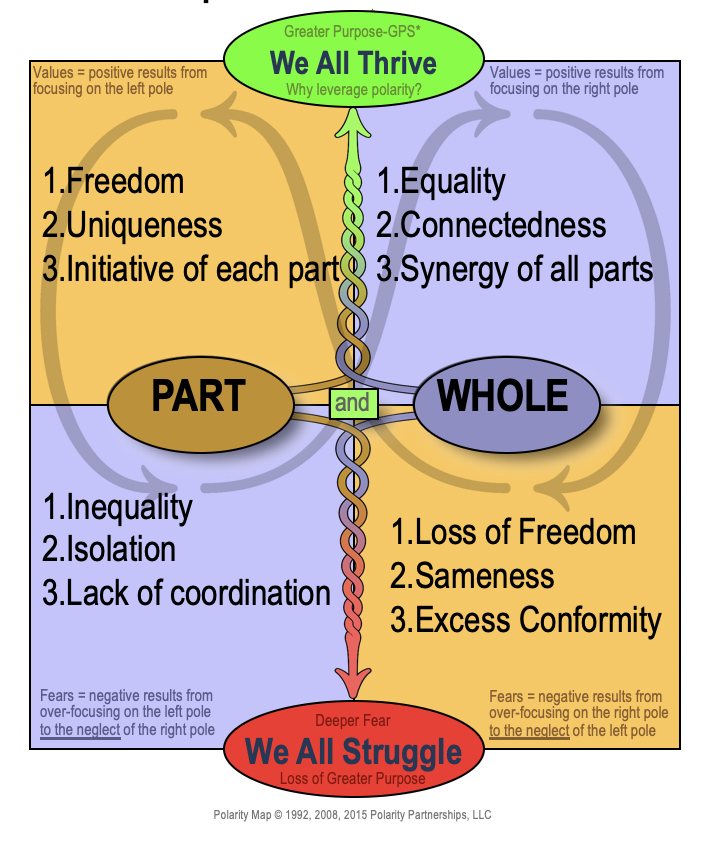
Polarity work demands a discipline most cultural commentary avoids: the same diagnostic must be applied to both directions of failure. The argument so far has emphasized Whole leveraged to the neglect of Part — scaling institutions, technology, and influence faster than the developmental cultivation required to sustain them. That direction of failure is the more visible one in this moment, and worth naming honestly.
Part leveraged to the neglect of Whole produces a different but equally damaging set of consequences. Parochialism. Tribal isolation. The hardening of communities and identities against the larger systems they belong to. The refusal of shared accountability. The fragmentation of nations into mutually-incomprehensible factions, each rooted in its own center, each unable to recognize itself in the other. Strong roots without connection to the larger ecosystem produce strong, isolated plants in dying soil.
Both failures damage the living system. The cultivation argument calls for the developmental work required to leverage Part AND Whole together—roots deep enough to hold and reach wide enough to recognize others as inseparable from the larger living system.
What Systems Become When They Lose Contact With Reality
Donella Meadows spent much of her life helping people recognize that systems produce exactly the outcomes they are structured to produce. John Gall warned that systems often lose contact with reality itself because “the real world” becomes whatever gets reported into the system.
That insight feels disturbingly contemporary.
Modern institutions respond to metrics, polling, engagement algorithms, branding dynamics, information velocity, and performative narratives while drifting from the lived human realities beneath them. Systems begin optimizing reports about reality instead of reality itself. Once that separation widens enough, distrust accelerates almost automatically. Whole loses contact with Part when reports, categories, and abstractions replace lived relationship.
Reality binds us to complexity.
It is easy to reduce human beings into categories, ideologies, tribes, parties, movements, identities, enemies, or abstractions from sufficient distance. Much harder face-to-face. Much harder inside actual relationships. Much harder when another human being remains visible as fully human and not merely symbolically useful.
Avoidance has become part of the system dynamic. We curate informational environments that protect certainty, reinforce identity, and minimize contact with the complexity capable of softening absolutism. Over time, distance permits dehumanization to scale far more easily than presence does.
The Tao points toward rootedness because rootedness restores contact with what is present.
I got this wrong during a stretch when I equated impact with scale: broader reach, more systems, larger influence, faster expansion. If something valuable worked in one place, the instinct was to extend it outward quickly.
That approach can produce impressive short-term results. It can also produce fragility underneath the surface that remains invisible until pressure arrives.
Over time I began noticing something. The further outward things stretched without sufficient rootedness at the center, the thinner everything became relationally. Alignment weakened. Trust became more conditional. Performance increasingly depended upon continuous energy expenditure where it might have rested on cultivated coherence. It became undeniable through a growing distance between what we were producing and what we had cultivated to sustain it.
I did not fully recognize it then. I can see it more clearly now: I was leaning toward Whole to the neglect of Part.
The modern world does the same.
We scale institutions faster than wisdom. Technology faster than discernment. Influence faster than maturity. Reaction faster than reflection. Eventually the strain shows everywhere simultaneously.
Cultivate It in the family,
the family finds its way.
Cultivate It in the community,
something steadier takes shape.
Cultivate It in the nation,
It reaches beyond itself.
That is developmental architecture, more than it is sentimental spirituality. What moves outward carries the quality of what formed it inwardly. Systems inherit the maturity of their relationships, the capacities of their people, and the developmental patterns their cultures reward.
Right now many systems reward speed over discernment, certainty over reflection, emotional activation over grounded presence, and influence over cultivation.
The work of cultivation becomes even more essential.
Why Inner Development and Sustainable Development Are the Same Conversation
This is where Inner Development Goals (IDGs) AND Sustainable Development Goals (SDGs) become one conversation rather than two. Sustainable systems require human beings capable of holding complexity without flattening into certainty, ideological possession, or dehumanization. Developmental work may be a prerequisite for sustainable systemic work. Cooperation at scale depends on capacities cultivated relationally first.
Citizens must distinguish adversaries from enemies. Wisdom must develop alongside machine capability. Shared humanity must remain available amid profound difference. Enduring systems grow from centers capable of sustaining them.
The Tao illuminates an interdependence that preserves difference. Interdependence becomes unavoidable under sufficient complexity.
That may be why this chapter feels urgent now. We no longer have the luxury of pretending fragmentation at one level remains isolated from the others. Emotional fragmentation travels outward through information systems, institutions, and society.
Everything moves outward.
Integrity and wisdom move outward. Immaturity and fear do too. Whatever we cultivate travels.
The central question underneath Chapter 54 may be simpler — and more demanding — than many modern leadership frameworks are prepared to acknowledge:
What are we actually cultivating before we attempt to scale it?
Whatever we are holding now is already moving outward into families, teams, organizations, nations, technologies, institutions, and systems.
The quality of what moves outward can never sustainably exceed the quality of what has first been cultivated inward.
From the center,
what is true
moves outward.
The movement is already happening.
The only remaining question is whether what we are extending is rooted enough to endure.
Here’s Polarity Map for Part And Whole. For more on the Part And Whole polarity, see And, Volume 1, Foundations Section 5, Chapters 22-25:
INVITATIONS:
To use an AI-trained “Chat w/Cliff” for Step 1, Seeing” CLICK HERE.
Ready for the Polarity Advantage? Go deeper into Polarity Thinking, see our online self-directed Credentialing and Introduction to Polarity Practice or in-person training with Barry Johnson and me at Kayser Ridge by CLICKING HERE.
Sources and Acknowledgments
• Lao Tzu, Tao Te Ching, Chapter 54 (Cliff Kayser, interpretive rendering).
• Barry Johnson, And: Volume 1 — Foundations, Section 2: Part AND Whole (Chapters 4–11). Polarity Partnerships, 2020.
• Cliff Kayser, And: Volume 2 — Applications, Chapter 42: Multarities. Polarity Partnerships, 2021.
• John Gall, Systemantics: How Systems Work and Especially How They Fail.
• Donella H. Meadows, Thinking in Systems: A Primer.
• Polarities of Democracy Institute (Dr. William Benet) — Freedom AND Authority; Justice AND Due Process; Diversity AND Equality; Human Rights AND Communal Obligations; Participation AND Representation.
• Inner Development Goals initiative — for the inner capacities required to navigate the Sustainable Development Goals.
• Lura Forcum — recent essay on tribalism, polarization, and human complexity that helped sharpen several reflections in this chapter.
Cross-Reference this Chapter With”:
• Wiser Decisions Series — “Hooked. Stuck. Unstuck.”
• Wiser Decisions Series — “Democracy Was Never Meant to Be Comfortable.”
• Just Tao It, Chapter 13
• Just Tao It, Chapter 78