

See the Series Introduction for Just Tao It, Part I: HERE
See the Just Tao It Series Introduction Tao/It on-ramp, PART II: HERE
See Just Tao It, Chapter 1: HERE
From my interpretation of the Tao Te Ching, Chapter 56 (Unpublished):
Those who know don’t talk.
Those who talk don’t know.
Walk what is true.
Release the show.
Resolve the tangle,
Remove the rust,
Soften the angle,
Settle the dust.
Dust settles the same.
To which we all return,
Freed from concern
For friend or enemy,
Neglect or courtesy,
Praise or disgrace.
Walk with It in this way.
Let virtue need no witness.
—
This ancient wisdom cuts differently in the age of artificial intelligence.
The chapter may unsettle certain egos because it challenges one of the oldest human seductions: the desire to appear knowing. Not knowing in service of wisdom, discernment, or care. Knowing as status. Knowing as identity. Knowing as a place above others.
You’ve likely seen it: the meeting where a crucial decision needs to be made—not just a technical one, but something that will affect people’s lives, work, or trust—and everyone automatically defers to whoever has the most credentials, the longest tenure, or the most confident delivery. The person who’s “been here the longest.” The one with the MBA. The technical expert.
It’s not that experience, expertise, or credentials don’t matter. They do. But when they become the automatic trump card—when the room goes silent not because wisdom has been spoken but because status has—something vital gets lost. The insight from someone newer. The ethical question no one with seniority wants to raise. The “I don’t know” that could have opened genuine exploration.
That assumption was shaky before AI.
Now it is dangerous.
For a long time, knowledge itself created advantage. Those with access to education, expertise, institutions, or information held power others did not. But AI is changing that relationship. Today, nearly anyone with access to advanced systems can supplement their thinking with vast amounts of accumulated human knowledge.
Information is becoming radically democratized.
That creates extraordinary opportunity—and extraordinary risk.
Because information is not truth. Intelligence is not wisdom. More data does not naturally produce better judgment. More processing power does not tell us what matters. Raw signals, stories, images, arguments, and endless generated language can support truth. They can also support delusion, propaganda, distortion, and confident nonsense.
Networks do not automatically optimize for truth. They often optimize for attention, cohesion, power, or speed. Which means AI can now process and generate information at extraordinary scale without possessing wisdom, humility, or concern for truth. It can solve problems without feeling consequences. It can produce coherence without conscience. It can amplify what we already bring to it—our bias, our fear, our vanity, our certainty, and our need to be seen as right.
Which means humility, discernment, and compassion are no longer optional qualities. They may become conditions for survival.
So the old workplace pattern of defaulting to credentials and confidence becomes even less useful. If everyone can now borrow machine-amplified intelligence, then expertise alone loses some of its shine. The more important question becomes: who remains open enough to keep learning, grounded enough to keep discerning, and humble enough to know that access to intelligence is not the same as wisdom?
I can’t count the number of executive team retreats where the most important sentence in the room finally arrived only after someone with real standing said, “I don’t know.” I’ve watched the same thing happen in PACT Certification cohorts—the moment a seasoned leader stops defending a position and starts asking a real question is usually the moment the whole room gets smarter.
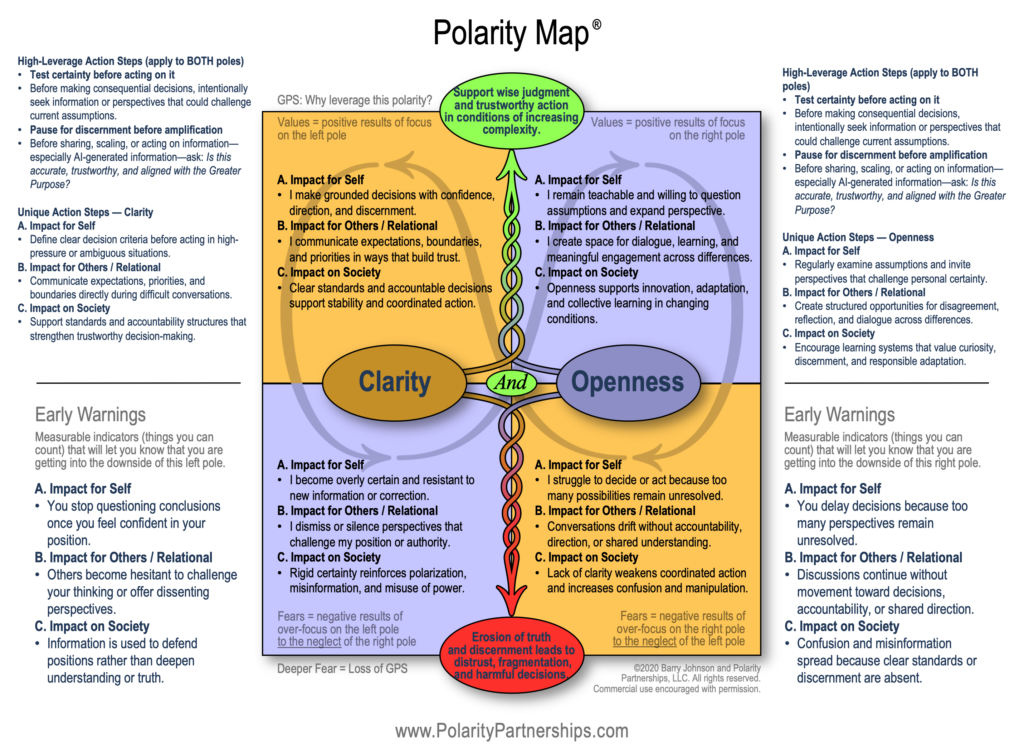
Which brings us directly to the polarity this chapter illuminates: Clarity AND Openness.
Clarity remains essential. Without it, systems drift into confusion and indecision. Leaders need to decide, communicate direction, establish boundaries, and act under pressure. Either/Or thinking remains essential in many situations. A surgeon cuts or does not cut. A pilot lands or aborts. A court rules guilty or not guilty.
But many of the challenges shaping the future are not problems that can be permanently solved. They are polarities and multarities (interdependencies of more than two that share a greater purpose) that must be leveraged over time. Human Judgment AND Artificial Intelligence. Innovation AND Wisdom. Freedom AND Responsibility. Speed AND Reflection. Expertise AND Humility.
Clarity to the neglect of Openness turns intelligence into arrogance. Openness to the neglect of Clarity dissolves discernment into reaction, drift, and endless uncertainty.
The deeper danger is that intelligence itself becomes performance.
The appearance of knowing replaces the discipline of learning.
The need to be seen as informed becomes stronger than the willingness to remain teachable. The room fills with credentialed people, and trust still erodes.
The problems shaping human survival now operate at scales no isolated certainty can solve. They require cooperation across differences humanity still struggles to sustain.
The emergence of the Inner Development Goals reflects that recognition. The SDGs identified what humanity needs to accomplish together. The IDGs recognized that achieving those goals requires inner capacities many leaders and systems have not sufficiently developed: humility, reflection, perspective-taking, relational maturity, and the ability to remain open while acting with clarity. See the trailer for the 2025 Summit with the theme: Bridging Polarities.
In that sense, this chapter is not asking people to become less intelligent.
It is asking whether intelligence without humility becomes dangerous.
Dust settles the same—on the Ivy League diploma and the GED, on the corner office and the studio apartment, on the verified account and the anonymous life. No amount of status, brilliance, followers, wealth, institutional power, or machine-enhanced intelligence changes where we eventually return.
The ego hates that. Reality does not care.
Those who know don’t talk.
Those who talk don’t know.
The warning is not against speaking itself. It is an invitation to stop performing knowing and begin practicing wisdom.
This is not easy. Every organizational system rewards the appearance of certainty. Every algorithm rewards confident assertion. Swimming against that current requires more than understanding. It requires practice, courage, and communities capable of valuing inquiry alongside expertise.
Imagine what might change if the most credentialed person in the room said, “I don’t know.” What are others seeing? The intelligence in the room changes when inquiry becomes more important than performance. Over time, cultures may depend on that shift.
Here’s a Polarity Map for Clarity And Openness:
INVITATIONS:
Take a customized Polarity Self-Assessment for Clarity AND Openness CLICK HERE.
To use an “AI-trained Chat w/Cliff for Step 1, Seeing” CLICK HERE.
Ready for the Polarity Advantage? Go deeper into Polarity Thinking, see our online self-directed Credentialing and Introduction to Polarity Practice or in-person training with Barry Johnson and me at Kayser Ridge by CLICKING HERE.