

See the Series Introduction for Just Tao It, Part I: HERE
See the Just Tao It Series Introduction Tao/It on-ramp, PART II: HERE
See Just Tao It, Chapter 1: HERE
From my interpretation of the Tao Te Ching, Chapter 57 (Unpublished):
Govern a country with justice.
Address conflict with surprise.
Conquer the world with patience.
How do I know this?
From experience.
Without excessive rules,
people become honest.
Without feeding desire,
greed does not take hold.
Without imposed belief,
people return to what they know.
Let go of what is forced.
What is steady does not require grand displays.
In what is simple, there is enough.
In what is enough, there is abundance.
—
Chapter 57 asks what makes social order durable. Force can secure compliance for a time. Shared life depends on something deeper: enough truth to remain grounded in reality, and enough trust to remain in relationship with one another.
In 2017, I helped found the Polarities of Democracy Institute with Dr. Bill Benet and Barry Johnson because I was carrying a fear I could not shake.
At the time, I probably couldn’t have built a fully persuasive argument for what I was sensing. I only knew something in me was sounding an alarm. Democracy didn’t just seem politically strained — it felt vulnerable to being hollowed out from within, through something slower and more familiar than tanks in the street or a spectacular institutional failure. What concerned me was the gradual weakening of the habits, tensions, relationships, and values that allow people to govern themselves together at all.
That fear became one of the forces organizing my work. It connects directly to why I write, why I coach, why I consult, why I convene retreats at Kayser Ridge, and why I return to the Tao Te Ching. There’s a red thread running through those seemingly separate parts of my life — something to do with helping people reconnect to what’s essential before noise, ideology, fear, and speed pull them too far from center.
Chapter 57 may be the clearest expression of that thread I know: govern a country with justice, address conflict with surprise, conquer the world with patience. That reaches deeper than politics or strategy, because democracy, at its core, is a conversation. It depends on people remaining in relationship with one another and with reality long enough to work tensions that survive every temporary victory.
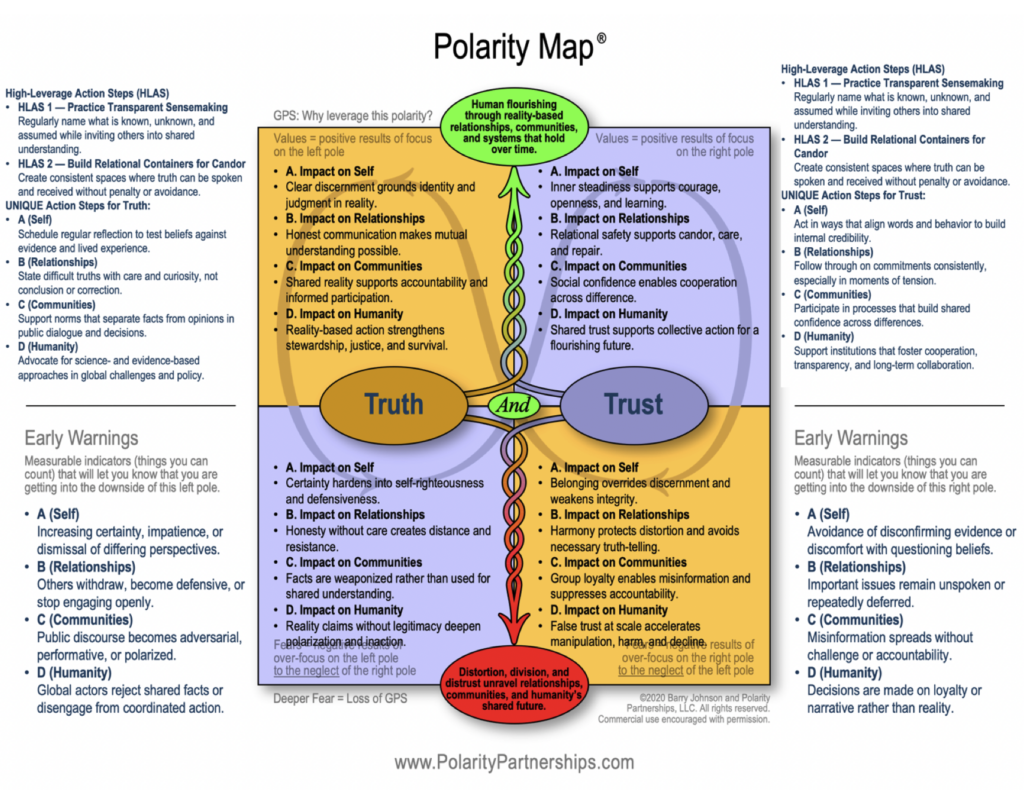
Truth helps that conversation stay connected to reality. Trust helps people stay inside the conversation long enough to act together. Democracy needs both.
Dr. Bill Benet’s Polarities of Democracy framework has shaped my understanding of this more than almost anything else. Democracy isn’t secured by choosing the correct value once and for all — it depends on leveraging interdependent values continuously over time: Freedom AND Authority, Justice AND Due Process, Diversity AND Equality, Human Rights AND Communal Obligations, Participation AND Representation.
Each pair names an enduring tension, and each depends on the others. When one value is pursued to the neglect of its partner, democratic life distorts. Freedom to the neglect of Authority fragments. Authority to the neglect of Freedom constrains.
These are ongoing tensions requiring discernment, maturity, humility, and stewardship over time. When those capacities weaken, the democratic conversation deteriorates from the inside.
Chapter 57 points toward that same reality from another direction. Without excessive rules, people become honest. Without feeding desire, greed doesn’t take hold. Without imposed belief, people return to what they know.
Those lines land hard right now. Modern systems substitute force for relationship, speed for reflection, spectacle for legitimacy, certainty for discernment. We’re repeatedly promised that one more victory, acceleration, or display of control will restore order.
The Tao remains profoundly unimpressed by those fantasies. It distinguishes imposed order from cultivated justice, volume from truth, compliance from trust. What endures is rarely what was forced. What endures has usually been cultivated deeply enough that people live it instead of just submitting to it.
Trust allows people to remain in relationship long enough for democratic life to function at all. Democratic life requires trust in ourselves, one another, and the institutions carrying shared responsibility. It also requires confidence that disagreement doesn’t erase another person’s legitimacy, that law serves more than factional victory, and that a shared reality remains possible.
Without enough trust, democratic systems become ceremonial structures people continue invoking even as their confidence in them erodes.
I’ve watched this erosion happen in real time. Conversations that once stayed difficult yet workable now fracture quickly. Relationships that once tolerated tension harden into suspicion. Institutions that once self-corrected now calcify defensively instead.
Trust is essential, and it remains vulnerable when separated from truth. Human beings can trust what’s false. Groups can organize around conspiracy, grievance, or emotionally satisfying distortion, and digital systems now let those distortions spread with extraordinary speed.
Truth without Trust is resisted, weaponized, dismissed, or ignored. Trust without Truth becomes unstable, manipulative, tribal, or untethered from reality itself. A thriving humanity requires both. Together, Truth AND Trust serve a larger purpose: Shared Reality — the capacity to inhabit the same world together, make decisions grounded in what’s really happening, and remain in relationship long enough to navigate what can only be lived over time.
Shared Reality is the ground beneath democratic participation. Once reality becomes factional property, collective decision-making loses its foundation.
AI intensifies this challenge by producing persuasive language, images, and claims faster than human discernment and institutional trust can evaluate them.
I helped found the Polarities of Democracy Institute because I was scared. I feared that losing the capacity for shared conversation would cost us far more than elections or policy agreements — that we’d lose the developmental conditions democratic life itself depends on.
Once that erosion accelerates, the consequences don’t stay isolated inside politics. Families strain. Teams harden. Organizations fracture into camps. Truth becomes negotiable. Trust becomes tribal.
Much of this gets marketed to us as strength. Some days I genuinely wonder whether we still remember what mature strength looks like.
Chapter 57 distinguishes justice from domination, and sustainable order from temporary compliance. Legitimate governance grows through relationship, participation, and trust lived deeply enough to endure conflict.
I love the Tao because it refuses to flatter our appetite for force, spectacle, domination, certainty, and control. This chapter calls for disciplined participation. Excessive legalism rarely produces honesty. Feeding greed rarely produces abundance. Imposed righteousness rarely produces love.
Chapter 57 brings that same thread into view: helping people remain connected to reality, to one another, and to the larger systems carrying us all.
I’ll admit something honestly here. In recent years, I’ve struggled to distinguish periods of depression from the grief and exhaustion of responding honestly to what I see. They may be more connected than I once understood. My energy falls, returns, and falls again.
People who demonstrate that coherence remains possible help restore me.
I think of them as islands of coherence in a sea of chaos, a phrase often associated with Nobel Prize–winning chemist Ilya Prigogine’s work on complex systems far from equilibrium. Prigogine’s family escaped revolutionary Russia, then later the rise of Nazism in Europe — he understood instability personally as well as scientifically. His work gives language to what I experience around such people: that when a system is far from equilibrium, small islands of coherence have the capacity to shift the entire system toward a higher order.
The image describes how living systems can reorganize around coherence. Hope begins there, becoming sturdier than emotional reassurance.
My sister Lori founded Team Tony Foundation to support people navigating cancer diagnoses and end-of-life realities. She works daily with people confronting mortality directly. Nobody would blame her for becoming sentimental. She remains fierce, practical, grounded, loving, and relentlessly hopeful.
She centers much of her work around one word: hope.
I’m wearing one of her Team Tony bracelets right now. Printed on it: “I am not alone. We are stronger together. Know your mission/Why? Create your plan. Believe in yourself.”
That bracelet has outlasted more polished strategic frameworks than I care to admit, because it reflects practice. Practice is what hope looks like once it matures beyond emotion.
If democracy is a conversation, hope helps us stay inside it when fear, exhaustion, outrage, or cynicism pull us toward withdrawal or domination instead. Hope gives Truth AND Trust enough endurance to become practice, not slogan. Hope becomes credible through disciplined practice.
Stay in the conversation. Tell truth in ways that strengthen trust, and build trust capable of bearing truth. Democracy lives through that discipline whenever people refuse to surrender shared reality to panic, grievance, spectacle, or manufactured certainty.
My sister’s bracelet offers no grand theory, just a practice: know what you’re serving, make a plan, believe people are stronger together, remember you’re not alone.
Truth names the reality we share. Trust helps us remain together long enough to respond. Democracy lives or dies through that relationship, one conversation and one community at a time.
Chapter 57 returns me to what cannot be forced. Shared reality grows through cultivation. The work begins where we already are.
Here’s my Polarity Map for Truth And Trust:
INVITATIONS:
To use an AI-trained “Chat w/Cliff” for Step 1, Seeing” CLICK HERE.
Ready for the Polarity Advantage? Go deeper into Polarity Thinking, see our online self-directed Credentialing and Introduction to Polarity Practice or in-person training with Barry Johnson and me at Kayser Ridge by CLICKING HERE.