


See the Series Introduction for Just Tao It, Part I: HERE
See the Just Tao It Series Introduction Tao/It on-ramp, PART II: HERE
See Just Tao It, Chapter 1: HERE
From my interpretation of the Tao Te Ching, Chapter 67 (Unpublished):
One by one,
they will say It is great.
Then turn from It,
calling It inadequate.
If It were not what It is,
it would be like all else.
Guard what is given.
Hold close
the three:
Courage,
Love,
Humility.
With courage,
you face what must be met.
With love,
you see yourself and others more completely.
With humility,
you remain able to lead.
When courage thins,
fear draws near.
When love recedes,
we lose what makes us clear.
When humility fades,
we drift apart from here.
Courage meets fear—
without losing what is right.
Love holds all things—
bringing self and other into sight.
Humility keeps us near—
and able to lead with light.
—
One of the more predictable patterns in human behavior is how quickly we elevate something and then turn on it. We call something essential, even sacred, and then, almost without noticing, begin to question its usefulness. It starts to feel impractical. Inadequate.
Love tends to follow that arc.
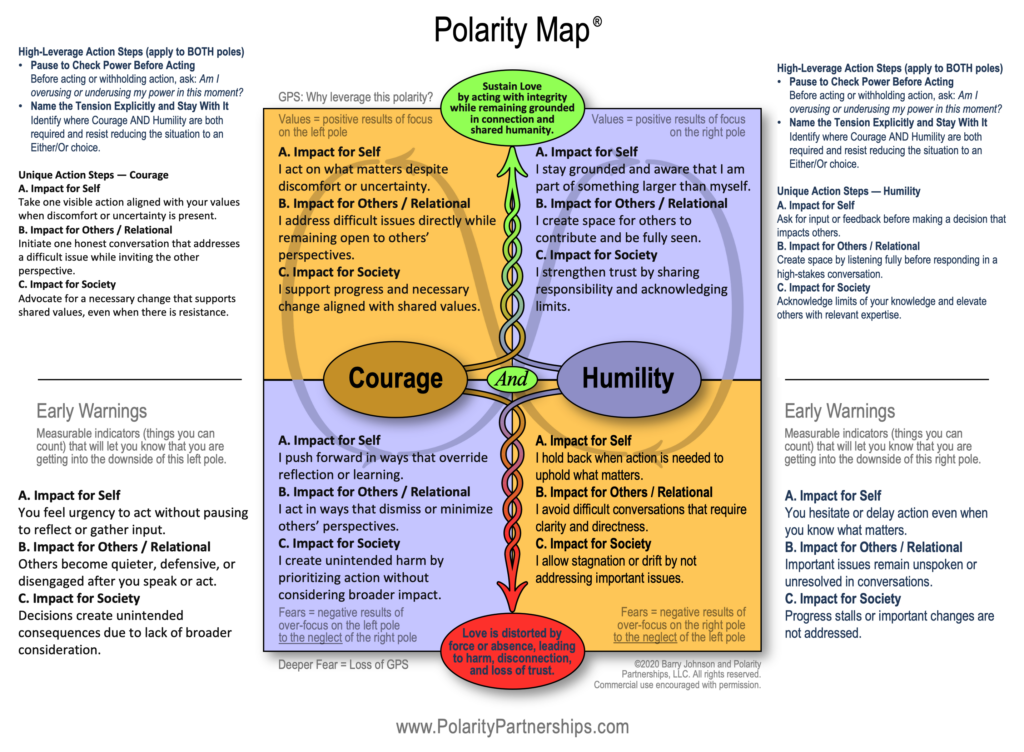
At the center sits Love. Love is the purpose. Courage and Humility are the conditions that allow it to endure.
It’s easy to agree with in the abstract. Harder to live when it asks us to stay present in moments we would rather exit, or to see more than we’re comfortable seeing. Love, as it shows up across traditions and across time, isn’t soft in the way we often make it. It’s demanding. It requires us to see ourselves and others more completely, without reducing either to something easier to manage.
That’s the point at which most people reach for something else. Often it’s Courage, but without much connection to anything beyond the act itself. That kind of Courage can move quickly. It can disrupt, challenge, and push through resistance. It can also leave damage behind it, especially when it isn’t anchored in anything that holds the whole. It becomes force—decisive, occasionally necessary, but often unaware of what it’s creating in the process.
Other times it’s Humility, but in a way that steps back too far. It looks like restraint, like not wanting to impose, like giving space. And at times it is that. But it can drift into absence. Things that need to be said go unsaid. Moments that call for action pass without movement. It can feel like steadiness from the inside, but from the outside it lands as distance.
Neither of those sustains Love.
And when either pole operates alone, trust erodes.
Trust grows in two directions: toward yourself, that you can act with strength without becoming rigid, and hold back without becoming absent; and toward others, that they can handle both your conviction and your uncertainty without requiring you to perform one at the expense of the other.
When Courage AND Humility move together, trust has room to build. When they separate, it begins to thin.
I think of a coaching conversation where a client needed to hear something he wasn’t going to like. Saying it took Courage—there was no path to make the message land softly. Listening to what came back after, without defending or retreating, took Humility. Neither pole alone would have preserved the relationship. Both together did.
What tends to get missed is the role of power itself: the ability to act, to influence, to shape what happens next, rather than mere position or authority. Everyone has it. The question is how we use it, not whether we have it.
Most of the dysfunction we see doesn’t come from a lack of power. It comes from how power gets applied under pressure, especially when tensions that require both/and thinking get reduced to either/or choices. Act or don’t act. Speak or stay silent. Push or hold back. Those moves feel clean in the moment. Decisive. Clear. But over time, they strip out the very conditions that allow things to hold.
Artificial intelligence is amplifying that pressure. It accelerates action—speed, decisiveness, scale. What it cannot supply on its own is accountability, restraint, or awareness of its own limits.
Courage overused becomes force. Humility overused becomes absence.
In both cases, Love—the thing that holds the whole—begins to give way.
Courage, when it stays connected, does something different. It doesn’t remove fear; it moves with it. It shows up when there’s enough clarity about what matters that avoiding it isn’t really an option. Most of the time it isn’t dramatic. It looks like staying in a conversation that would be easier to leave, or saying something that might not land cleanly but needs to be said anyway. It’s not about winning the moment. It’s about not abandoning what matters in it.
Humility, when it stays connected, shifts in a different direction. It doesn’t reduce responsibility; it grounds it. It keeps things from becoming about you, even when you’re central to what’s happening. You can see it in people who don’t rush to claim credit when things go well and don’t look for somewhere else to place blame when they don’t. There’s a steadiness there that makes it possible for others to show up more fully, because the space isn’t being managed for appearance.
When Courage AND Humility move together, something else becomes possible. There’s enough strength to act and enough grounding to stay connected to what the action affects. Enough clarity to move forward and enough awareness to adjust when needed. It doesn’t eliminate tension. It changes how tension is carried.
That’s what allows Love to hold as something lived, not just an ideal. Something that can remain intact even when the moment is uncomfortable, uncertain, or unfinished. Without that, Love gets reduced to preference, agreement, or ease. With it, Love has the structure it needs to endure.
Most of the damage we see doesn’t come from people choosing wrong. It comes from reducing tensions that require both to choices that force one. Power makes that reduction faster. More visible. More consequential.
Over time, leaders who can hold Courage AND Humility together develop something more durable than strength or restraint alone. They develop the capacity to act in ways that hold—not because the decision was perfect, but because it remained connected to what mattered beyond the moment.
Love doesn’t sustain itself.
It’s sustained by how we move.
Here’s a Polarity Map for Courage And Humility:
INVITATIONS:
Take a custom Polarity self-assessment based on this polarity HERE.
To use an AI-trained “Chat w/Cliff” for Step 1, Seeing” CLICK HERE.
Ready for the Polarity Advantage? Go deeper into Polarity Thinking, see our online self-directed Credentialing and Introduction to Polarity Practice or in-person training with Barry Johnson and me at Kayser Ridge by CLICKING HERE.