

See the Series Introduction for Just Tao It, Part I: HERE
See the Just Tao It Series Introduction Tao/It on-ramp, PART II: HERE
See Just Tao It, Chapter 1: HERE
From my interpretation of the Tao Te Ching, Chapter 68 (Unpublished):
The best fighters
are not hungry for violence.
The best soldiers
understand their adversaries.
The best competitors
do not worship conquest.
The best leaders
lead with humility.
The ancients knew:
what pushes hardest
breaks first.
what grasps tightly
loses hold.
The best in us
does not dominate.
It lives as virtue
from the deepest source.
—
I have a confession: I love science fiction movies, and this chapter immediately stirred scenes from The Matrix. Not the leather trench coats, slow-motion bullets, or flying—although all that was undeniably entertaining. The scene I return to is the moment everything changes for Neo, when he stops trying to overpower the system surrounding him.
Something in him releases.
Up until then, he spends most of the movie trying to become “The One.” Trying to prove himself. Trying to force himself into mastery over a system he barely understands. And like most frightened human beings trapped inside systems larger than themselves, the harder he forces control, the more trapped he becomes by the system he is trying to escape.
Then something shifts. Fear exhausts itself. Grasping loosens. The world reorganizes in front of him. The bullets freeze. The code beneath the performance reveals itself differently.
The older I get, the more that scene feels like commentary on human consciousness disguised as science fiction.
Especially now.
We’re living through a strange moment in history where almost anyone with access to artificial intelligence can generate the appearance of brilliance. Essays. Arguments. Strategies. Images. Confidence. Certainty. Entire industries are forming around synthetic intelligence layered on top of very human insecurity.
Almost everyone can now sound intelligent.
That’s different from being wise.
Spend a few minutes online and it becomes difficult to miss the pattern. Political tribes performing outrage. Corporations performing virtue. Influencers performing authenticity. AI systems amplifying whatever keeps human attention emotionally activated the longest.
And underneath much of it sits an anxiety that information alone does not seem capable of resolving:
What if fewer people actually understand the systems shaping our lives than we want to believe?
Richard Barrett’s work on human consciousness offers one way to understand this. Beneath the models and developmental frameworks sits a fairly grounded human observation: when fear dominates people and systems for extended periods of time, distortion follows.
Fear-driven consciousness gradually weakens both Clarity and Openness.
Rigid certainty starts masquerading as discernment. Curiosity becomes harder to sustain because uncertainty itself begins feeling threatening. Human beings become consumed by survival, control, status, validation, and protection. Organizations drift toward blame, bureaucracy, manipulation, and internal competition. Leaders begin performing certainty instead of cultivating wisdom.
The best fighters are not driven by violence. The best leaders lead with humility. That sounds almost absurd inside cultures organized around performance, dominance, certainty, and algorithmic attention warfare.
Yet Lao Tzu keeps returning to the same underlying pattern: the strongest force is often the least preoccupied with appearing strong. The wisest person may be the one least trapped by the need to win every argument. The most grounded leader may be the one capable of remaining open long enough to continue learning.
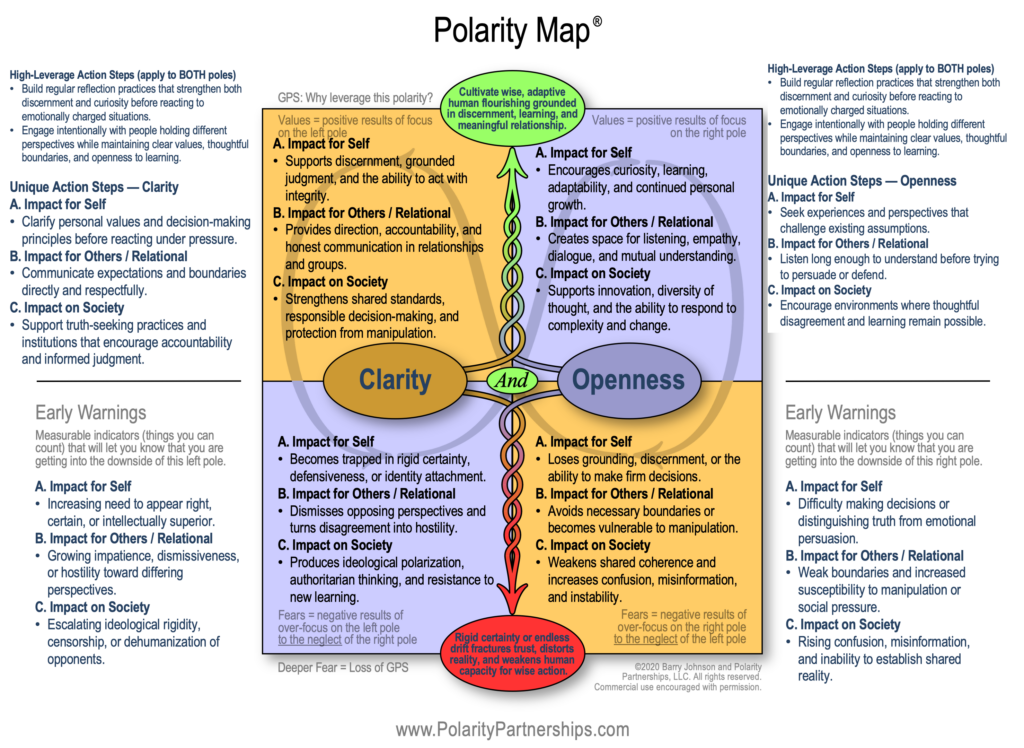
Clarity asks us to recognize that reality continues existing whether we prefer it or not. Actions carry consequences. Boundaries remain necessary. Discernment remains indispensable.
Yet Clarity to the neglect of Openness hardens into ideology, certainty, and domination. Curiosity weakens. Opponents gradually become enemies. Complexity gets flattened into emotionally satisfying slogans.
At the same time, Openness to the neglect of Clarity drifts toward confusion, manipulation, and endless relativism. A mind can become so open that it loses the ability to stand anywhere at all.
Neither pole creates the problem by itself. The strain emerges when one expands beyond relationship with the other.
The ability to remain Open without dissolving into confusion feels just as essential as the ability to hold Clarity without drifting into rigidity.
Human maturity requires something fundamental inside systems optimized for fear, acceleration, performance, and emotional activation.
What continues striking me about the top Levels of Barrett’s 7 Levels of Consciousness is how closely they resemble what many wisdom traditions have pointed toward for centuries. As people mature, life gradually stops revolving entirely around protection, status, ego performance, and identity defense. Attention begins shifting toward meaning, integrity, contribution, relationship, stewardship, and service beyond the isolated self.
Most people already know this at some level.
Very few people reach the end of life wishing they had spent more time winning arguments online.
That’s part of why I love being at Kayser Ridge doing the work we do there. When people reflect on their lives, they rarely talk about performance. They remember being loved. Friendship. Beauty. Trust. Shared meals. Laughter. Purpose. Meaningful work. Moments where they felt fully alive without needing to perform being alive for someone else.
That’s part of what Neo finally recognizes. The system loses some of its power the moment he stops confusing performance with reality.
It’s part of what the Tao keeps inviting us toward as well: learning how to move through reality without becoming fully possessed by fear, ego, domination, or the endless pressure to prove ourselves through conquest.
Because what pushes hardest eventually breaks. What grasps too tightly eventually loses hold.
In this emerging AI-shaped world, where artificial certainty is becoming infinitely scalable, human flourishing may depend on recovering something much older and much simpler:
common sense and common practice
The ability to remain human while surrounded by systems constantly pulling us away from ourselves. The ability to remain Open without losing Clarity. The ability to see through performance without losing compassion for the people trapped inside it.
Try this. The next time absolute certainty rises inside a charged political, cultural, or ideological conversation, pause for a moment and ask:
Am I seeing clearly, or am I defending certainty because uncertainty feels threatening? What would I need to learn to test whether my clarity is grounded or reactive? Can I hold conviction while remaining curious about what I may not yet be seeing?
The invitation is learning the difference between wisdom and the performance of wisdom.
And in a world where AI can generate the appearance of brilliance instantly, that distinction may become one of the most important human capacities we have left.
That’s the deeper work now. The best in us still does not dominate. It continues living as virtue from the deepest source.
That’s what Neo finally discovered: the system could not be transcended through domination.
It could only be transcended through awareness.
Here’s a Polarity Map for Clarity AND Openness:
INVITATIONS:
To use an “AI-trained Chat w/Cliff for Step 1, Seeing” CLICK HERE.
Ready for the Polarity Advantage? Go deeper into Polarity Thinking, see our online self-directed Credentialing and Introduction to Polarity Practice or in-person training with Barry Johnson and me at Kayser Ridge by CLICKING HERE.