

See the Series Introduction for Just Tao It, Part I: HERE
See the Just Tao It Series Introduction Tao/It on-ramp, PART II: HERE
See Just Tao It, Chapter 1: HERE
From my interpretation of the Tao Te Ching, Chapter 7 (Unpublished):
For all It endures,
All is within It.
Those who align with It
endure.
They are content
to stand in the background
and set things right.
They are content
to step forward
and win without fight.
They plant each seed.
They shine their light.
They chop the wood,
carry the water.
They tend fruit and flower.
They endure—
not by force,
but by not needing
to claim power.
—
This chapter has always felt deeply connected to how human beings relate to power, especially the subtle ways power changes us once identity, recognition, status, fear, or control begin attaching themselves to it.
The deeper question is what kind of self is doing the serving.
For all It endures, all is within It. Those who align with It endure because they no longer organize themselves primarily around self-preservation, visibility, or domination.
They remain capable of stepping forward when needed and stepping back when appropriate without experiencing either movement as a threat to identity.
Living this inside real systems becomes extraordinarily difficult.
Most people have been conditioned to think of power as something possessed, accumulated, defended, performed, and expanded. Visibility becomes confused with influence. Volume becomes confused with leadership. Dominance becomes confused with strength. Entire systems reward people for centering themselves in the outcome, even while those same systems gradually weaken trust, relationship, and long-term coherence.
The people described here still act. They still shape outcomes. They still influence reality. They plant each seed. They shine their light. They chop the wood and carry the water. Yet none of it feels organized around self-inflation.
That distinction changes everything.
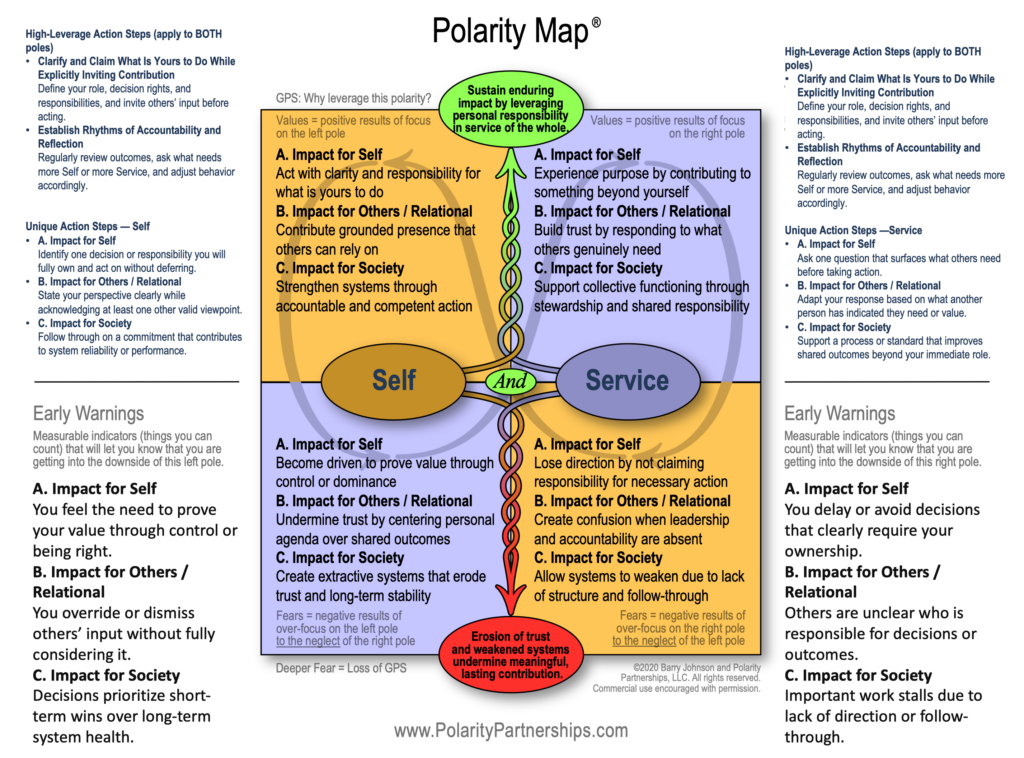
Barry Johnson’s work around Claim Power AND Share Power illuminates something many leadership systems struggle to articulate clearly. Healthy systems require both. Human beings must claim enough power to act responsibly, contribute meaningfully, establish boundaries, offer direction, and shape reality where shaping is required. At the same time, systems weaken once power stops circulating relationally.
Claim Power to the neglect of Share Power gradually drifts toward domination. Decisions may still get made, and outcomes may appear strong for a while. Beneath that surface, trust erodes, participation narrows, resentment accumulates, and the larger system becomes more dependent on concentrated authority.
The opposite drift creates different problems. Share Power to the neglect of Claim Power often begins with admirable intentions while slowly losing the ability to provide direction, accountability, clarity, or stewardship. Necessary leadership dissolves into hesitation. Systems lose coherence because no one fully steps forward to help hold the whole together.
The people Lao Tzu describes are not passive. They are deeply engaged. Their engagement emerges from relationship with something larger than self-centered identity management. They do not disappear into Service, and they do not inflate Self into the center of everything surrounding them.
Over time, that creates a very different kind of leadership presence. Modern leadership literature often tries describing pieces of this dynamic through ideas like servant leadership, adaptive leadership, systems leadership, relational leadership, and developmental leadership. Each framework captures part of the territory. What continues striking me is how naturally the Tao approaches the issue without turning it into methodology or performance.
The leader listens because reality itself is distributed. No single person fully sees the whole system. The leader acts because moments still require action. The leader shares power because healthy systems require participation rather than dependency. The leader claims power because responsibility still needs to be carried somewhere.
None of this feels especially glamorous.
You can see the effects most clearly in environments where the polarity is functioning well. People speak more honestly. Trust stabilizes. Decisions hold longer without requiring constant enforcement. Systems become more adaptive because individuals remain connected to both responsibility and participation simultaneously.
You can feel the difference relationally. Conversations become less performative. Manipulation loses some of its attraction. People spend their energy on shared work instead of protecting image.
The Golden Rule captures part of this movement: treat others as you would want to be treated. Helpful guidance, certainly. Over time it reveals its limitations because it still centers the self as the primary reference point. The Platinum Rule moves further into relationship: treat others as they would want to be treated. That shift requires greater awareness, restraint, listening, flexibility, and maturity because people are no longer projecting themselves automatically onto everyone else.
That requires power too.
The scientist checking the data carefully when distortion would travel faster. The analyst refusing to manipulate reality for convenience. The public servant continuing stewardship work that most people only notice once systems begin failing. The teacher who continues showing up attentively after institutional recognition fades.
These people are not weak. They are claiming power over their own participation while sharing power with reality itself.
Strongman leadership styles continue attracting attention globally because concentrated power produces emotionally satisfying displays of certainty, control, decisiveness, and dominance. Under conditions of fear or fragmentation, people understandably feel relief when someone appears willing to take command completely.
Yet systems built primarily around concentrated power rarely endure. Trust and participation weaken. Reality itself starts bending around preservation of authority rather than stewardship of the larger whole.
The damage may not surface immediately. Eventually systems begin paying the accumulated cost of the imbalance.
The ones who endure steward power instead of feeding identity through it.
They shape without over-shaping. They influence without overreaching. They participate fully without needing to center themselves constantly inside the outcome.
And because of that, their impact often outlasts the moment itself.
The system continues moving. It always will. Human beings remain participants inside larger flows of relationship, responsibility, interdependence, stewardship, identity, and power whether we acknowledge those tensions consciously or not.
Which leaves the deeper question sitting with each of us personally:
Can we learn how to claim what is ours to claim while sharing what was never ours to keep?
Self AND Service. Both, over time, in ways that endure.
Here’s a Polarity Map for Self And Service:
INVITATIONS:
Take a custom Polarity self-assessment based on this polarity HERE.
To use an “AI-trained Chat w/Cliff for Step 1, Seeing” CLICK HERE.
Ready for the Polarity Advantage? Go deeper into Polarity Thinking, see our online self-directed Credentialing and Introduction to Polarity Practice or in-person training with Barry Johnson and me at Kayser Ridge by CLICKING HERE.