

See the Series Introduction for Just Tao It, Part I: HERE
See the Just Tao It Series Introduction Tao/It on-ramp, PART II: HERE
See Just Tao It, Chapter 1: HERE
From my interpretation of Chapter 71 of the Tao Te Ching (Unpublished):
Seeing that you don’t know
is brilliance.
Not seeing that you don’t know
is blindness.
To know is to see.
To see
is to be.
The way to brilliance
is patient.
—
What Lao Tzu is naming here goes deeper than ignorance. Ignorance is neutral — a gap waiting to be filled. This is closer to a disease: the moment not-knowing gets mistaken for knowing, and the gap stops registering as a gap at all. The cure is a strange, humbling capacity — to feel the disease as disease, to notice in real time that certainty has started doing the work understanding used to do.
There was a stretch in my career where I became convinced that organizations rise or fall on the quality of their relationships. I had seen enough damage from Task to the neglect of Relationship that the pattern felt unmistakable to me. People stopped listening carefully to one another. Trust weakened beneath the surface. Cultures became brittle in ways performance metrics often failed to capture until much later.
So I moved strongly toward Relationship. I slowed conversations down. Tried creating more space for people to feel heard. In one leadership meeting, I opened space for reflection well after most people in the room were ready to decide. I experienced the extra conversation as care. Others experienced it as another delay in a process that had already taken too long.
For a while, many good things emerged from that shift. People felt seen differently. Other consequences eventually surfaced too. The work itself started drifting. Decisions took longer. What felt like depth to me felt like distance to others. The same people frustrated by too much Task began reacting to what looked, to them, like too much Relationship.
They were seeing something real, though so was I. What I couldn’t recognize at the time was how attached I had become to one side of the tension. Their blindness to the downside of Task to the neglect of Relationship was matched by my blindness to the downside of Relationship to the neglect of Task. We reinforced each other beautifully while imagining we were solving the problem.
Relief arrives, and the corrective insight begins to feel morally superior and intellectually complete — until the limitations hidden inside that certainty introduce themselves too. That’s the same disease the Tao is naming.
I’ve watched entire organizations circle that same pattern repeatedly. A Task-focused leader replaces a Relationship-focused leader. Then a Relationship-focused leader replaces another Task-focused leader. Each shift arrives carrying the promise of correction. The dysfunction changes shape, and each failed correction deepens cynicism.
At this point in life, adult development looks to me like circling the same barn repeatedly with slightly more humility each decade — a PhD from the University of Hard Knocks, with advanced study in overcertainty. Adult-development theories often describe a similar movement: certainty and expertise build capability, while later development expands our capacity to see the limits of any single framework.
The movement is humbling. What once felt like clarity reveals itself as partial perspective. Contradictions become harder to eliminate, and other people start looking like carriers of information I may still be missing myself. That shift doesn’t eliminate conviction. It changes my relationship to certainty.
Seeing that you don’t know is brilliance.
We were already struggling with all of this before AI entered the room. The pace was already accelerating before generative AI. Now coherent answers can arrive before a group has fully understood the question.
Coherent answers now appear within seconds — structured, plausible, confident, and often useful. Their speed can compress reflection before assumptions, emotional undercurrents, consequences, and downstream costs have entered the conversation.
I watched this happen recently with a team trying to decide how to address a breakdown in trust that no technical answer could resolve for them. The silence in the room stretched. Discomfort became visible. Finally someone laughed nervously and asked, “Should we just ask ChatGPT?” Everybody laughed, and everybody understood the temptation immediately.
The technology was sitting there offering relief from discomfort, ambiguity, tension, slowness, relational friction, and the vulnerability of not yet knowing.
For a few seconds the room could have tipped either direction. I stayed present with them inside the tension, and eventually they stayed too. The conversation deepened. What emerged afterward was imperfect, though deeply owned — their answer.
The margin had been narrow — how easily the group could have outsourced the very struggle producing their growth, and how often modern systems reward exactly that reflex.
Democracy depends on the same willingness to stay inside tensions long enough for legitimacy to emerge collectively. Shared governance moves through deliberation, relationship, listening, negotiation, and the gradual development of legitimacy. Domination can appear faster because it bypasses those human processes. Democracies frustrate people precisely because human beings frustrate people.
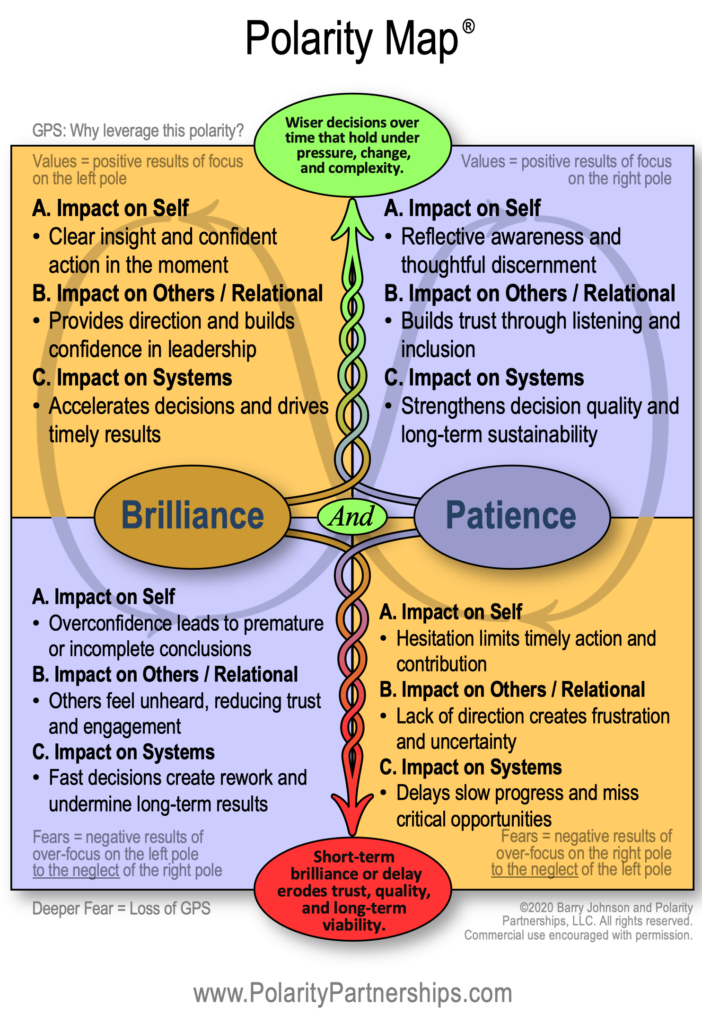
Brilliance to the neglect of Patience can harden into premature certainty, unilateral action, and contempt for the slower processes through which legitimacy develops. Patience to the neglect of Brilliance can delay necessary decisions and weaken the capacity to interrupt harm. Democratic life requires the insight to act and the patience to build legitimacy.
Modern systems reward speed, certainty, optimization, and visible movement. Remaining present long enough for something more complete to emerge can look inefficient by comparison. But trust, legitimacy, repair, and collective judgment still develop through slower forms of attention — and they’re usually the first things to erode when a system stops making room for it.
Humanity will become more technologically capable. Our future will also be shaped by whether we remain willing to do the slower human work wisdom still requires — listening, questioning, repairing, and learning together — inside tensions that refuse easy answers.
The team could have produced an answer in seconds. Instead, they stayed with the silence, the disagreement, and the not-yet-knowing long enough to reach an answer they could own together.
Brilliance begins with honesty about what we see. Patience leaves room for what we have yet to see.
Where, today, are you calling your not-knowing knowledge?
Here’s a Polarity Map for Brilliance And Patience:
INVITATIONS
How do you make decisions under uncertainty, over time? To take a short Polarity Assessment based on the Brilliance And Patience polarity, CLICK HERE
NOTE: the results include Leveraging Action Steps and Early Warnings (to support maximizing upside benefits and minimizing downside limitations).
To use an AI-trained “Chat w/Cliff for Step 1, Seeing” CLICK HERE.
Ready for the Polarity Advantage? Go deeper into Polarity Thinking, see our online self-directed Credentialing and Introduction to Polarity Practice or in-person training with Barry Johnson and me at Kayser Ridge by CLICKING HERE.