

See the Series Introduction for Just Tao It, Part I: HERE
See the Just Tao It Series Introduction Tao/It on-ramp, PART II: HERE
See Just Tao It, Chapter 1: HERE
From my interpretation of the Tao Te Ching, Chapter 73 (Unpublished):
In daring or caution,
harm and benefit
arrive together.
The wise do not choose
between them.
It is in heaven.
Not trying, It conquers.
Not speaking, It answers.
Not summoning, It attracts.
It seems at rest
as It acts.
Being infinite,
It is far and wide.
Being present,
It lives inside.
—
Few tensions test leaders more deeply than knowing when to act decisively and when restraint serves the situation more faithfully.
One of the most persistent leadership delusions is the belief that courage primarily means applying more force. Push harder. Move faster. Dominate the room. Win the argument. Control the outcome. Remove hesitation. Project certainty.
Most people have encountered this leader at some point. Many of us have probably become that leader ourselves at different moments—the one who mistakes activity for progress, volume for clarity, decisiveness for wisdom. The one unable to distinguish between discernment and hesitation because slowing down itself begins feeling threatening.
History fills quickly with examples of Courage to the neglect of Restraint: empires extending beyond sustainability, organizations expanding beyond coherence, leaders whose confidence gradually separated itself from reality.
At the same time, history also fills with examples of Restraint to the neglect of Courage: democracies appeasing authoritarianism, institutions studying injustice while refusing meaningful action, leaders analyzing conditions endlessly while systems deteriorate around them. Silence surrounding corruption. Delay surrounding danger. Endless interpretation while trust erodes.
The same pattern plays out at a much smaller scale, too. A parent who mistakes control for protection. A coach who mistakes silence for patience. A difficult conversation postponed long enough that trust erodes before either person says what needs to be said.
This is part of what gives the Tao’s warning so much enduring relevance:
In daring or caution, harm and benefit arrive together.
The deeper question is rarely which pole is “correct.” The deeper question concerns what happens once one side expands beyond relationship with the other.
Adult development research helps illuminate why this becomes so difficult for human beings and systems alike. Across decades of work by Robert Kegan, Jane Loevinger, Susanne Cook-Greuter, Jennifer Garvey Berger, Bill Torbert, and others, a consistent pattern emerges: development involves transformation in how human beings make meaning, not merely accumulation of additional knowledge.
Earlier stages of development often orient around certainty, stability, approval, control, belonging, achievement, or superiority. The world gradually organizes itself into categories: winners and losers, insiders and outsiders, right and wrong. Leadership becomes performance. Identity fuses with ideology, expertise, status, or belonging.
Later development begins once people gain increasing capacity to step back from the systems that once fully defined them. Kegan described this movement as shifting from being subject to a way of seeing the world toward making that way of seeing the world object for reflection.
An earlier-stage leader may ask:
Which approach is correct—Courage or Caution?
A more developmentally mature leader gradually starts asking a different kind of question.
How do I remain in relationship with both, and what conditions call each forward responsibly?
Later development does not remove conviction. It changes the relationship to conviction itself. People gain greater capacity to hold beliefs, commitments, and values without becoming entirely possessed by them.
Complexity changes leadership itself.
Technical problems often respond well to expertise alone. The machine breaks; someone repairs it.
Adaptive challenges operate differently.
In adaptive challenges, the problem partly includes us—our assumptions, fears, identities, and ways of making meaning. Expertise alone cannot resolve those tensions, because the system generating the problem includes the people attempting to solve it.
The struggling marriage. The organization losing trust. The polarized society. The destabilizing climate.
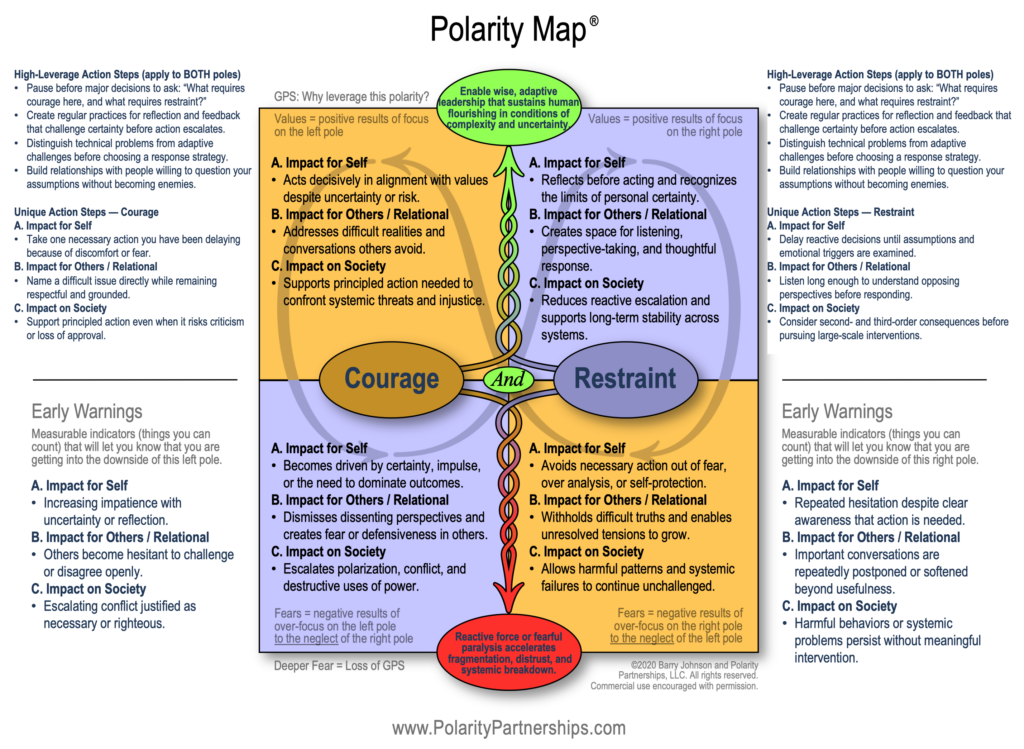
These situations require capacities extending beyond force, expertise, or certainty alone. They require leaders capable of holding Action AND Reflection, Conviction AND Humility, Courage AND Restraint over time.
Cook-Greuter’s work is especially valuable here: later development expands the capacity to remain present to ambiguity, paradox, and interdependence without demanding premature simplicity.
Many leadership failures emerge less from lack of intelligence and more from diminished capacity to leverage tension well over time.
Strength to the neglect of Restraint gradually hardens into domination. Restraint to the neglect of Courage gradually drifts toward paralysis. Nationalism to the neglect of Interdependence fuels isolation and aggression. Interdependence to the neglect of Sovereignty weakens coherence and resilience. Even wisdom traditions deteriorate once certainty overwhelms openness.
The Tao does not eliminate tension from human life. It changes our relationship to tension itself.
That becomes especially important once we consider the shadow.
In Owning Your Own Shadow, Robert Johnson warned that whatever remains rejected, denied, or unconscious does not disappear. It gathers force outside awareness, growing more distorted precisely because it remains unseen.
The leader denying vulnerability eventually breaks publicly. Organizations suppressing conflict often experience eruptions later through turnover, scandal, lawsuits, or institutional fragmentation. Nations refusing to confront shadow dynamics eventually externalize them politically and culturally.
What remains unexamined rarely remains inactive.
I’ve watched this happen inside executive teams more times than I can count. The leader who denies feeling threatened becomes the leader who works against the very person who threatens them, without ever naming why. I’ve watched it in myself too, usually in the moment I felt most certain I had nothing left to prove.
Johnson (Robert) also emphasized that shadow contains buried strength in addition to danger—what he called the “golden shadow.” The courage someone feared would make them dangerous. The tenderness feared as weakness. The authority distrusted. The moral clarity suppressed to preserve belonging.
Organizations bury golden shadows too.
So do nations.
Cultures organized around domination often lose relationship with vulnerability until loneliness, addiction, violence, or despair surface systemically. Cultures deeply fearful of conflict often suppress Courage until resentment eventually hardens into backlash.
Over time, shadow dynamics accumulate consequences.
This may help explain why mature leadership remains relatively rare.
Development threatens identity itself.
Cook-Greuter observed that later development frequently requires loosening attachment to the very meaning systems and identities that once generated success.
That can feel psychologically catastrophic for the ego because identity experiences itself as survival.
The expert becomes trapped inside expertise. The achiever becomes trapped inside achievement. The patriot becomes trapped inside ideology. The revolutionary becomes trapped inside righteousness. Institutions become trapped inside self-protection.
And beneath much of it sits fear: fear of uncertainty, fear of losing status, fear of losing coherence, fear of discovering that earlier success may no longer be sufficient for emerging conditions.
The Tao keeps returning somewhere quieter and deeper than force:
It seems at rest
as It acts.
Responsive.
Grounded.
Aware enough to distinguish reaction from strength.
This resembles what wiser leadership requires now: leaders capable of remaining sufficiently awake to complexity without surrendering discernment, humility, courage, or action.
The Tao offers no technique for achieving this. No certification. No guaranteed formula.
What it offers instead feels more demanding: presence.
The capacity to recognize when Courage hardens into domination. The capacity to recognize when Restraint drifts toward paralysis. The capacity to act from groundedness rather than fear.
Before significant decisions, it may help to pause long enough to ask:
Am I acting from Courage or from the need to appear courageous? Am I practicing Restraint or avoiding necessary action? What fear emerges when I imagine honoring the neglected pole?
The answers may not feel reassuring.
Wisdom begins somewhere inside that relationship with truth—held carefully enough that discernment, humility, and humanity remain connected to one another.
Because thriving in a complex world may depend less on conquering uncertainty and more on remaining human while moving through it.
Here’s a Polarity Map for Courage And Restraint:
INVITATIONS:
Take a customized Polarity Self-Assessment for Courage AND Restraint CLICK HERE.
To use an “AI-trained Chat w/Cliff for Step 1, Seeing” CLICK HERE.
Ready for the Polarity Advantage? Go deeper into Polarity Thinking, see our online self-directed Credentialing and Introduction to Polarity Practice or in-person training with Barry Johnson and me at Kayser Ridge by CLICKING HERE.